How to choose between therapists when they all seem like a good fit
Ivy Griffin
The short answer
When two or three therapists all look right, more research will not break the tie. What breaks it is comparing each therapist to your own pattern instead of to each other, spending a week noticing that pattern in real time instead of deciding in one hard evening, and talking with someone who already knows what each therapist is like to work with.
Introduction
You did everything right. You researched, you filtered, and you narrowed it down to two or three therapists who all seem like they could help.
You may have even talked with them, sat through the free consultations, or tried a first session somewhere along the way. And somehow, you're less sure now than when you started.
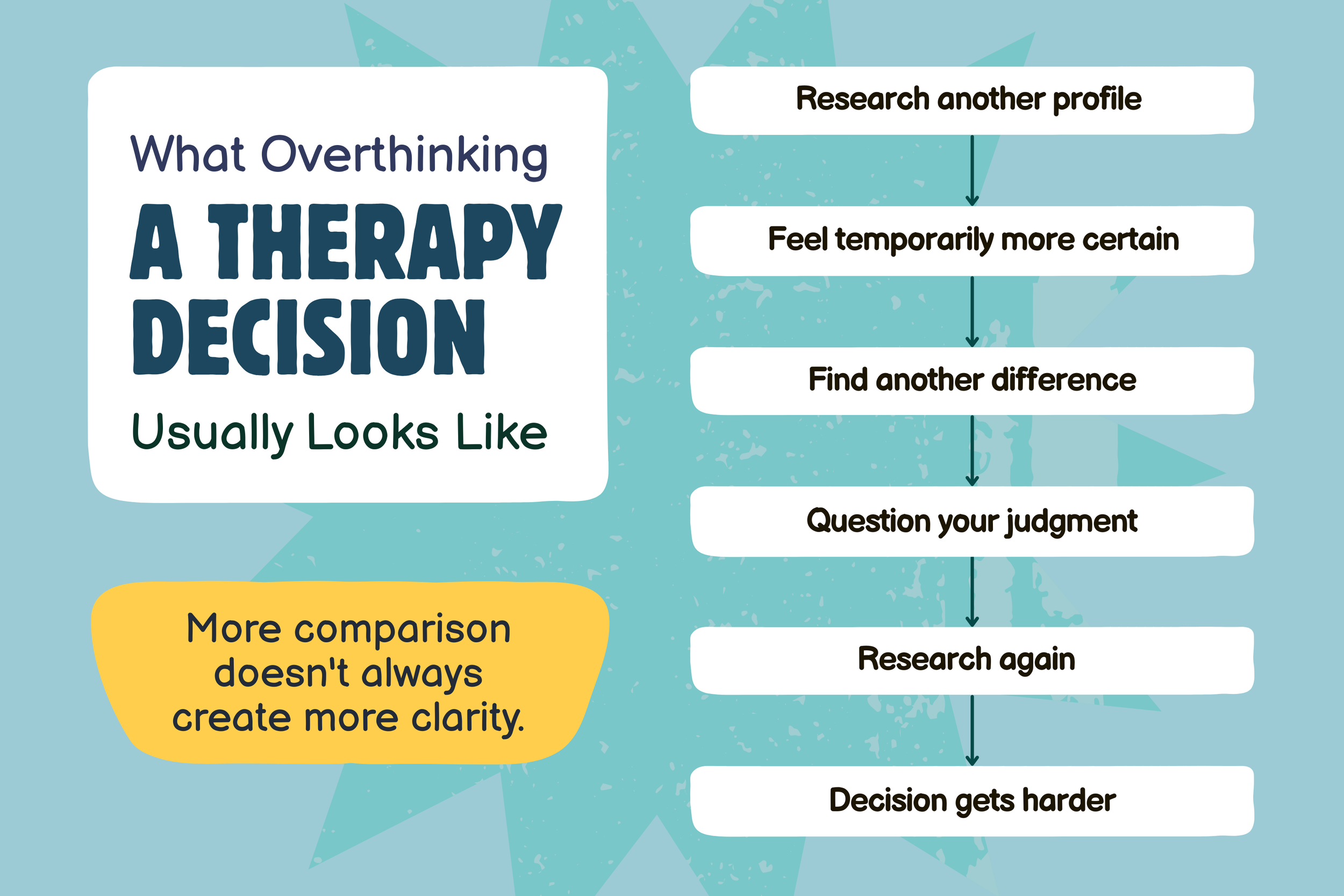
So on a Tuesday night, you open the same three tabs again. You re-read profiles you could quote from memory, and you replay the consultation calls, searching for a sign you might have missed.
You wrote the follow-up email, the one that says you'd like to book, two weeks ago. You still haven't sent it.
You told yourself you'd decide this weekend. That was two weekends ago. When a friend asks how the therapist search is going, you hear yourself say “still deciding” for the third week in a row.
Maybe your version of this is a little different. Maybe you haven't built a shortlist at all, and the harder part has been finding even one person you feel comfortable with. Either way, you've hit the same wall from a different side.
You feel the weight of it every time you open those tabs. You wonder: what if I pick the wrong person? What if they can't help me? What if I've wasted all this time?
And the longer you wait, the more you start to wonder whether something is wrong with you.
Nothing is wrong with you. Most people searching for a therapist stall at the end, with good choices on the table, not at the beginning when the options feel endless.
You've been working with tools, bios and directories and consultation calls, that were never built to answer the question you're now asking. Nobody warned you they would run out.
You can get to the other side of this. When you compare the right things, and when you get help from someone who has information you can't gather on your own, you can decide. You choose. You book. You begin. And you finally get to close those three tabs.
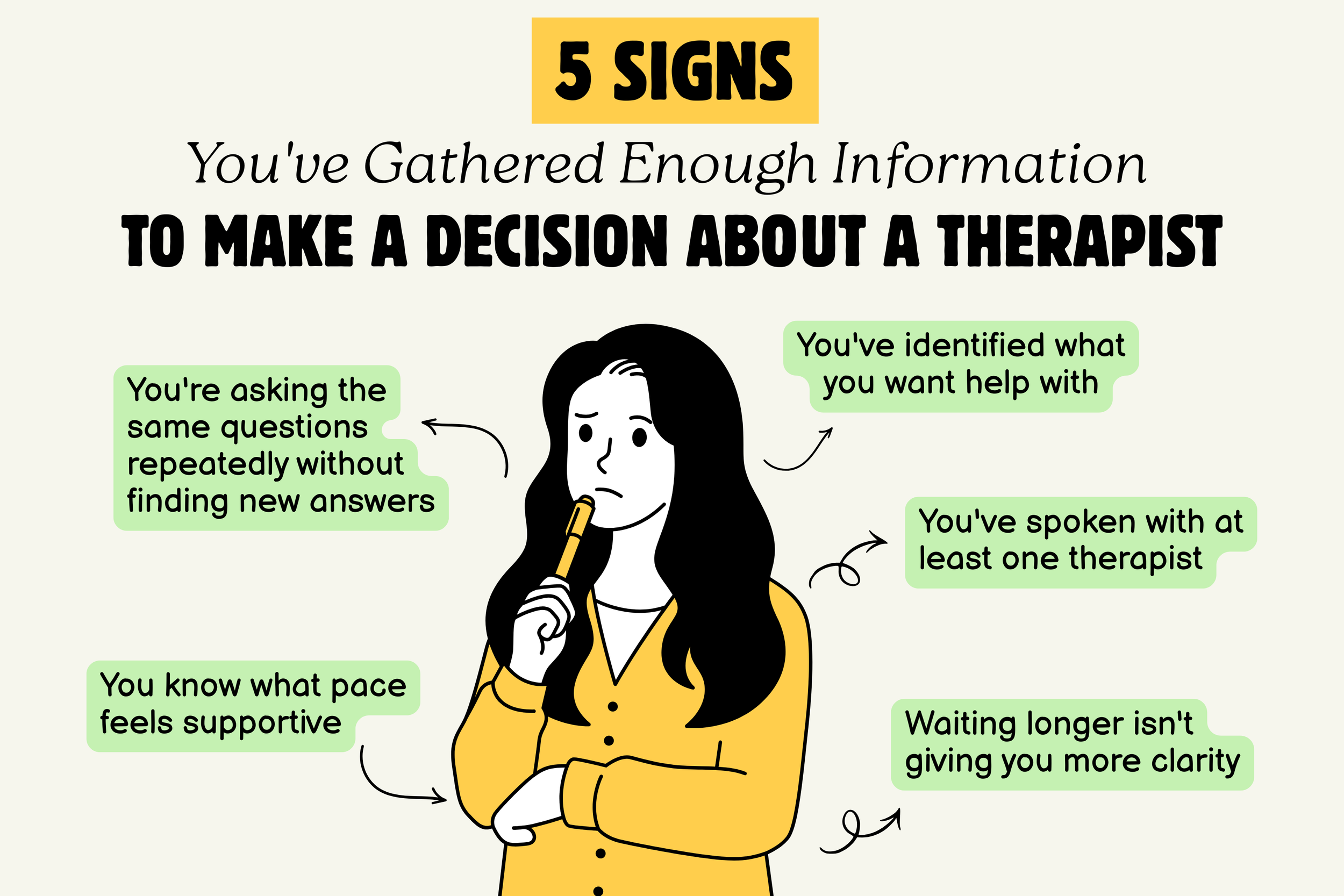
Here are the three shifts that break a tie between good therapists:
Compare each therapist to your own pattern instead of to each other.
Spend a week noticing instead of a night deciding.
Bring in a person who knows both sides of the match.
Shift 1: How do you compare therapists who are all equally qualified?
You compare each one to your own pattern instead of to each other.
Why does more research keep giving you the same non-answer?
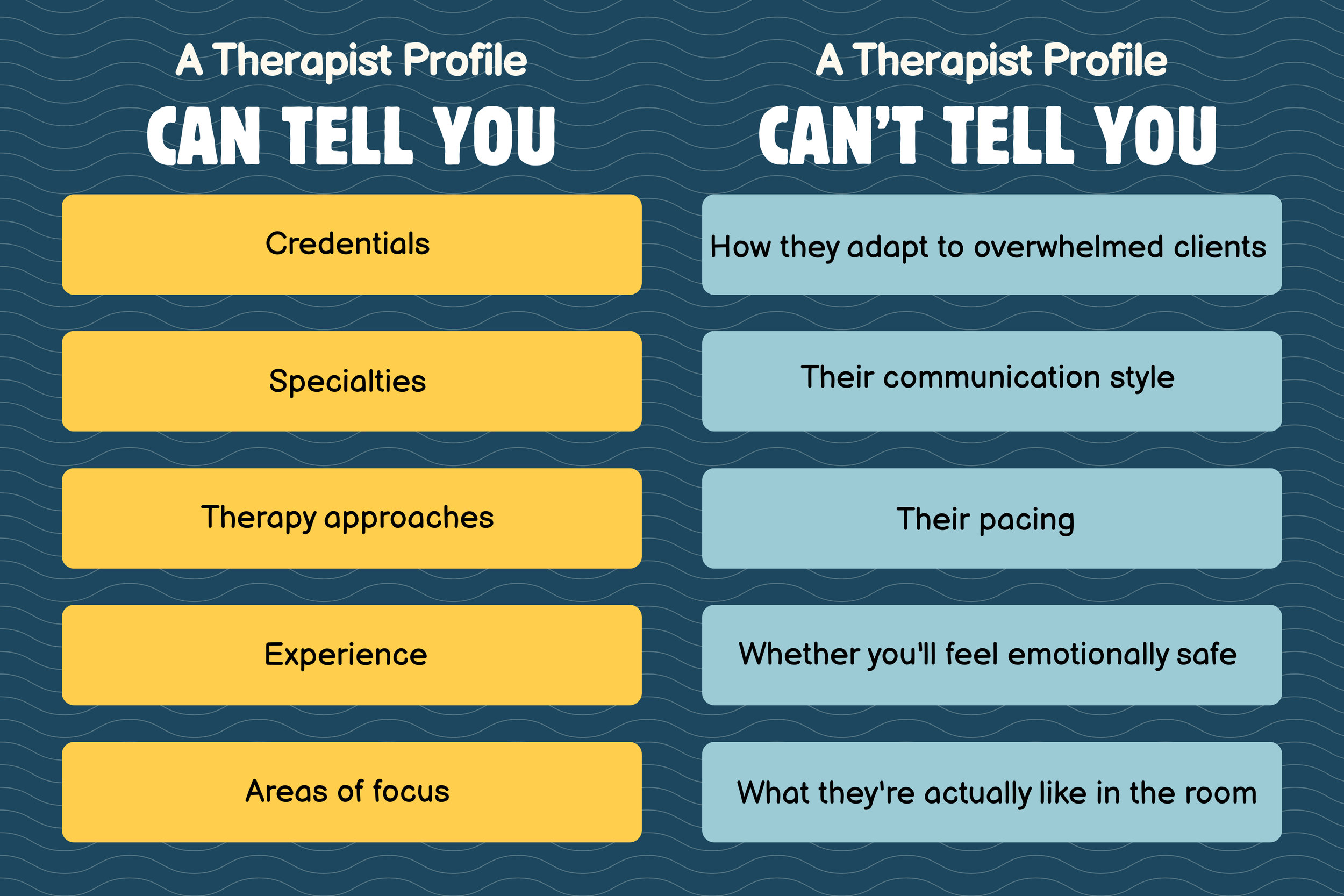
Because a bio can only answer whether a therapist is credible and relevant to you, and you have already answered that question three times over. That's how you built your shortlist.
Now you're asking a different question: which of these people is right for me? You can't answer that one by reading a profile, no matter how many times you read it.
You can get a real sense of a therapist's personality, values, and way of working from a bio. But you can't know what it's like to talk with someone until you're talking with them. A bio can never substitute for a real, live, breathing person.
Iyengar and Lepper (2000) found that past a certain point, more information doesn't produce a better decision. It makes people less likely to decide at all.
So every time you re-read those profiles, you land on the same non-answer. And after enough non-answers, you start believing you're bad at deciding. You're not. You're asking a page of text to do something no page of text can do.
Is there one right therapist and two wrong ones?
Almost never. You're choosing between several people who could each help you, in different ways.
You may be carrying a belief that makes this choice feel dangerous: that your shortlist holds one right answer and two wrong ones.
I once had a supervisor tell me that out of a whole room of therapists, a client could benefit in a different way from each one, because of their age, culture, life experience, personality, and values. I've never forgotten it, because I've seen it hold true.
You're not facing a test with one correct answer. When you let yourself sit with that, you may feel some of the fear drain out of the decision.
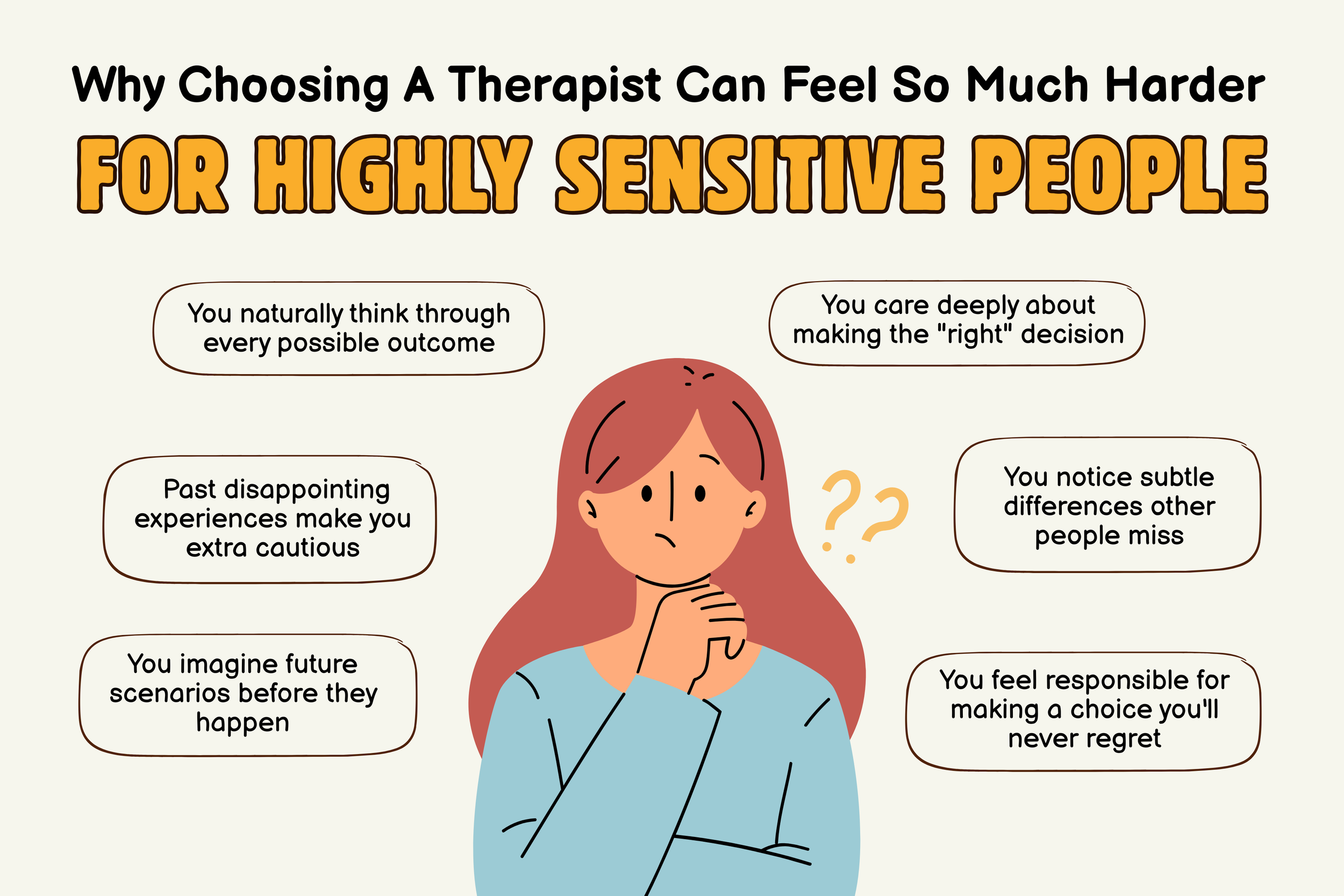
Why does this decision feel heavier if you're a highly sensitive person?
Because you process deeply. You imagine, in vivid detail, how working with each therapist might go, including all the ways it might go wrong, and you feel those imagined outcomes almost as if they were real. (Around 20–30% of the global population has been identified as highly sensitive.)
So you carry a much heavier version of this decision than anyone can see from the outside.
As a deep processor, you likely also have deep intuition. If you keep being drawn to one therapist because of a small detail (she comes from a big family, she moved across the country, she adores her dog), try not to dismiss it.
These are the details that can make someone a kindred spirit and a better match for you. You may be picking up on something that matters, even when you can't explain why.
What is your “pattern,” and how do you find it?
Your pattern is the place where you get stuck in a loop you don't want to return to: what happens when you get overwhelmed, what your anxiety attaches to, how you move through conflict, and what pace your nervous system can hold.
Two examples from my work:
A client who gets overwhelmed at work and shuts down. She goes quiet, stops sharing ideas, and stops contributing, because she's so stressed her mind goes blank. Later she berates herself for not being good at her job, and that self-criticism adds stress, which makes the next shutdown more likely.
A client who gets anxious in social situations and starts avoiding them. She declines invitations and sees friends less. She still feels anxious, but now she also feels lonely and down on herself, which makes the next dinner out harder. And so she repeats the cycle.
(Both are composites of real life experiences. We always protect client confidentiality.)
How does knowing your pattern break the tie?
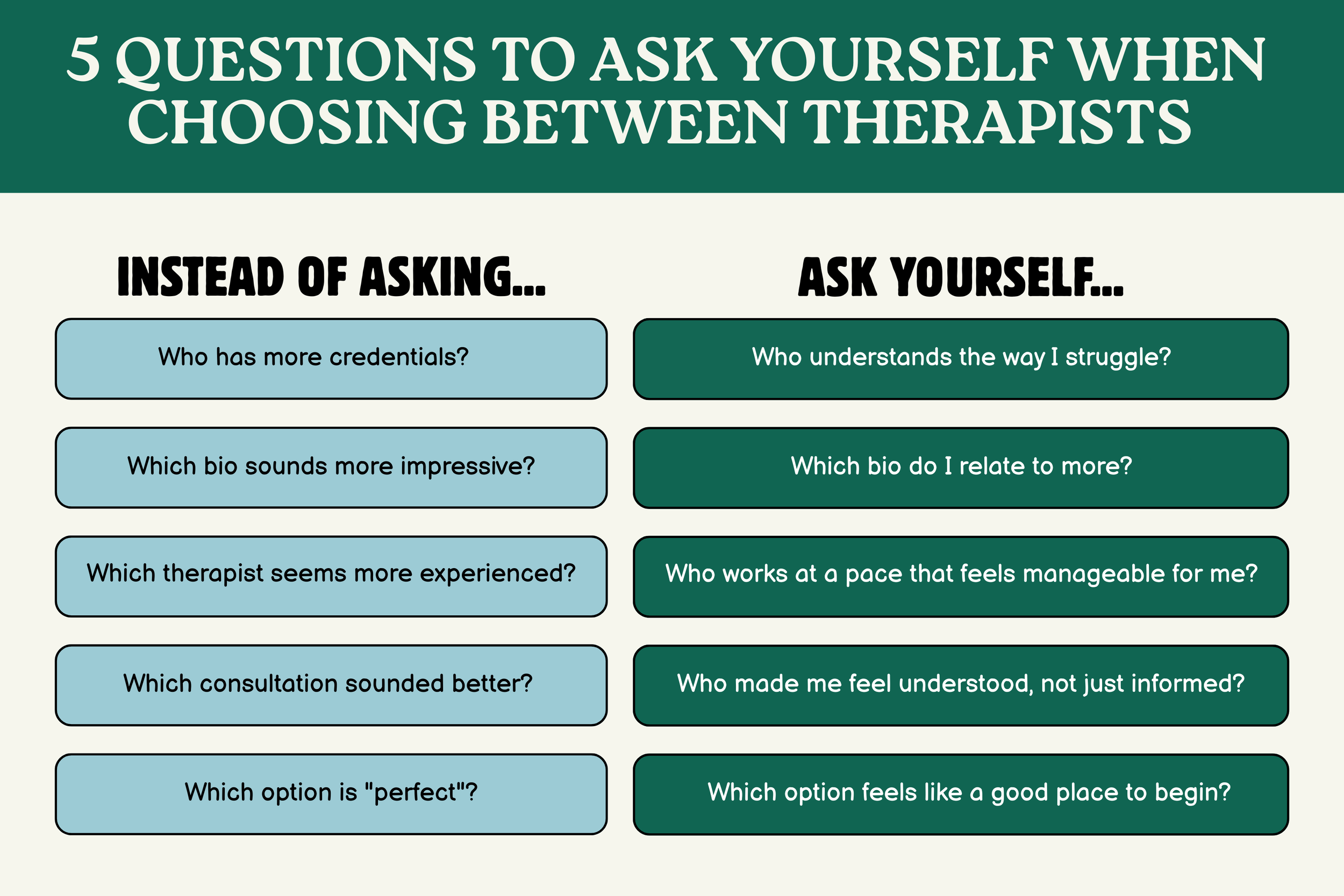
It changes the question from “which of these three is best?” to “which of these people is built for the way my struggle runs?”
How well you and your therapist connect is one of the strongest predictors of whether therapy will help you at all (Flückiger et al., 2018). So when you match on your pattern, you're matching on the thing that matters most.
Consider the client who shuts down at work. One therapist on her shortlist focuses on changing the shutdown behavior itself, through structured methods.
Another understands high sensitivity, how it affects her brain and body, and works needs-first: helping her ground herself in the moment, adjust her environment where possible, and find other ways to engage with her team.
Both therapists hold equal credentials. She will likely do better with the therapist who understands high sensitivity, because that therapist treats her sensitivity as the context to work within instead of the problem to correct.
Or consider the client avoiding social situations. If she works with a therapist who moves quickly into exposure work, she might feel flooded before she has built the awareness and internal resources to handle it. She likely needs a therapist who leads with insight, compassion, and self-awareness, and who matches her pacing.
Notice what you could and couldn't have learned from the bios in each case. You can learn a therapist's modalities from a bio. You cannot learn how she attunes to a client, paces the work, or adjusts the therapy to the person in front of her.
You've felt unable to decide because you've never had access to the information that would decide it.
What if you're still going in circles?
Then pick one and begin. Trying is not committing.
If you've researched, reflected, and you're still looping through the same options and the same imagined problems, sometimes the kindest move is the one I offer clients: choose one and see.
You take the pressure off getting it “right,” you remind yourself this was never a right-versus-wrong test, and you stay free to see how things go and adjust. You're allowed to make decisions that way, and psychologically, it's a healthy way to make them.
Shift 2: What do you do if you can't see your own pattern clearly?
You spend a week noticing instead of a night deciding.
Comparing therapists to your pattern only works if you can see the pattern clearly. And if you're tired, you can't think your way to that clarity in one hard evening. You'd only be giving yourself one more task.
Why is noticing in real time more accurate than reflecting?
Because how you feel in one moment colors how you remember the whole week, so a tough evening produces a distorted record.
So instead of introspecting, observe. Jot down real moments as they happen, a few minutes a day, on a single page, for seven days. By the end of the week you can look back at those small entries and watch your pattern take shape.
Here's why tracking in real time works, especially for a highly sensitive person. You feel emotions deeply. If you sit down to reflect on a night when you're feeling low, you'll zero in on everything you think you did wrong and decide you're failing at life. (You're not.)
We built the self-awareness activity in our Fit Check for exactly this. It’s a free resource to help you do this in a guided and structured way.
When you track in real time, you step around that problem. You capture the week as it happened, and you end up with a more balanced record than your memory can give you on a hard day.
How much noticing is enough?
A couple of words or bullet points a day. That's the honest minimum.
If part of you has already filed this under homework you'll fail at, I want to name that minimum plainly. It's cheesy but true: you can only fail this by not trying, and trying means jotting a few words. There's a reason it fits on one page.
If even that feels like too much right now, read the questions and let them sit in the background of your week. When you get specific about what you intend to notice, you become more likely to notice it, the same way you become more likely to follow through on a goal once you've said it out loud.
If you're afraid you'll forget, leave yourself a quick word in your notes app or a short voice memo.
Think of yourself as a curious researcher starting with a hypothesis about your own pattern. You might confirm what you already suspected, or you might surprise yourself. Either way, you'll walk away with something you could never have gotten from re-reading a bio.
Shift 3: Who can tell you what a therapist is like to work with?
Someone who works with those therapists directly. At Thrive, that person is our Intake Coordinator, who is a therapist herself and the first person you speak with.
You now have your pattern, or at least a week of honest notes pointing toward it. What you've never had, in all those weeks of solo research, is the other half of the decision.
What does our Intake Coordinator know that isn't on any website?
She knows each therapist's personality, communication style, and clinical preferences on a working level, because she's in touch with them constantly, sometimes daily.
We also keep a detailed internal list of each therapist's skills and specialties, how they work, and lived experiences they're comfortable sharing with colleagues even when those aren't in a public bio. Things like growing up in a large Mexican family, having a partner with ADHD, being trans-identified, or coming from an evangelical Christian background.
These are the details that can make a therapist a kindred spirit and a better match for you, and you won't find them on any website.
When you talk with her, she's listening for the subtle cues. If you're soft-spoken and gentle, she might match you with a therapist who is quiet and gentle herself.
If you've done years of talk therapy and want to work on trauma in a deeper way, she might match you with a therapist trained in somatic, art, or brain-based approaches. If you disclose an assault, she will ask you, gently, whether a male or female identifying therapist would help you feel safer from the very first session.
What does the matching conversation feel like?
Simpler than you might expect. She acknowledges that reaching out is hard, asks what you'd like to work on and what your preferences are, listens carefully, and makes a recommendation using everything she knows about our therapists.
You don't have to re-live anything, and you don't have to arrive knowing what to ask.
The most common thing clients tell us about this part is that it left them feeling empowered rather than processed.
I want to be precise here. You are not giving the decision away. You bring your pattern, we bring our working knowledge of each therapist. We make the match together, and you always have the final yes.
What happens after you reach out?
Here is the whole sequence, so none of it is a surprise.
You fill out the contact form on our website. Most people start there instead of calling.
If you'd like to ask questions or talk something over first, you can schedule a call. You don't have to.
We read what you've told us and recommend the therapist we think would be a good fit, either by email or on that call.
Once you're scheduled, you get a confirmation email and an invitation to our client portal, where the intake forms live.
Your therapist sends you a welcome message before the first session, so you've already made contact with a real person.
If we don't hear back from you, we follow up a couple of times by phone, text, and email. If you're not ready, that's okay. We'll send you something useful now and then instead of chasing you.
And at the bottom of that confirmation email there's a line we put there on purpose: if it's not a good fit, no problem at all. Just reach out and let me know, and I'll be happy to help you get matched with someone else.
We say it before your first session, not after, because we'd rather you know the door is open than spend six weeks wondering.
How do you start?
You have two options:
Not sure if we’re the right fit? We offer complimentary 20-minute fit check sessions. Schedule a call with our intake co-ordinator for your complimentary 20-minute fit check session.
Download & use our free Fit Check tools – guided reflection tools created by Thrive therapists to help you understand your patterns, and bring to the complimentary fit check session with our therapists.
Ready to work with us? Reach out through the contact form. Our Intake Coordinator will take it from there.
Common questions about choosing between therapists
How do you choose between two or three therapists who all seem like a good fit?
Stop comparing the therapists to each other and compare each one to your own pattern: how you get overwhelmed, what your anxiety attaches to, how you move through conflict, and the pace your nervous system can hold. A bio tells you a therapist's credentials and modalities, but it can't tell you how she paces the work or attunes to a client, which is why more research keeps giving you the same non-answer. Spend a week noticing your pattern in real time, then talk with someone who knows what each therapist is like to work with.
I'm not sure how to approach the first consultation. What should I expect?
You don't have to prepare anything, and you don't have to arrive knowing what to ask. Our Intake Coordinator opens by acknowledging that reaching out is hard, then asks what you'd like to work on and what you're hoping for in a therapist. She listens, and she recommends someone. You will not be asked to walk through your history or your trauma in order to get matched.
Will they understand me as an individual, or will I get generic care?
Being understood as a specific person instead of a category is one of the real dimensions of fit, and it's a fair thing to ask for. Our matching is built around it. We listen for your pacing, your communication style, your identity and lived experience, and what you have already tried, and we match on those instead of on availability alone.
What if my therapist and I don't click?
Sometimes you only learn fit by doing, and that isn't a failure. It's information. If the match isn't right, you simply tell our Intake Coordinator who made the match, and she’ll help you schedule with another one of our therapists. You don't start over and you don't retell your story, because we already have your history and we’ll share it privately with your new therapist.
While this is always an option available to all our patients, we’ve only had 2-3 clients transfer to a different therapist in a year. We do it happily, without any emotional burden on you.
How easy is it to switch if the match isn't right?
Easy, and you don't have to have the conversation with your therapist if that feels uncomfortable. You can reach back out to the Intake Coordinator, who is a neutral person in this, and let her know you'd like to switch. That option is written into your confirmation email before your first session ever happens.
Isn't choosing your own therapist a decision you make yourself?
You still choose. You choose with better information than you could produce through a solo search.
If you're highly sensitive, you're living in a world that often isn't built for you. And if you've spent your life being told you're “too much” for needing help with things other people seem to handle alone, I want you to hear this: we all need help sometimes. That doesn't make us weak. It makes us human.
You always make the final choice. We work with you to identify which therapist is a great fit so you don't have to figure it out alone, and we defer to your preferences at every step. We designed this matching process to take the pressure off you.
You were never bad at choosing
Here are the three shifts, one more time.
Compare each therapist to your pattern instead of to each other.
Spend a week noticing instead of a night deciding.
Let someone who knows both you and our therapists help you break the tie.
As a highly sensitive person, you research and think and reflect before you decide. That's a huge strength. But sometimes you get stuck, especially on a decision that more research can't answer.
You were asked to make a specialist's decision with a generalist's tools, and now you know there's a different way.
We're here for you, and we'd love to help. You don't have to do this alone.
About the author
Ivy Griffin, LMFT, is the founder and director of Thrive Therapy & Counseling in Sacramento, California. She has practiced since 2009, opened her private practice in 2012, and built Thrive into a group practice in 2017. She is a CAMFT Certified Clinical Supervisor and a Certified Brainspotting Therapist, and she works with highly sensitive people, teens, and busy professionals. She is a highly sensitive person herself.
References
Flückiger, C., Del Re, A. C., Wampold, B. E., & Horvath, A. O. (2018). The alliance in adult psychotherapy: A meta-analytic synthesis. Psychotherapy, 55(4), 316–340. https://doi.org/10.1037/pst0000172
Iyengar, S. S., & Lepper, M. R. (2000). When choice is demotivating: Can one desire too much of a good thing? Journal of Personality and Social Psychology, 79(6), 995–1006.