
What “Good Fit” With a Therapist Actually Means (It’s Not Just About Liking Them)
Ivy Griffin
If you’ve been searching for a therapist for a while now, there’s a good chance you’ve had this experience:
You got on a call with someone. They seemed warm. The conversation flowed. You thought — okay, this could work. So you booked.
But then something happened in the actual sessions that you couldn’t quite name. Maybe you kept leaving without feeling like anything happened. Maybe you found yourself censoring what you said before you said it. Maybe the way they responded to you felt slightly off — not wrong, exactly, just not right. Like you were being understood in a general sense but not seen as specifically yourself.
So you stopped going. And now you’re back to searching, with a quietly uncomfortable question underneath it all:
“Is it me? Am I too hard to help? Or is there something about the way I’ve been searching that keeps leading me to the wrong room?”
I want to answer that question directly, because I’ve seen it stop people for months — sometimes years — from finding the support they really need.
It’s not you. But there is something about the way most people search for a therapist that can lead to this outcome. And it comes down to a myth about what “good fit” actually means.
I’m Ivy, and I run Thrive Therapy & Counseling in Sacramento. We work with teens and adults, and we’ve built our practice specifically around the problem of fit — because getting it wrong is one of the most common reasons people give up on therapy altogether. Not because therapy didn’t work. Because the match didn’t work, and they didn’t have a way to know that until they were already in the room.
The Myth: If You Liked Them, It’s a Good Fit
The dominant belief most people carry into a therapist search is something like this: fit is a chemistry thing. If the vibe was warm, if the conversation felt easy, if you left the call thinking I could talk to this person — that’s a good sign. You’ll know it when you feel it.
This makes sense. It’s how we evaluate most relationships. And warmth and ease genuinely matter — a therapist you dread talking to is not going to be helpful for you.
But here’s the problem: liking someone is the floor, not the ceiling. It’s a necessary condition, not a sufficient one. And when people treat chemistry as the primary signal, they end up filtering on the one thing the search process gives them — a brief, surface-level interaction with a stranger — while staying blind to the dimensions of fit that actually determine whether the work will go anywhere.
When those other dimensions are off, you feel it. You just don’t have language for it yet. So you say “we didn’t click” or “it wasn’t the right fit” and start the search over — without knowing what to look for differently.
That’s the cycle this blog post is here to break.
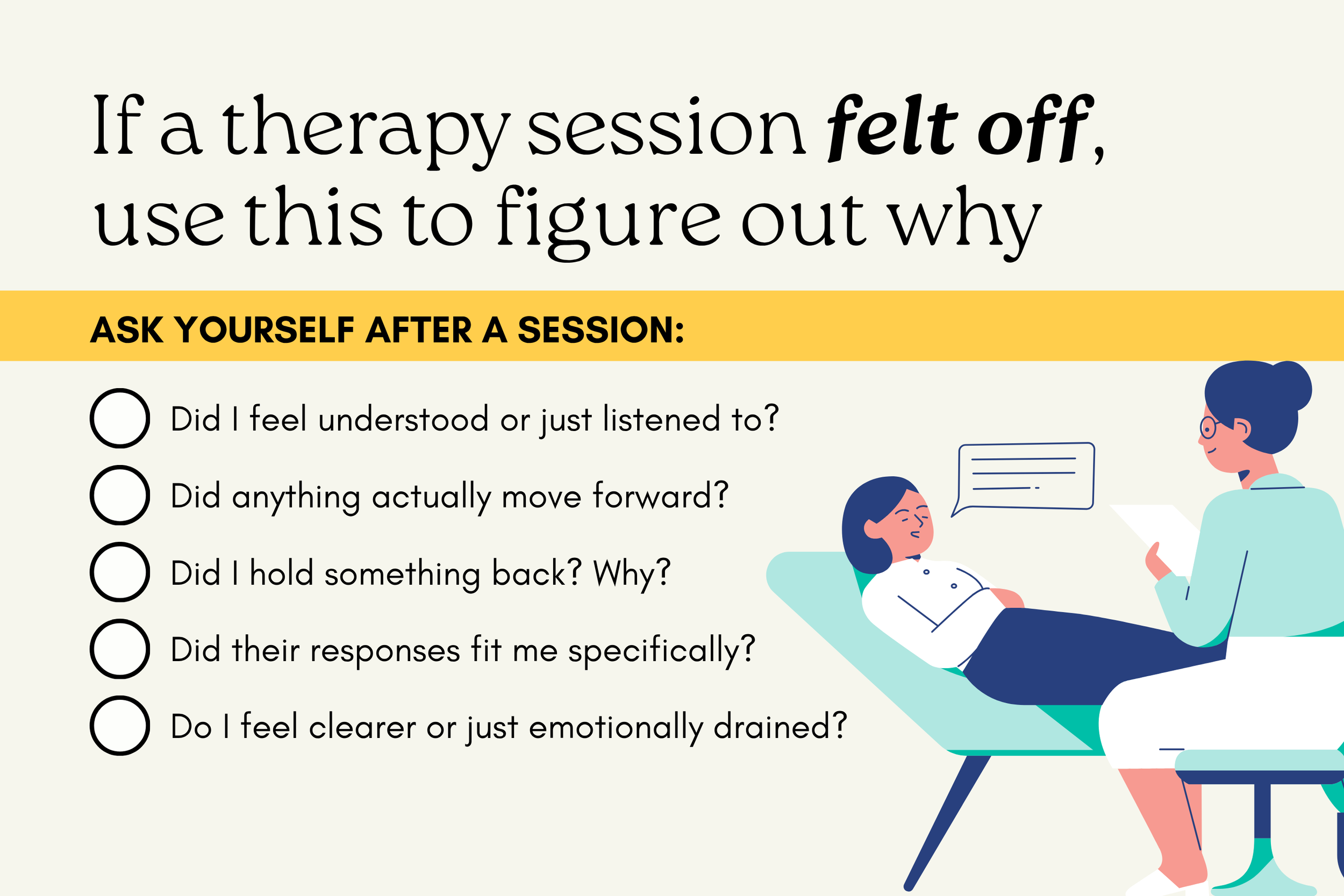
What Fit Actually Requires — The Dimensions That Don’t Show Up in a Consult Call
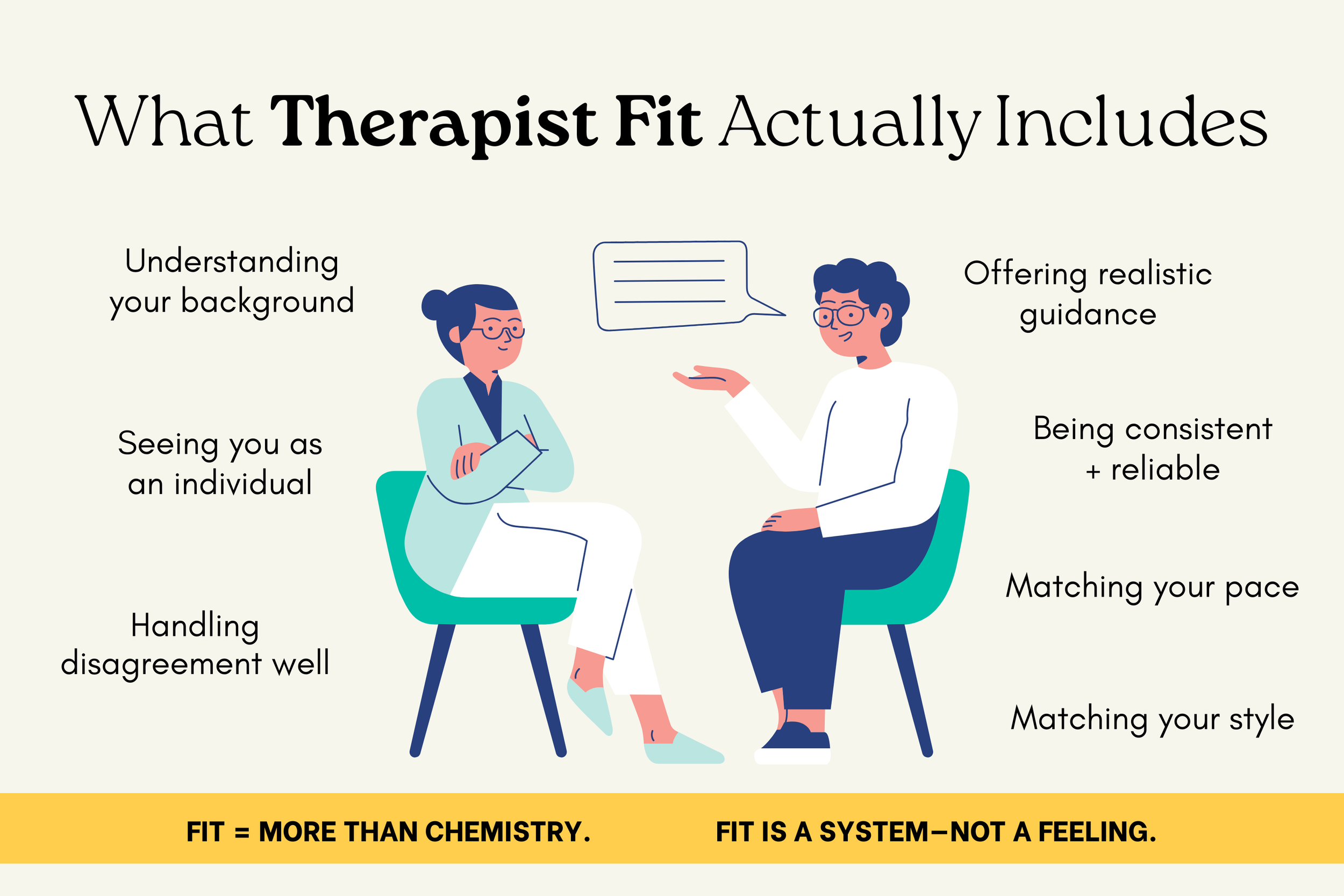
Real fit isn’t one thing. It’s the alignment of several distinct variables — and most of them are invisible until you’re already in the work. Here’s what they actually are.
1. Cultural and Experiential Understanding
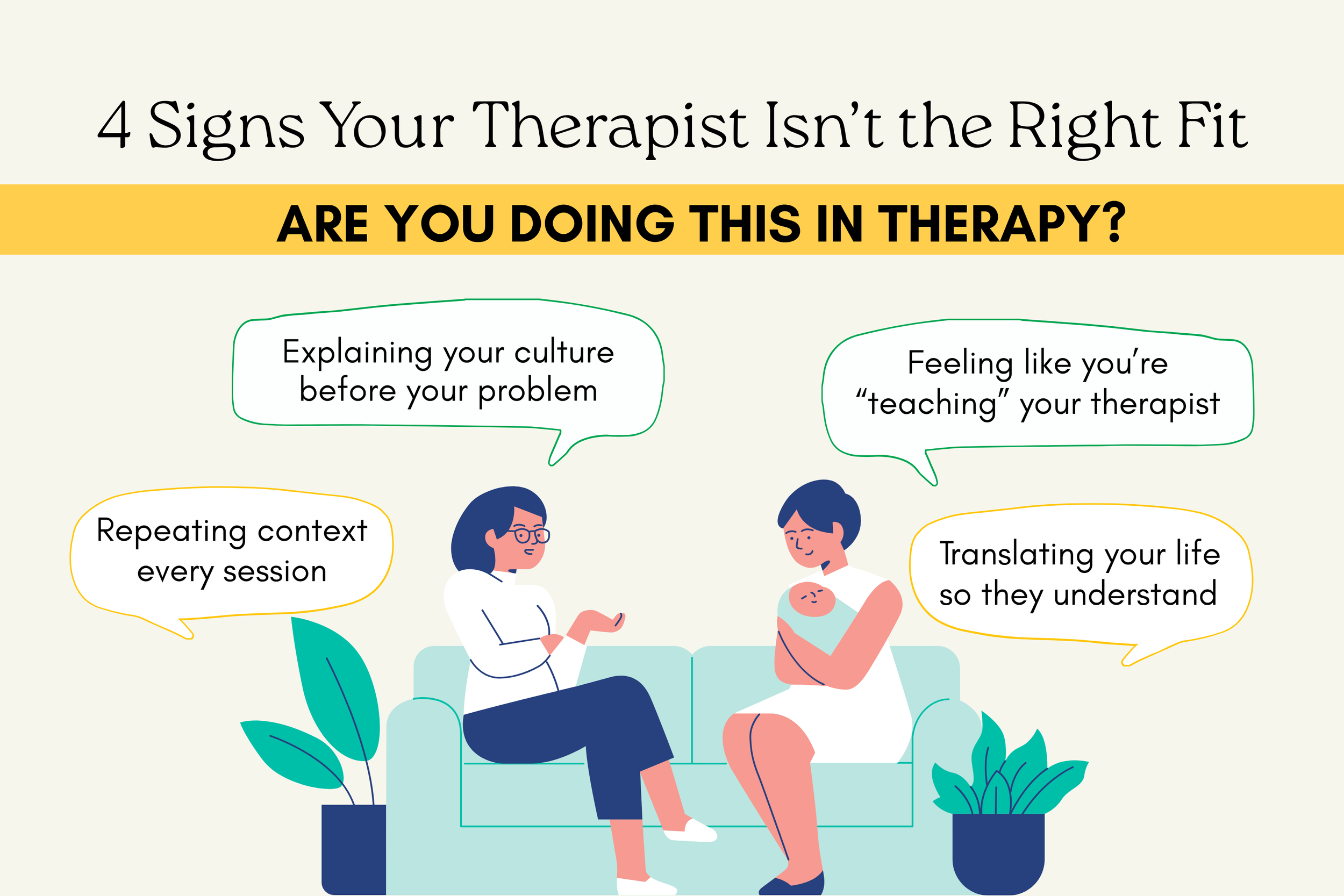
This isn’t just about whether a therapist has demographic overlap with you, though that can matter. It’s about whether you have to translate your life to them before you can get to your actual problem.
When this fit is off, you spend the first part of every session — or the first several sessions — establishing context. Your cultural values. Your community’s relationship with mental health. What your specific life circumstances make possible and impossible. You’re doing invisible labor before the work even starts.
“I often had to explain my life perspective THEN begin explaining my specific issues. Exhausting.”
That exhaustion is real, and it’s a fit problem — not a you problem.
2. Being Seen as an Individual vs. Being Categorized
There’s a difference between a therapist who is genuinely curious about you and one who is, even subtly, fitting you into a framework they already have.
People feel this acutely, even when they can’t name it. A therapist who makes a sweeping generalization, or who jumps to a conclusion before they’ve actually listened, breaks something in the room. You stop trusting that what you say will be received as information about you, specifically — and you start managing what you share.
“She told me I wasn’t depressed because I told her I had a good week while on vacation.”
“A therapist once said that I was a typical only child.”
That’s not a therapist who is bad. That’s a therapist who stopped being curious. And a therapist who has stopped being curious cannot see you for you.
At Thrive, we aim to build your therapy around exactly who you are and what you need. We know everyone brings their own life history and background with them, and our goal is to co-create your treatment plan based on your unique experiences.
3. Directional Match — Where Is the Work Going?
This is one of the most common sources of the “felt off” experience, and it’s almost never named correctly.
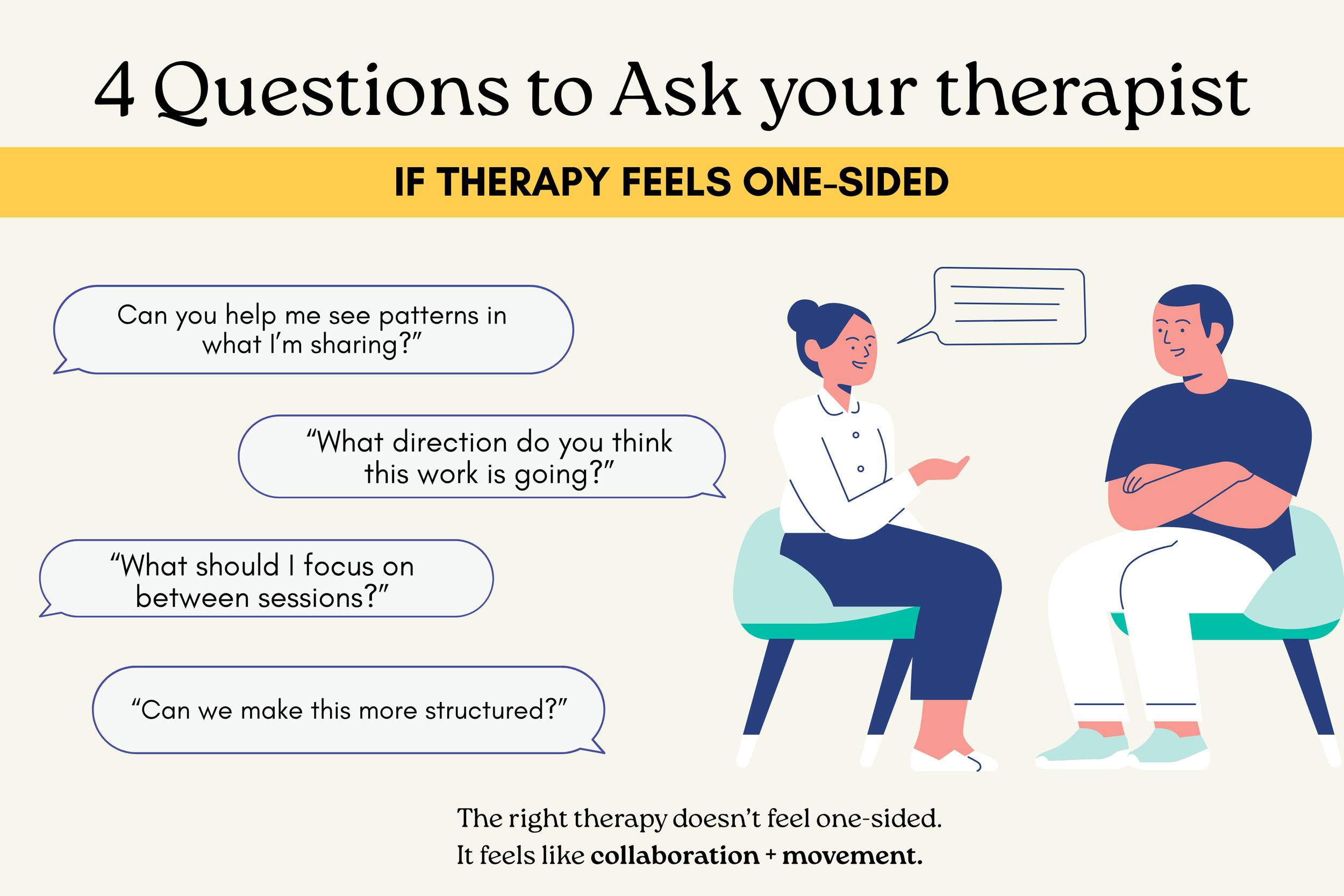
Some people need structure. They need a therapist who will help them identify patterns, synthesize what they’re sharing, and give them a sense that they’re moving somewhere. Others need open exploration — space to think out loud, follow threads, move at their own pace. Neither is the wrong way to do therapy. But when someone who needs direction ends up with a purely non-directive therapist, sessions start to feel like venting into a void.
“It feels like I’m just venting without an outcome.”
“My therapist mostly listens and nods… minimal feedback, no synthesis, no real structure.”
That’s not a lazy therapist. That’s often a skilled therapist working in a way that doesn’t match what this particular person needs.
My team and I strive to check-in with our clients frequently, starting in the first session, and make sure that they’re making the progress they need. If anything feels off, we truly appreciate when clients give us feedback, so we can make adjustments to help them get exactly what they need.
4. Pacing and Challenge Tolerance
How much challenge does this person need — and when?
Some people need to feel completely safe before any real work is possible. They need warmth established first, trust built over time, and challenges introduced carefully and collaboratively. Apply pressure too early with someone like this and they shut down. They stop sharing the real things. They act okay instead of doing the work.
Others find that approach frustratingly slow. They want to be challenged. They want a therapist who will call them out and name what they see.
Neither of these is a character trait to overcome. It’s just how different nervous systems engage with the therapeutic relationship. A mismatch here produces exactly the kind of experience that makes people think therapy isn’t for them.
At Thrive Therapy & Counseling, we’re actively involved in the therapy process. We’ve had clients tell us that it feels like “you’re right there in it with me.” Our focus is to meet you where you are and match your pacing. You set the tone, and we walk alongside you - reading your cues, challenging when it’s needed, but also adjusting if it’s not the right approach or time for you.
“He will keep pushing, and it makes me frustrated.”
“If you don’t feel like you can open up to him, I’d say it isn’t a good fit.”
5. How the Therapist Handles Ruptures
This one is, in my clinical view, the most important dimension on this list — and the one almost no one evaluates for, because it only reveals itself under pressure.
What happens when you push back? When you say “that doesn’t fit me”? When there’s a moment of misunderstanding — when your therapist misreads something, or says something that lands wrong?
A good therapist notices ruptures and repairs them. They stay curious when you disagree. They don’t defend their interpretation or get visibly frustrated when you say “actually, that’s not quite right.”
When this goes wrong, the consequences are serious. Clients start managing their therapist’s reactions instead of doing their own work. They edit themselves to keep the session from becoming uncomfortable.
“My therapist will try to ‘correct’ me on certain thinking and it almost turns into arguments and we don’t go anywhere.”
“It got to a point that I felt as if I could not even say anything at all.”
That last one stops me every time I hear a version of it. Because that person came to therapy to finally be able to say the things they haven’t been able to say anywhere else — and the therapeutic relationship itself became another place where they couldn’t.
6. Values and Worldview Neutrality
This one is subtle, and it often goes unnoticed for a long time — which is part of what makes it so corrosive.
A therapist’s worldview shapes what they consider a healthy outcome, even when they’re not aware of it. Their assumptions about family structure, about what a good life looks like, about what “healthy boundaries” means in a given cultural context — all of that enters the room, whether it’s named or not.
A skilled therapist recognizes their own worldview and can still hold space and understanding for your unique worldview. When a therapist doesn’t check their biases and their worldview quietly conflicts with yours, you start to notice you’re editing what you share. The “solutions” they offer don’t quite fit your life. You feel vaguely judged without being able to point to anything they said explicitly.
“Focused on certain solutions that weren’t practical or feasible for me to implement in my life — I really didn’t feel like she heard me.”
“He has inserted his own beliefs and opinions.”
That’s a therapist who isn’t remaining open, so their map of what’s possible doesn’t match the territory of this person’s actual life.
From the first time a new client contacts us at Thrive, we aim to offer openness, acceptance, and understanding, honoring diversity and the innumerable paths to healing and building a meaningful life.
7. Reliability & Consistency
This one sits underneath everything else — because no therapeutic work is possible in an environment that itself feels unstable.
Chronic lateness. Scheduling changes. A missed appointment. These aren’t just inconveniences. For people dealing with anxiety, or who have a history of relationships where they couldn’t count on people, a therapist who is unreliable reactivates exactly what they came to heal.
“Late to session, scheduling miscommunications, disrespect… I felt anxious, misunderstood, angry.”
“Constantly changing around appointments and then randomly canceling… She missed one of my appointments, which was the last straw for me.”
Trust in a therapeutic relationship is built in the small, consistent moments. It’s also broken there.
My team and I strive to be reliable and trustworthy from your first contact with our Intake Coordinator. We know the work of therapy can be hard, so we want to be as consistent as possible, including by scheduling you for a recurring appointment time so you know what to plan for. Even though we sometimes get sick or may be out of the office, we’ll let you know and will always provide a plan for our next appointment.
Why the Standard Search Process Gives You Almost None of This
A 15-minute phone consultation tells you: is this person available, do they seem warm, can I get words out in their presence.
That’s genuinely useful. But it tells you almost nothing about directional match, pacing, how they handle ruptures, or whether their worldview will quietly conflict with yours three sessions in. It tells you nothing about whether you’ll feel seen as a specific person or categorized. It gives you no information about what the work will actually feel like once you’re in it.
A bio page is even less. A list of modalities is not a match. “Trauma-informed” and “CBT” and “attachment-focused” tell you something about a therapist’s training — they tell you almost nothing about whether the way that therapist works will fit how you process and what kind of relationship allows you to actually open up.
Most people have been trying to predict a complex, multi-dimensional match from a surface-level interaction. And when it doesn’t work out, they blame the outcome on bad luck or personal chemistry — which gives them nothing to work with the next time.
That’s not a personal failing. It’s a structural problem with how the search works.
What Changes When You Know What You’re Actually Looking For
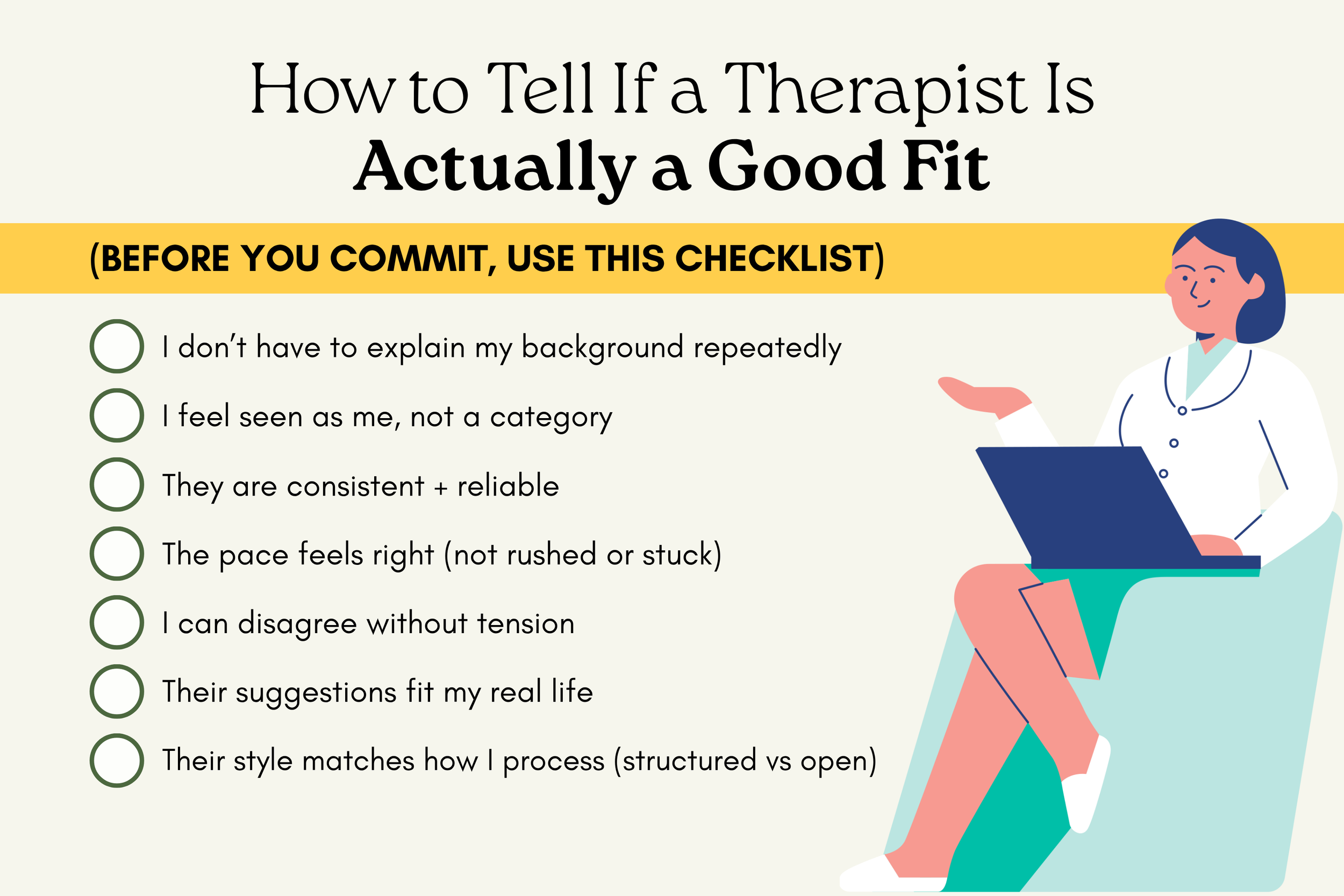
When you understand that fit has these dimensions, the question shifts. It’s no longer “did I like them?” It becomes: what do I actually need from a therapist?
Do I need someone who will give me structure and direction, or space to explore? Do I need warmth established before any challenge is possible, or am I someone who wants to be pushed? Do I need a therapist who understands my cultural context without me having to explain it? Do I need someone who will name what’s happening between us when something feels off — who won’t go quiet or get defensive when I push back?
Most people searching for a therapist right now have never been asked these questions. Not because they’re incapable of answering them — but because the search process never created space for them.
It’s also okay if you’re not sure about your answers or if they change over time. Our therapists’ goal is to check in with you on a regular basis, so we make tweaks throughout our work to keep it centered on what you need at that moment in time.
When clients come to us after having an experience with another therapist that “felt off,” I notice that they have 1.) learned more about what they are looking for or 2.) are curious to have a different experience - even if it’s hard to name what that would be or 3.) are more cautious and hesitant about therapy, but still want to give it another try.
If you’ve defined what they need in therapy, that’s great! We’d love to help create that therapy with you. But, if you’re still not sure, it’s okay too. Our therapists are here to guide you, so together you can identify what you need and build around that.
How Thrive Evaluates Fit
This is exactly why our intake process is built the way it is.
When you reach out to Thrive, the first person you speak with is our intake coordinator, who is also a therapist. She asks about logistics and about what’s bringing you to therapy. She knows each therapist on our team, and she brings all of that deep, specific knowledge — not just what their bio says, but how they actually work in the room. What kinds of clients they work best with. What their personality is like. Where their clinical strengths live. Then, she recommends a therapist for you.
You’re not being randomly matched. You’re talking to a real person who’s integrating her specialized knowledge and experience with our therapists to create a personal recommendation for you.
The match recommendation is based on the real dimensions of fit. Not guesswork.
That’s why therapist switches at Thrive are rare. Not because we discourage them — we don’t, and if a match needs adjusting, we can do that internally without sending you back to square one. But because when the matching process accounts for the real variables, the matches hold.
You’re Not Too Picky. You Just Needed Better Information.
If you’ve been in the search for a while, and something keeps feeling off, I want you to hear this clearly:
The feeling that something wasn’t right? That was real. It was worth listening to. The problem was never that you were asking for too much. It’s that the process you were using couldn’t answer the questions that actually matter.
Fit is not a vibe. It’s a set of specific, identifiable variables — and when the right ones align, something different happens in the room. You stop editing yourself. You leave sessions feeling like something actually moved. You find yourself saying things you haven’t been able to say anywhere else.
That’s what a real match makes possible. And you don’t have to figure out how to find it alone.
If you’re ready to have a conversation about what you actually need — not just what you’re available for — we’d be glad to help.
References
Norcross, J. C., & Lambert, M. J. (Eds.). Psychotherapy Relationships That Work: Evidence-Based Therapist Contributions. Oxford University Press.
Wampold, B. E. The Great Psychotherapy Debate: The Evidence for What Makes Psychotherapy Work. Routledge.
Ivy Griffin, LMFT, is the founder of Thrive Therapy & Counseling in Sacramento, CA. Thrive is a group practice specializing in anxiety, trauma, and support for highly sensitive people, LGBTQIA+ clients, and adults navigating major life transitions. Thrive offers in-person therapy in midtown Sacramento and online therapy across California.