
The questions most people forget to ask before booking a first therapy session
Ivy Griffin
You've been trying to find a therapist for a while now.
Maybe weeks. Maybe longer than you want to admit. This doesn’t even include the time you’ve spent thinking about it.
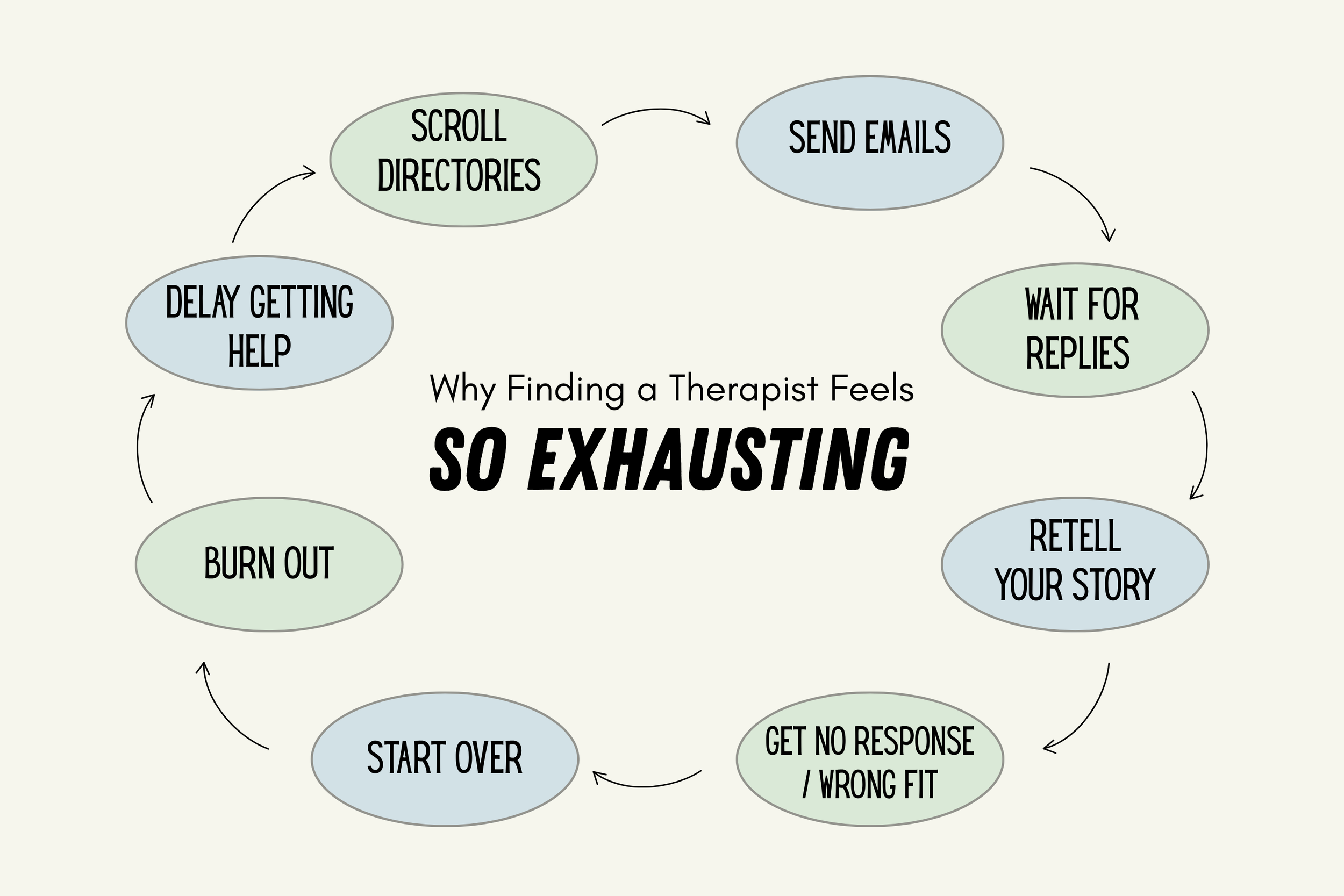
You've scrolled through the directories. You've read the bios, and after a while, they all start to sound the same. You've sent emails that went nowhere. Left voicemails that weren't returned. Found someone who seemed promising and then found out they weren't taking new clients. Or didn't take your insurance. Or had a three-month waitlist.
And somewhere in the middle of all of it, you've had to tell your story. Over and over.
To intake coordinators, to therapists on consult calls, to whoever picks up the phone.
Each time hoping this is the one. Each time starting from the beginning.

I've heard people describe looking for a therapist as feeling like a second job. That's not an exaggeration. It is work, real, effortful, emotionally expensive work, and it lands on you at exactly the moment when you have the least capacity for it.
And underneath the exhaustion, there's usually a quieter, harder question starting to form:
Is it possible to get the help I need? Or am I just looking for something that doesn't exist?
It exists. But most people are searching without the one thing that would make the search shorter, sharper, and significantly less painful.
They don't know what to ask.
Not on a consult call. Not in a first session. Not at any point in the process where they actually have a therapist in front of them and a real window to find out whether this person is right for them, not just available, not just nice, but genuinely right.
Most people assess vibe and move on. And vibe is not fit.
Why the search keeps going longer than it should
The reason most people stay stuck in the search isn't that good therapists don't exist. It's that the standard process for finding one is badly designed for what you actually need to find out.
Directories give you bios. Bios give you specialties, credentials, and a paragraph about an approach that was written to appeal to as many people as possible. Consult calls give you fifteen minutes with someone you've never met, while you're already activated just from making the call, trying to compress your entire situation into something coherent, and then somehow evaluating whether this stranger is the right person to help you with the most personal parts of your life.
And then you go on feeling.
Which makes sense. It's all you have. Nobody teaches you how to evaluate a therapist. Nobody gives you a framework. So you do what comes naturally in any social situation, you read the room, you assess whether it feels okay, and you decide.
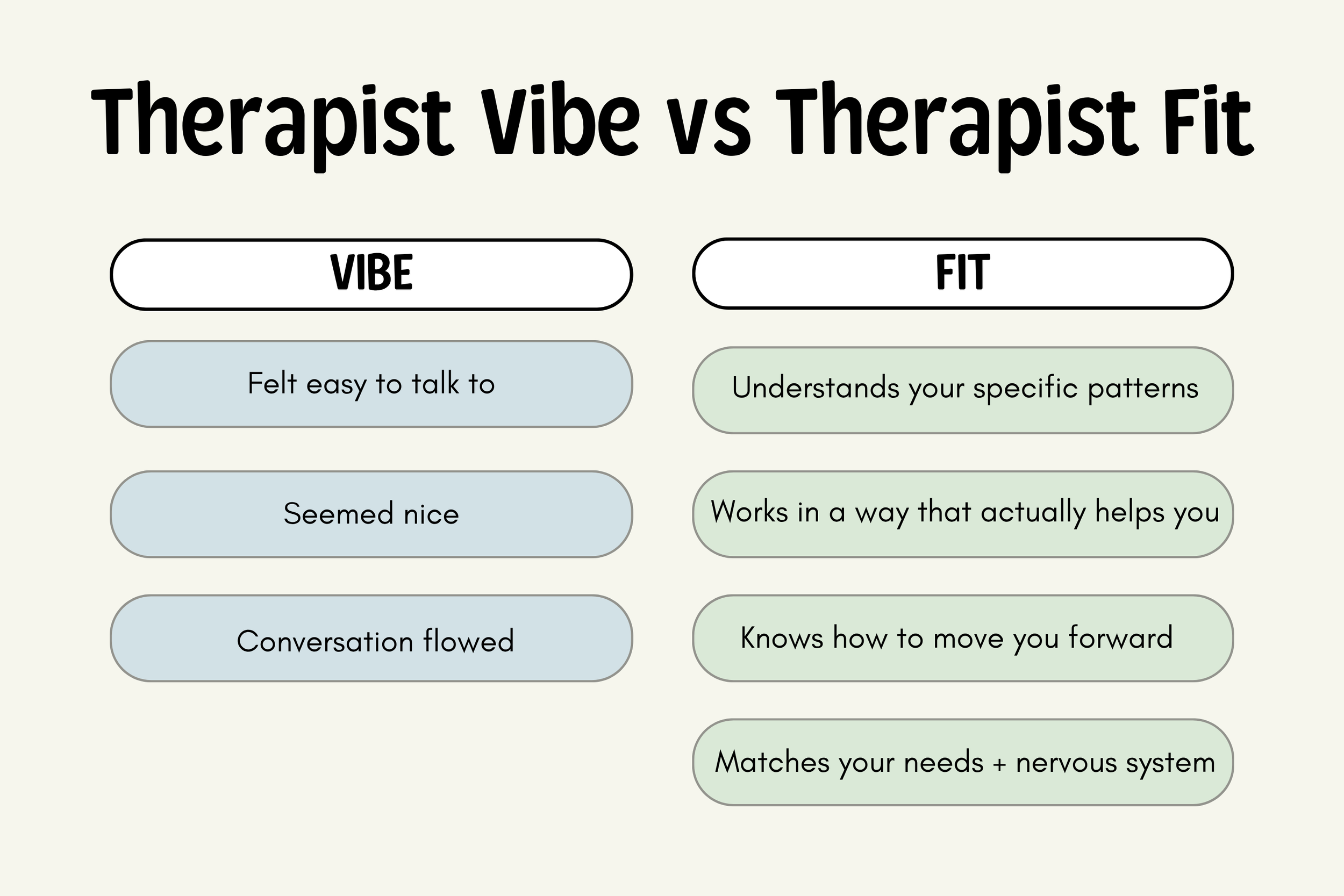
The problem is that a warm, thoughtful, skilled therapist can still be the wrong match for you. Not because they're lacking anything. But because fit is specific. It's not about quality in the abstract, it's about whether this particular person's way of working fits with this particular person's way of being.
A consult call can feel comfortable and still not be the right fit for the work you need to do. And sometimes, a call can feel a little awkward — because you’re nervous, because it’s unfamiliar, or because you’re talking about hard things with someone new.
So the feeling you leave with does matter, but it’s not enough on its own.
Instead of asking, “Did this feel good or not?” try getting more specific:
Did I feel understood?
Did their responses actually make sense for what I need?
Did anything feel off, and do I understand why?
Because it’s not just the feeling that tells you something, it’s whether you can make sense of it, alongside the answers to the right questions.
Before the questions: one thing that helps
I want to acknowledge something before we get into this.
If you're in the middle of the search right now, you may be running low. The process of looking, the emails, the calls, the retelling, the waiting, takes something out of you. And I'm about to ask you to do one more thing before you pick up the phone.
So I'll keep it simple.
Before your next consult call, try to name one true thing about yourself. Not your diagnosis. Not your full history. Just one real thing about how you show up, something you know about yourself that makes this hard, or that has made previous attempts fall short.
Something like:
I need to feel like someone actually gets my world before I can trust them.
I shut down when I feel managed or talked at.
I look completely functional on the outside and I'm not.
I've tried this before and I know all the vocabulary and nothing has changed.
I need to feel challenged, but only by someone who has earned it.
Whatever it is — hold it. Bring it to the call. Because the questions that follow are only useful if you're asking them as yourself — the real version, not the version that's trying to seem like a reasonable, easy client.
You're not looking for a therapist who is good in general. You're looking for a therapist who is good for you specifically. That's a different search — and it starts with knowing what "you specifically" actually means.
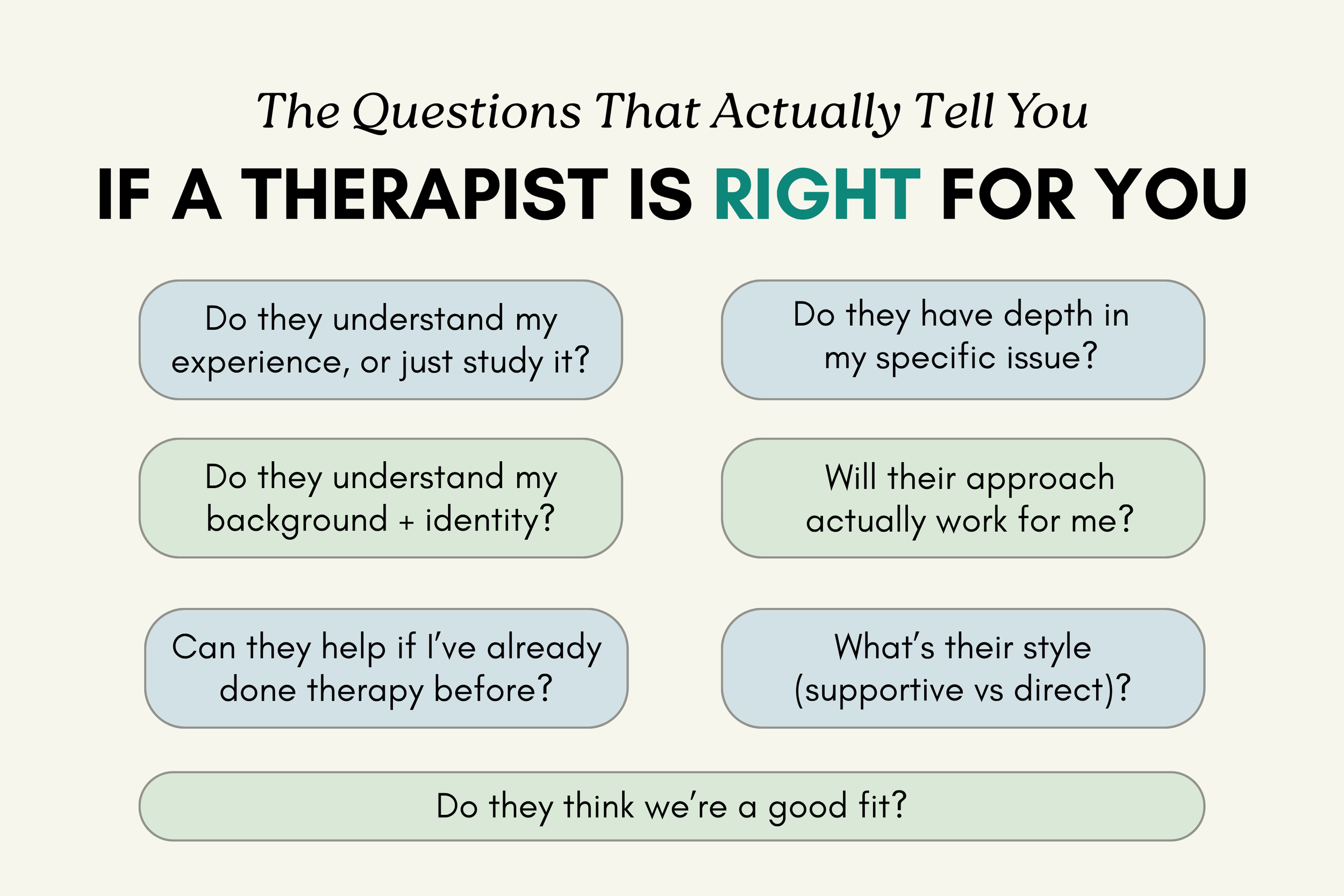
The questions
1. Would you mind sharing if you or someone in your life has experience with being highly sensitive? If so, how does that impact the way you work? What training do you have in working with hsps?
It can feel presumptuous to ask. Maybe even a little rude. Like you're asking the therapist to audition their history and resume before you've even started.
However, you're asking something very reasonable: does this person have enough proximity to my experience to understand it?
There's a difference between a therapist who has studied anxiety and one who has felt the specific exhaustion of a nervous system that won't quiet down. There's a difference between clinical knowledge of high-functioning burnout and an understanding — from somewhere real — of what it costs to keep performing competence when you're running on empty.
You don't need them to have lived your exact life. But proximity changes what's possible and what’s understood. It changes how quickly you can move, how much you have to explain, and whether the therapist's responses land as genuinely understanding or technically correct.
At Thrive Therapy & Counseling, our therapists are HSPs themselves or have loved ones who are HSPs. Many therapists are drawn to our practice precisely because of our understanding and acceptance of sensitivity. Plus, as the Founder and Director, I talk frequently about my experiences as an HSP and provide ongoing continuing education trainings to our team so we can best support sensitive folks in our community.
While each therapist may have a different comfort level with how much information they disclose (we’re trained, after all, to only share info about ourselves if it directly benefits the client!), they can tell you more about how they work with your needs and concerns.. What you're listening for is specificity and an understanding that they can help you — not a reassurance that they work with all kinds of people.
2. What's your experience working with clients from my background?
For a lot of people, this question really matters.
If you're LGBTQ+, you need to know whether "affirming" means the therapist took a class once on cultural sensitivity or whether they actually understand what it costs to navigate a world that wasn't built for you.
At Thrive Therapy & Counseling, many of our therapists are part of the LGBTQIA+ community themselves, and all of our therapists are queer and LGBT-affirming and participate in ongoing training so that we can meet you exactly where you are.
If you come from a specific cultural background, a religious upbringing, a community with particular values around privacy or mental health or family loyalty — it matters to know whether this therapist is already familiar with that experience. You should not have to spend the first several months of therapy explaining the context of your life before you can actually work on it.
A great therapist, even if they don’t have experience with your particular background, will do their homework, consult, and center the therapy around you as a person, so that you don’t have to waste time explaining your identity or cultural experience.
You shouldn't have to educate your therapist about your own existence in order to get help.
A good answer to this question is specific. It describes real situations, real familiarity, and gives you confidence that this therapist can support your needs.
The question is not whether they're perfect. It's whether they have enough genuine proximity to your world that you won't be carrying the additional weight of constant translation.
3. Are you someone who tends to be more warm and nurturing in sessions, or more direct and challenging — and how do you determine that with someone new?
This is the most practical fit question you can ask. And almost nobody asks it.
Because this is actually what people are trying to figure out when they assess the vibe on a consult call. They're trying to predict: what is it going to feel like to be in this room week after week? Is this person going to push me? Hold space for me? Both? When?
The problem is that vibe doesn't answer this reliably. A warm person on a call can be a challenging therapist in the room. A quieter, more reserved person can turn out to be the most holding presence you've ever experienced in a session.
So ask directly.
And then listen for what comes after. Because the follow-up — how do you calibrate that with someone new? — is where the real information lives. A therapist who adjusts their approach based on what a specific client actually needs is different from one who has a default style and applies it consistently. Both can be effective. But you need to know which you're getting.
Depending on which of these sounds more like you, this question might look very different for you:
If you need to feel genuinely heard before you can take in any kind of challenge — before redirection lands as care rather than criticism — you want a therapist who understands that sequence and won't skip it.
If you need to feel like the therapist actually has something you don't before you can let them lead — who needs to feel earned before you'll be challenged — that's a specific dynamic. Not every therapist can hold it. Ask whether this one can.
4. I've done enough reading and enough therapy that I know a lot of the vocabulary. I can talk about my patterns analytically. But knowing it hasn't changed it. Have you worked with clients in that position — and what do you think that's usually about?
Note: This question is specifically for readers who have tried therapy before. If you're earlier in the search and haven't been in therapy yet, skip ahead — the next question is for you.
This is the question for the reader who is not new to this.
The one who can tell you exactly what their attachment style is, what their nervous system does under stress, what childhood wound is probably underneath the current pattern. Who has done the reading, knows the vocabulary, and is quietly, sometimes bitterly frustrated that none of it has produced the change they came in for.
If that's you, this question is the most diagnostic one you can ask.
A therapist who has real experience with this profile will have a genuine answer. Not a generic one.
A specific theory about why insight doesn't always translate, and what they do differently when it doesn't. They might talk about the difference between cognitive understanding and embodied change. Or how somatic and brain-based therapies take you deeper – how you need to do more than just talk about trauma to reprocess experiences and memories in your brain.
They might describe what has to happen in the therapeutic relationship itself before intellectual knowledge can land somewhere real. They might talk about releasing underlying traumas, exploring unknown parts, or using art or expressive therapies to find healing.
What you're listening for is whether their answer surprises you. If it offers you something you haven't already thought of or gives you confidence that they know how to move through this stuckness, that's a signal. If it restates things you already know, that's a signal too.
5. Have you worked with a lot of clients dealing with anxiety and overwhelm? What have you found most helpful for them?
Every therapist's profile lists specialties. This question pushes past the list.
Because there is a real difference between a therapist who has taken a training in trauma and one who has spent years in the room with trauma survivors and knows, from accumulated experience, what the work actually requires. There is a difference between someone who lists anxiety as a specialty because it's common and someone who has genuine depth in the particular flavor of anxiety you're carrying — the high-functioning kind, the kind that hides, the kind that looks like productivity and competence from the outside.
A therapist with real depth will answer this differently. More specifically. With texture. They might describe what they've seen, what they know about how it tends to move, what gets in the way. A therapist who is stretching their specialty list will give you a more general answer.
Both responses tell you something.
At Thrive, our team of highly trained therapists consults with one another multiple times each month, so each of our therapists benefits from a wealth of experience and knowledge. Our therapists who have been seeing clients for years share their wisdom and insights, and our newer therapists share their creative ideas and fresh perspectives. When you work with one of us, you’re getting our combined collective knowledge and lived experience.
6. Do you tend to give direction, concrete tools, or things to work on between sessions — or is the work mostly in the session itself?
There is a real difference between a therapist who sends you home with something — a framework, a practice, something to notice or try — and a therapist whose model is primarily the relational and reflective work that happens in the room itself. Both approaches have solid research support. Both can produce meaningful change. But they feel completely different week to week.
For certain people — particularly action-oriented people who are used to making progress by doing things — an open-ended reflective model can start to feel like nothing is moving. Not because it isn't working. But because the mechanism of change is invisible to them, and there's no felt sense of forward movement between sessions.
If that sounds like you, ask this question. And then ask the follow-up: if I told you I was leaving sessions and not knowing what to do with any of it, how would you respond to that?
My team and I find that each client is different, and our goal is to create a shared experience in therapy that is tailored to who you are. Whether you’re highly sensitive, introverted or extroverted, LGBT+ or not, you bring your own personality, background, and needs to the therapy room. Our goal is to design a new therapy for each client based on who comes into our office each session, so you can walk away with real, tangible change.
The goal isn't to find a therapist who assigns homework. The goal is to find a therapist whose way of working will keep you engaged and give you a felt sense of movement — because a therapy you quietly disengage from isn't helping you, no matter how clinically sound the approach is.
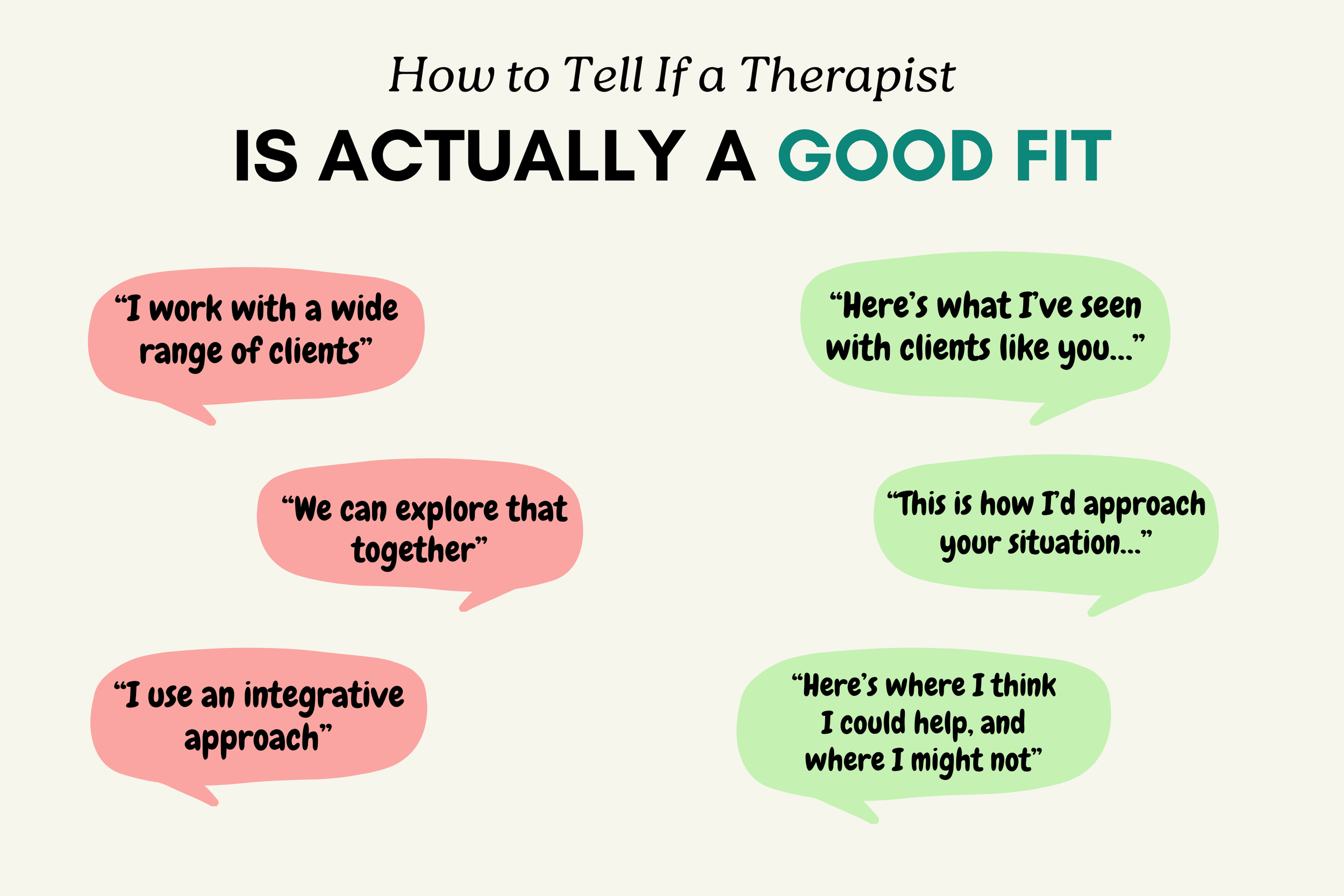
7. Based on everything I've just told you — do you think you're a good fit for me?
Ask this one last. After you've told them the real things. After you've described your situation, your patterns, the thing you know about yourself that makes this hard.
And then wait for the actual answer.
A therapist who is confident and self-aware will give you one.
They might say yes, and tell you specifically why — what they've heard that makes them think the match makes sense. They might say they think so but want to know more about one specific thing first. And occasionally — which is valuable, even if it doesn't feel that way in the moment — they might tell you they're not sure they're the best fit, and here's why.
All three of those answers are more useful than leaving a consult call with nothing but a feeling.
What you're not looking for is a reassurance. "I work with a wide range of clients" is not an answer to this question. Neither is "I think we could do good work together" without any specificity about what that's based on.
You came in and told them something true about yourself. You deserve a response that takes it seriously.
A note on asking these questions
I want to name the hesitation directly, because I know it's there.
Asking these questions can feel like you're being difficult. Setting an impossible bar. Not being appropriately deferential to someone with more clinical expertise than you.
You're not being difficult.
You're doing the one thing that makes the difference between finding a genuinely good match and spending more weeks in the search, or months in sessions that feel okay and produce nothing.
A therapist who is right for you will welcome these questions.
They'll have real answers. They might even be glad you asked. And if the questions produce vagueness, defensiveness, or a string of reassurances that don't actually say anything, that's not you being too demanding. That's information. Some of the most useful information you can get before you've spent a dollar or told your story one more time.
You are not asking whether a therapist is good. You're asking whether they're good for you.
That's a completely different question. And it's the only one that matters.
What it looks like when the search is over
I want you to picture something for a moment.
Imagine you've already done this. You made one more call. You asked the real questions. You got answers that actually meant something.
You reached out to Thrive. Our intake coordinator — who is herself a therapist — asked you a few specific questions. Not your full history. Just enough to understand what you're actually dealing with right now, what matters to you about how you work, and what you need from the person you're going to trust with this. It took ten minutes. It didn't feel like starting over.
— — —
She matched you with a therapist who has real experience with what you're bringing in. Not a generalist. Someone whose background, working style, and way of being in the room fits the specific shape of what you're carrying.
— — —
You had your first session. And at some point in the first twenty minutes, you noticed something quiet: you weren't managing the conversation. You weren't monitoring how the therapist was reacting or editing yourself to seem more manageable. You were just talking — actually talking — about the thing you came in for.
— — —
You drove home and realized: you're not looking anymore.
The search is over. You found someone.
— — —
A few weeks in, something is shifting. Not because you're trying harder. Because the match is right and the work is actually pointed in the right direction.
— — —
That's what this is supposed to feel like. Not magic. Not instant. Just the clear, settled sense that you're in the right place, and that you never have to start that search again.
This is what our intake process is built for
The questions in this post reflect the kind of thinking that's already built into how we match clients at Thrive.
You don't have to prepare a list. You don't have to run the interview yourself and hope you asked the right things. You don't have to tell your story to five different people and assess five different vibes and still end up unsure.
When you reach out, you'll connect with our intake coordinator. She'll ask you targeted questions — about what you're dealing with, your preferences, and your availability. She's not taking a clinical history. She's gathering exactly what she needs to make a match that actually holds.
Then, you’ll get a follow-up message confirming your appointment and going over the logistics. So, you don’t have to remember to ask about the address or when to show up - we’ll walk you through all the need-to-know info. All you need to do is reach out, and we’ll guide you through each step of the process so you can get the support you deserve.
You can also browse our therapist team yourself and bring a name or a preference — we'll take that seriously too. Some people want to be matched. Some people want to choose and have someone confirm the fit. Either way works.
The goal is the same: you start with a therapist who makes sense for you. Not whoever had an opening. Not whoever seemed nice on a fifteen-minute call. Someone who actually fits.
You've been doing the hard work of searching long enough.
Reach out here — and let us take it from here.