
‘Anxiety therapy’ isn’t one thing. Here’s what HSP-trained therapy does differently.
Ivy Griffin
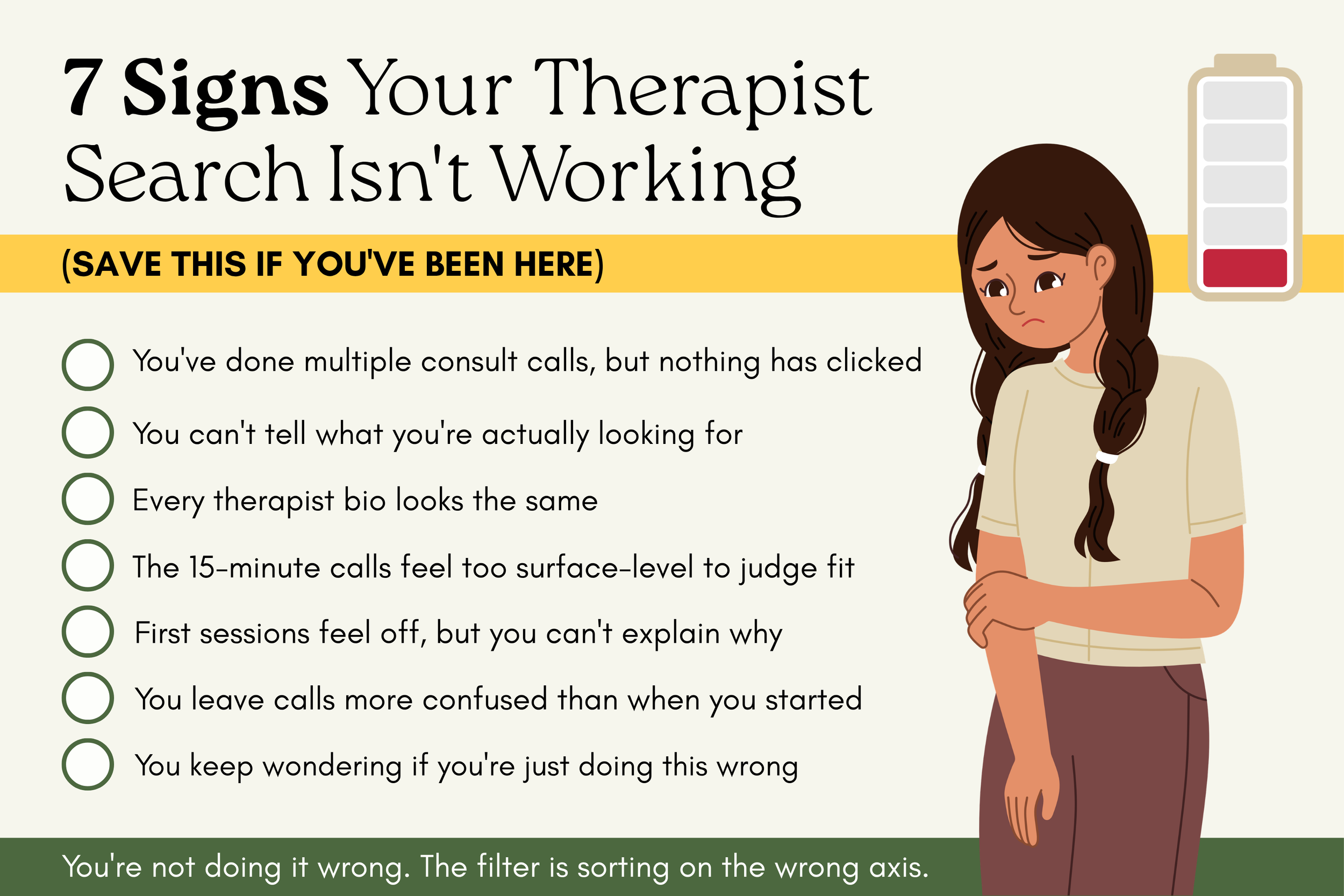
You have three tabs open right now. Psychology Today, filter set to “anxiety.” Headway. Maybe Alma. The Google doc where you’ve been keeping notes on the last few therapists you talked to — the one with the half-drafted follow-up email at the bottom you haven’t sent yet.
You’ve done a couple of 15-minute consult calls. Maybe a first session or two. Nothing has clicked. And underneath the calls and the filtering and the bios, a quieter question keeps coming up:
What am I actually trying to find, and how will I know it when I see it?
The search treats “anxiety therapy” as one thing. But it isn’t. Two distinct mechanisms get collapsed under that single label — and the directory filter has no way to identify which therapists work with the one HSPs actually have.
We’ll explain why. We’ll explain what HSP-trained therapy does differently. And we’ll give you a few real questions you can ask on your next initial call so the next 15 minutes do more work.
Why this myth is so easy to believe
Three things make this collapse unseen.
First, directories sort therapists by what they treat, not by how they work with nervous systems. Psychology Today, Headway, Alma, insurance directories — none have a “works with HSP nervous systems” filter. Even if “Highly Sensitive Persons” shows up as a specialty checkbox, which I’ve never seen, there’s no quality control on who checks it.
Second, generalist anxiety therapy genuinely works for most people. CBT is evidence-based and effective for cognitively-driven anxiety. When your friend tells you her therapist helped her so much, she’s telling the truth. The mismatch isn’t that the therapy was wrong for her — it’s that her anxiety is different than yours.
Third, HSP as a clinical trait isn’t taught in most graduate programs. Elaine Aron’s research has been around since the mid-1990s, but it lives in continuing education and self-study, not foundational curriculum. The average generalist may have heard the term. That’s different from being trained to work with it.
So when an HSP filters for “anxiety” and the therapy doesn’t quite land, the easy explanation is I must be doing this wrong, which ties in to a HSP’s common tendency to blame themselves. The harder explanation — that the search infrastructure is sorting on the wrong axis — isn’t visible from inside the search.
Generalist anxiety therapy isn’t wrong. It’s a different mechanism.
What this is costing you, this week
Three things show up in the search itself.
One: the filter produces a list of options that look interchangeable. A hundred “anxiety” therapists. Same checkboxes. Similar bios. Similar rates. The filter has done its job; you still can’t choose. Decision fatigue isn’t a personal failing. It’s what happens when the filter sort doesn’t work in a way that’s helpful.
Two: the 15-minute calls feel surface-level. When a therapist says “yes, I work with HSPs” on a consult call, you don’t yet have a way to tell whether that means I completed advanced HSP training and have been doing this work for years or I checked the box because I read The Highly Sensitive Person once. Both therapists will sound warm on the call. Only one has the advanced knowledge you need.
Three: first sessions are hard to read for fit. An HSP nervous system in an unfamiliar setting with an unfamiliar person does what an HSP nervous system does — it inhibits. So when the first session feels slightly off, you can’t tell whether it’s the therapist’s modality mismatch, your own nervous-system inhibition, or both. You stay uncertain, or you bail, or both.
We see this pattern repeatedly. The most common opening when an HSP eventually lands at Thrive is some version of I know I need help with anxiety, but it’s been hard to find what will help me. Which is exactly the right concern. It’s just being graded on a rubric that can’t create the answer.
What’s actually true
Here’s the distinction you’re trying to identify on the next 15-minute consult call — and most readers don’t yet have language for it.
Two parts of the brain run two different anxiety mechanisms.
Generalist anxiety is often cognitive
It lives in catastrophizing, what-if loops, predictive thinking running faster than the situation calls for. CBT works well here because CBT targets that cognitive layer directly — challenges the thought, tests the prediction, exposes the avoidance. It’s evidence-based and effective. It’s the right treatment for the majority of people who present with anxiety.
HSP anxiety is architectural
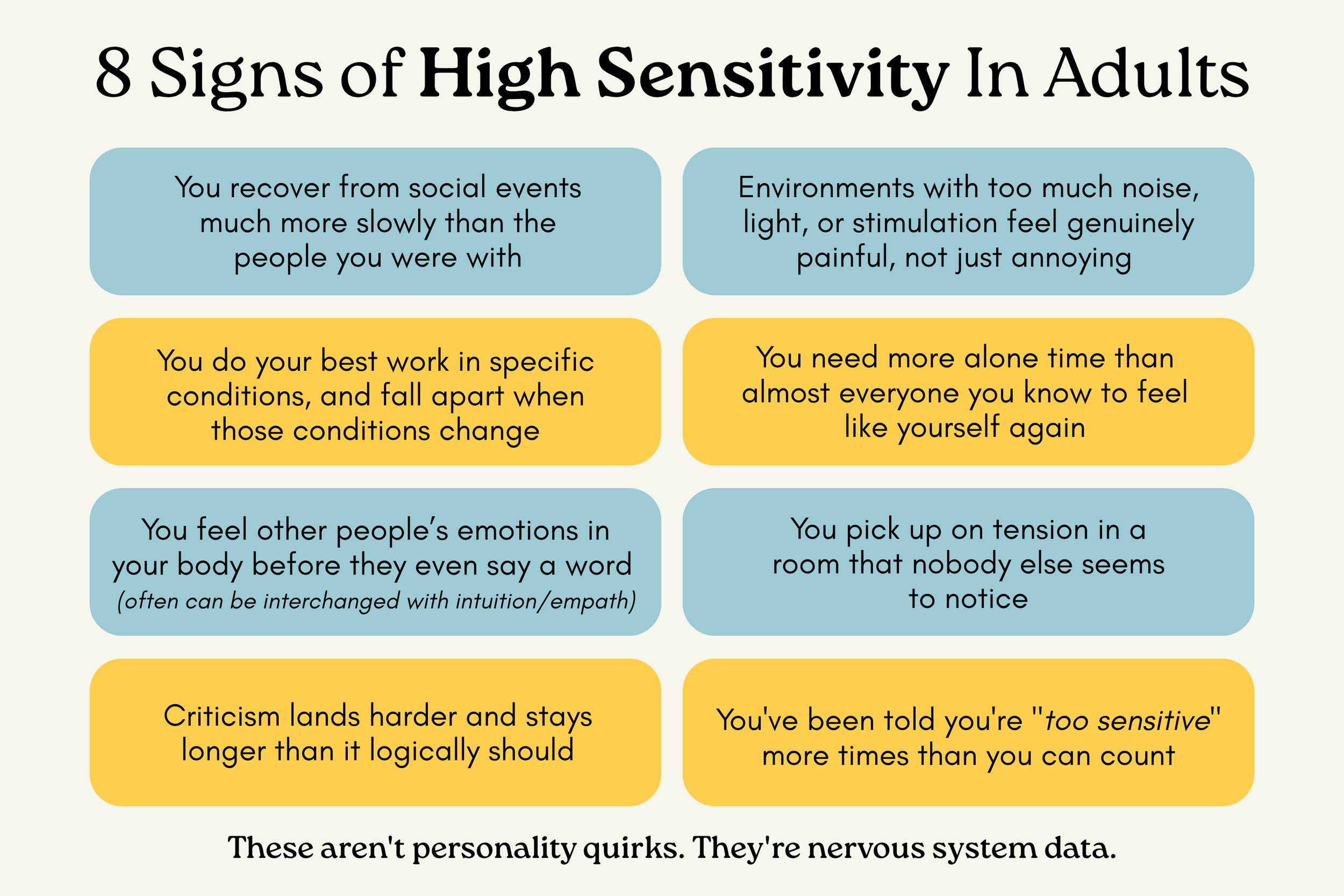
It lives downstream of high sensory processing sensitivity — a nervous-system trait Elaine Aron began researching in the early 1990s. An HSP nervous system processes more sensory and emotional information per minute than a non-HSP nervous system. That’s wiring, not weakness. It’s neurodivergence. In an environment that doesn’t accommodate that processing load (and most modern environments don’t), the system runs hot. The anxiety isn’t a cognitive distortion to be challenged. It’s a real-time response to genuine input the nervous system is actually receiving.
Treating architectural anxiety with cognitive-layer tools is a bit like reading a book aloud to fix a hearing problem. The book might be good. The intervention isn’t matched to the mechanism.
So what does HSP-trained therapy actually do differently? Five things.
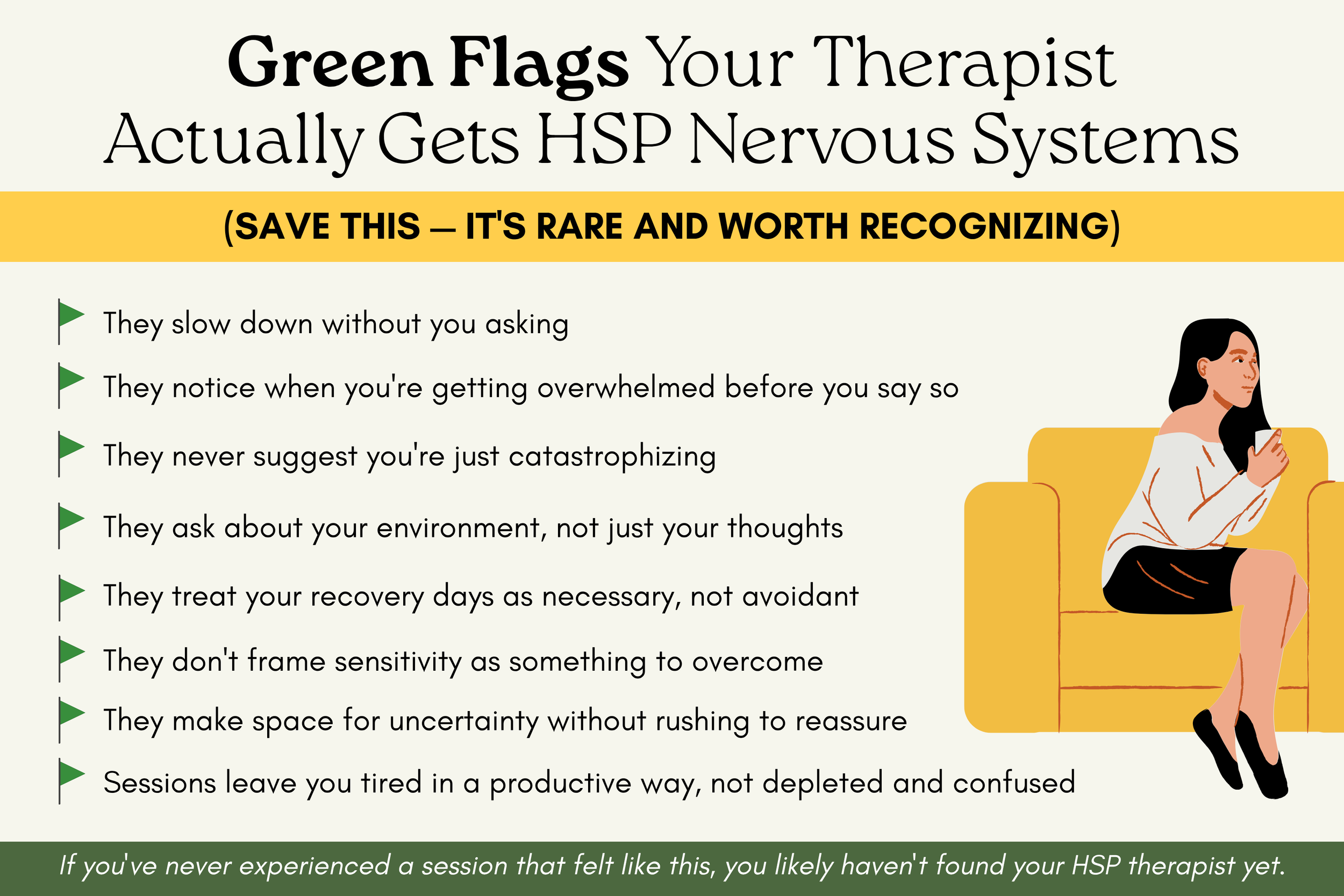
1. Paces sessions to nervous-system capacity
Standard 50-minute sessions assume the client can sustain that arousal level. HSP-trained therapists watch the nervous system in the room and pace accordingly — pause, slow, repeat, sometimes shorten — because pushing through fatigue produces more shutdown, not more insight.
2. Integrates sensory awareness into the clinical picture
Treats the body and the sensory environment as relevant data, not background noise. What time of day was the spike? What was the lighting? Was there background noise? When did you eat last? This brings in the missing, often ignored, data.
3. Addresses the overwhelm-and-depletion seesaw
HSP nervous systems don’t sit at a stable baseline; they oscillate between overstimulation and underrecognized need for recovery. HSP-trained therapy addresses both ends, rather than treating “anxiety” as a single steady-state condition. HSP therapy recognizes this seesaw is ongoing and identifies how to care for the nervous system to make the fluctuations more gentle.
4. Distinguishes trait sensitivity from pathology
A generalist may pathologize what an HSP-trained therapist sees as trait-typical. The distinction matters enormously for the direction of treatment — you don’t try to fix architecture; you accommodate it. Because HSPs are not broken. Your brain and nervous system simply work differently and need to be understood and accommodated.
5. Treats HSP training as a baseline, not a checkbox
All of our therapists have advanced training in working with highly sensitive people, and most of them also have their own lived experience with high sensitivity. Ivy studied Elaine Aron’s Psychotherapy and the Highly Sensitive Person, completed a retreat with Elaine Aron focused on her decades of research on HSPs, and continually shares this knowledge with the team at Thrive through consultation and ongoing training. It’s an exciting time in understanding the HSP trait because of the proliferation of research all over the world in the last 10 years, and our therapists at Thrive stay in the know so we can best support our HSP clients.
What you can do differently, starting on the next call
Two things.
First, four questions you can ask on the next 15-minute consult call that identify the difference between checkbox HSP and trained HSP work. None of these are gotcha questions. A good therapist will answer them in stride.
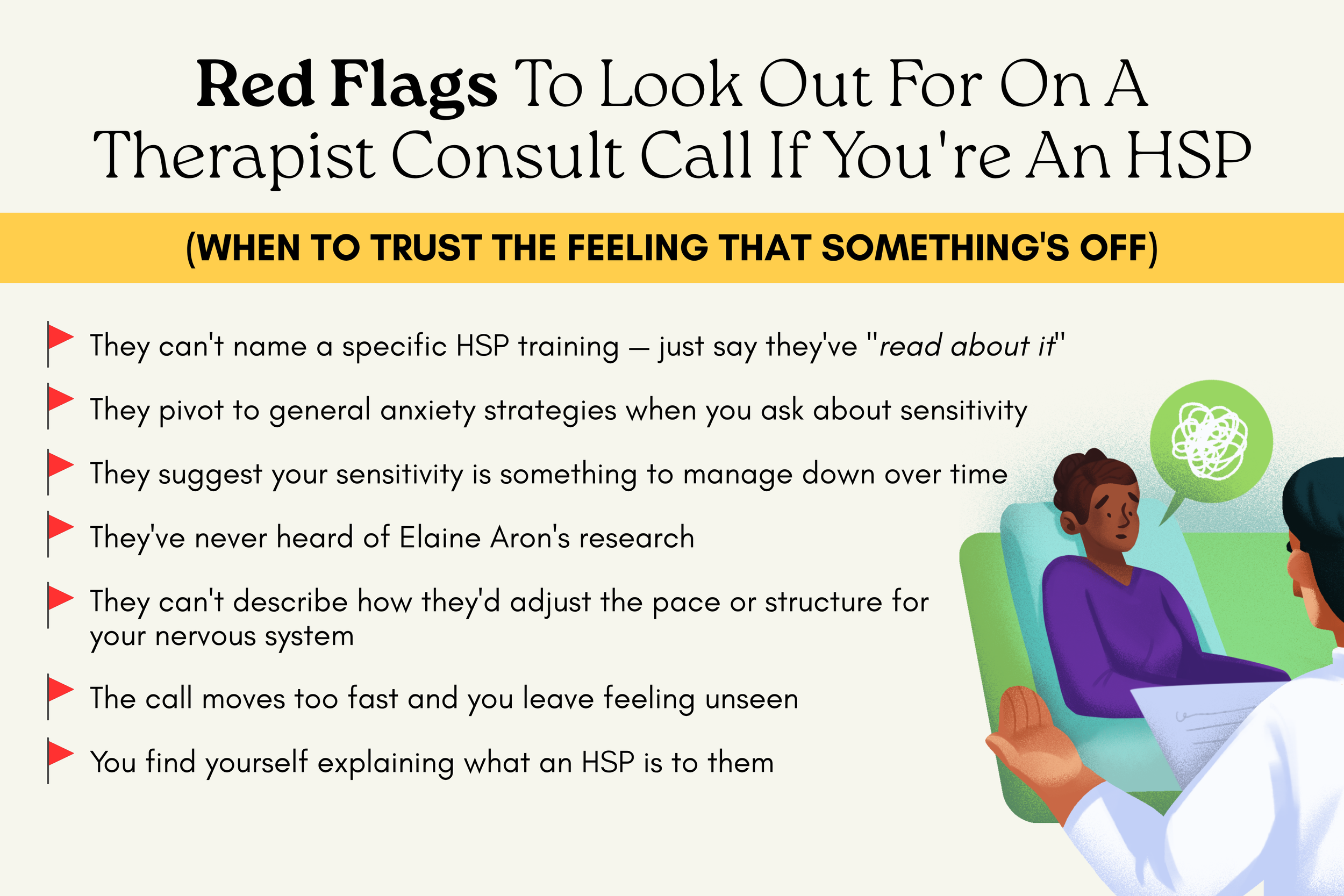
What HSP-specific training have you completed, and over what time period? A real answer names a program, a year, a depth of involvement. Example of what to listen for: “I completed Elaine Aron’s HSP Knowledgeable Professional training in 2019 and have worked primarily with HSP clients since.” A checkbox answer is vague — I’ve heard about it. I work with sensitive people.
How do you adjust your work for an HSP nervous system specifically? A real answer names pacing, sensory environment, understanding capacity. It recognizes that this trait is not a problem to be fixed but a characteristic to be worked with. A checkbox answer redirects to general anxiety strategies.
How do you think about the difference between a trait sensitivity and a clinical issue? A real answer is specific and has a clear clinical position. It acknowledges that a trait isn’t going to change much, so instead of trying to “fix” it, you will work with it. A checkbox answer conflates the two or doesn’t have one.
(Optional) What’s your own relationship to high sensitivity? A therapist whose lived experience or strong training informs the work usually has an answer. A therapist who checked the box usually deflects or isn’t sure what to say.
A note: a therapist who doesn’t have HSP-specific training isn’t a bad therapist. They may be excellent at their actual specialty. The heuristic is about fit for you, not quality of the work.
Second, an alternative path if you’d rather stop running the gauntlet alone.
You’ve been doing a lot of work this week. Researching and reflecting. Making some calls. Evaluating responses. Trying to read fit through your own nervous-system inhibition in unfamiliar settings. That’s a real workload, and it’s the workload the search asks of you by default.
We’ve built an intake conversation that skips it. The practitioner you talk to already speaks HSP from minute one — no preamble, no “let me explain what an HSP is,” no testing whether the therapist gets it. And there’s a short self-awareness activity you can do at your own pace before the call — the Overwhelm & Underarousal Tracker — so you walk into the conversation with structured observation of your own pattern, rather than having to articulate it from scratch in 15 minutes.
This doesn’t ask you to give up the rest of your search. If the four questions above help, use them. If you’d rather skip the lone-evaluator work entirely, we’re here.
But what if I’m not actually an HSP — what if I’m just anxious?
This is the kind of careful question a high-sensitivity nervous system asks before committing to anything. Am I sure this label applies to me? It’s not resistance — it’s the same trait running in the background.
You don’t have to be certain you’re an HSP to do this work. Aron’s HSP self-test is a low-stakes way to explore on your own time. And our intake conversation is built to hold the uncertainty: if you bring I’m not sure if I’m an HSP into the call, the practitioner can explore it with you rather than assuming it.
Even if you turn out not to be a textbook HSP, the questions you’re now asking — am I being met clinically, is this paced for me, does this therapist understand what I’m describing — are good questions for anyone. You don’t have to be certain about the label to ask better questions in the search.
Before you close the tabs
The time you’ve spent in this search hasn’t been wasted. It’s been gathering information that, with the right frame, becomes usable. You came in wondering whether the difficulty in finding a match was you. You leave with a different explanation: the search has been sorting on the wrong axis, and now you have a sharper one. The next consult call can do more work than the last one did.
If you’d like our help
If you’re mid-search and the calls so far haven’t quite landed — we’d love to help you keep going.
The Fit Check is a short activity you can do at your own pace, followed by a free 20-minute conversation with one of us. The Overwhelm & Underarousal Tracker is the one built for this exact pattern — three quick check-ins a day for a week, no history-taking, no long forms. You walk into the call with your own observed pattern in front of you; the practitioner picks it up from there or, if you’d rather reach out the standard way, click here.
We’re here when you’re ready.