
The myth that your first session tells you whether a therapist is the right fit
Ivy Griffin
You closed the door behind you, feeling heavy, exhausted. You told your story again to another sympathetic therapist, but became more anxious the longer you talked. Now you feel unsure and worse than when you went in. You feel stuck, a little hopeless, and dread going back to the drawing board, again.
Here's the myth underneath that moment: you're treating the first session as the yardstick for whether this therapist is the right fit, but it's not a reliable measure. That first session was mostly information-gathering, it can't begin to capture what therapy will actually feel like.
Stay with me a minute. Because once you see what that session was actually doing, the last few weeks start to make a lot more sense.
Why this myth is so easy to believe
Using session one as your fit test isn't your mistake. It's what everything trains you to do.
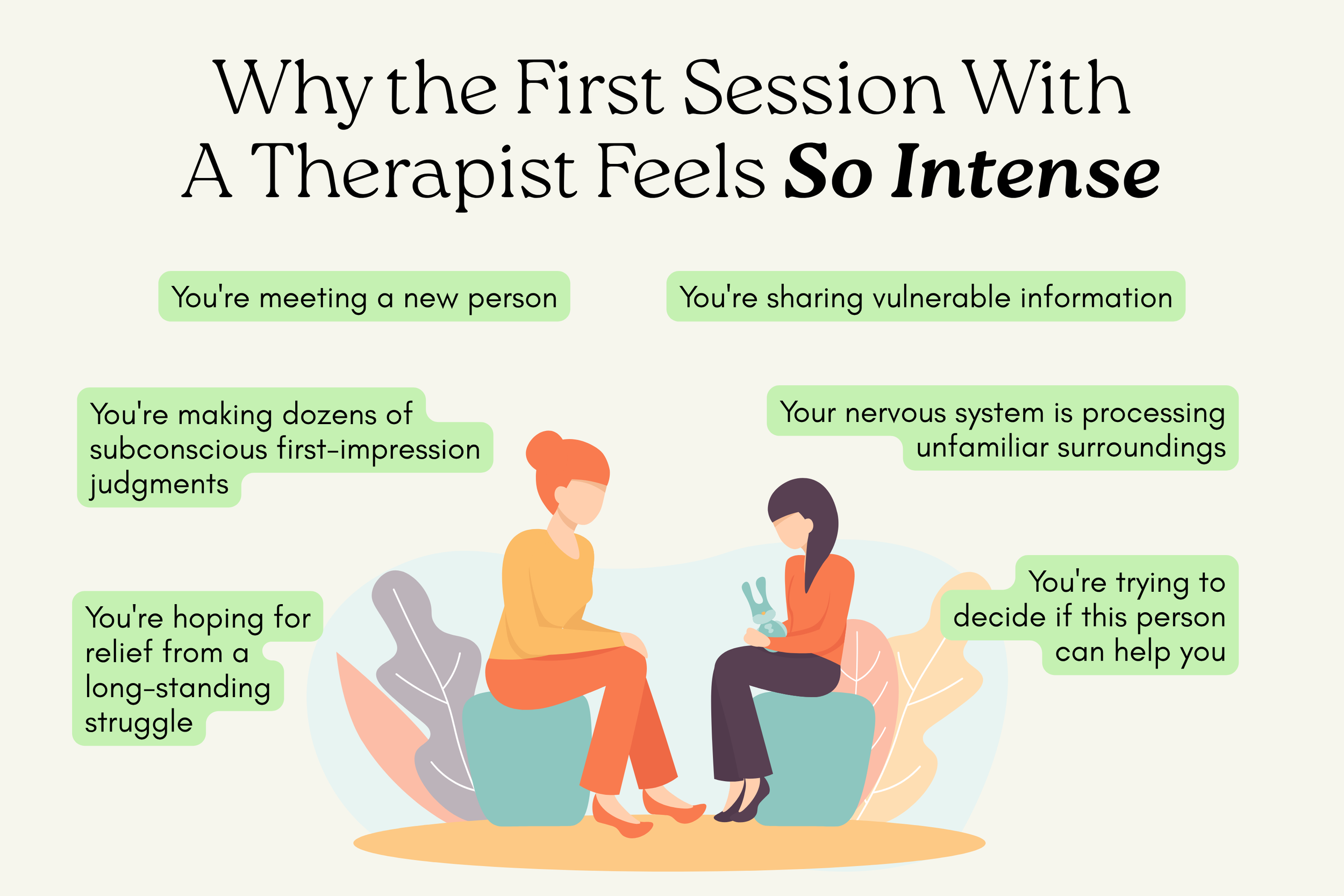
For one, we judge every new relationship by first impressions, a first date, a first day, so judging a therapist the same way feels natural. For another, the search is exhausting, and a worn-down nervous system wants the decision over with; "I'll know in the first session" is a way to end the search faster.
Then there's the part no one explains: what the first session is for. It looks like therapy, same room, same chair, same 50 minutes, so you assume it is therapy and grade it accordingly, when structurally it's intake.
And there's a piece specific to you as an HSP: a demanding first session leaves a physical residue, a racing heart, a body that won't settle, trouble sleeping that night, and a highly sensitive nervous system takes longer to come down from it. Your body's "that was a lot" gets read by your mind as "that wasn't right."
Plus, it's understandable to not want to invest in a relationship that feels like it didn't get off on the right foot. The catch is that the first session is really limited.
A hard first session isn't a fit signal. It's the cost of front-loaded information-gathering.
Why believing this has been holding HSPs back
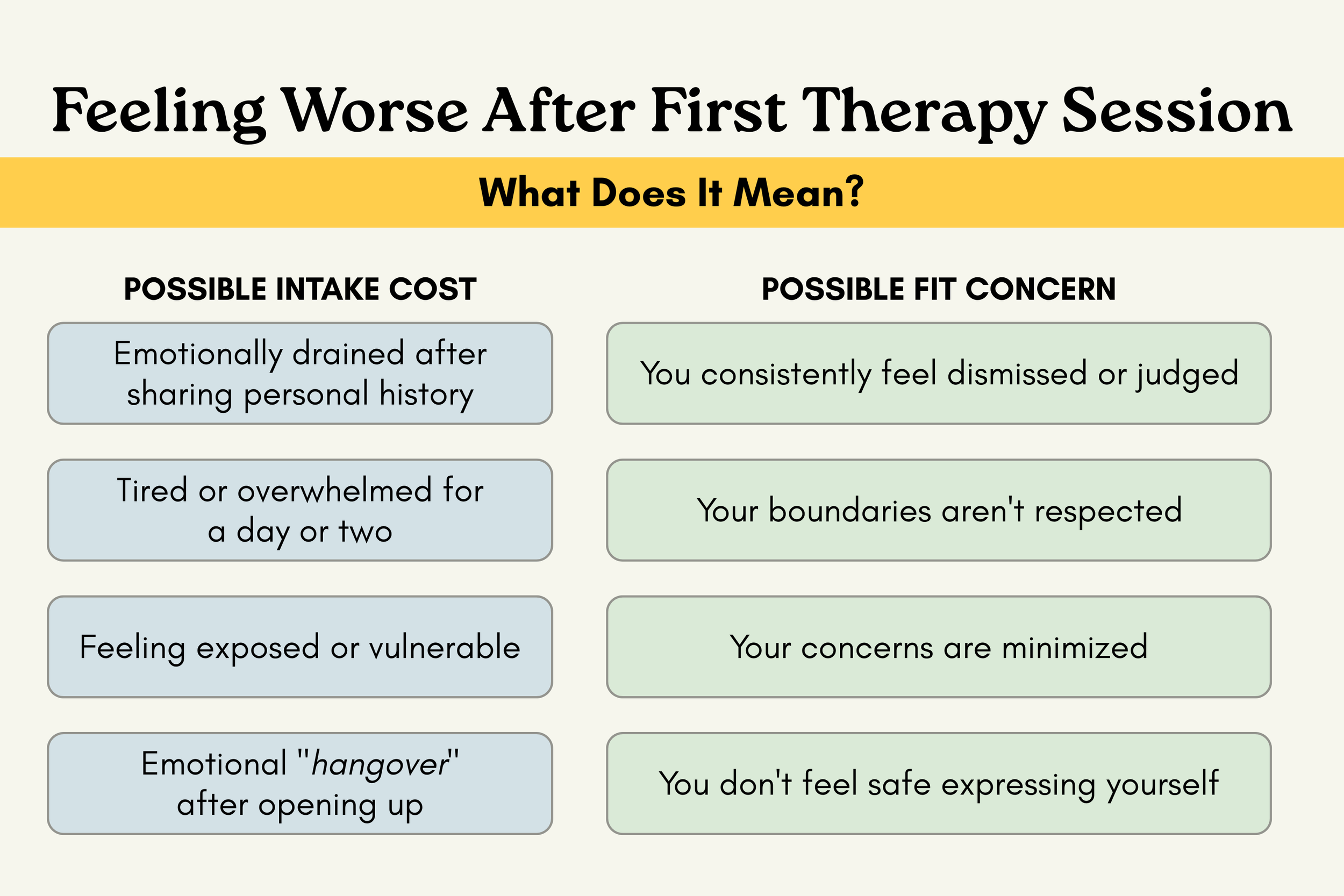
1. First, you walk out of a first session feeling worse and read that as misfit. Telling your story drained you; the exposed, depleted feeling afterward is the predictable cost of handing your history to someone you just met, not evidence the therapist is wrong.
Without that frame, "I feel worse" becomes "this isn't the one," and you cross off a name that might have been a good match.
However, it's actually very normal to feel worse after therapy sessions, especially in the beginning, as you open up the lid of your pain. Feeling worse might be a sign that you did exactly what you needed to in that first session.
Sometimes clients think quitting therapy is the rational option after feeling worse. The impulse to stop the pain makes perfect sense, but please try talking to your therapist first.
Sharing what happened for you during and after your session gives your therapist valuable insight:
can help them adjust the pacing and the container of therapy,
and is a great invitation to go deeper and get to that real, meaningful work you want to do.
2. Second, you abandon a potentially good match after one session and restart the search you're already exhausted by. Each restart means another directory scroll, another set of calls, another first session, the exact loop wearing you down.
So the myth doesn't cost you one therapist; it costs you the next one, and the one after that.
Deep down, you also blame yourself for being broken, and you question whether anyone or anything can really help you. If you have a history of self-blame, it's easy for this to spiral into old stories about unworthiness. Such beliefs tend to make people feel more alone, isolated, and decrease their belief that they can find help.
3. Third, you're now bracing against the next first session, so you stall.
Having felt the cost once (or three times), you dread paying it again, the retelling, the wipe-out afterward. The search slows or stops, not because you stopped wanting help, but because starting now costs more than you have to spend.
You tell yourself you'll do it later. And later becomes 1 month, 6 months, 2 years. I've heard many people say, "I wish I would have started therapy sooner" when they realize they suffered alone in their pain for too long.
What's actually true
Here's what that first session was actually doing, and why it could never have answered the question you were asking it.
I think of a session with a new client like picking up a book in the middle. It's necessary to identify the characters, their history, the plot, and the current conflict before we can understand where the story will go.
But that history-gathering takes time, and when you're on the client-side, it's easy to feel like "nothing's happening" or "this isn't going anywhere" when, in fact, the foundation is being laid to build a solid structure going forward.
That's what the hour is for. It's information-gathering.
The clinician needs your history to plan care, so the hour goes to learning about who you are, the story, the background, sometimes the hardest parts, while the therapeutic relationship is beginning to be built. That is a different activity from therapy.
An ongoing session, months in, feels nothing like it: the context is already shared, the shorthand exists, you're not recapping your week, you're working. So the first session is, almost by definition, the least representative hour of the entire relationship. Judging fit on it is like judging a book by the table of contents.
And it's doubly misleading for a highly sensitive person. Recounting your history, including some painful memories, before you've really settled into the therapeutic relationship, spikes your already-reactive nervous system, and the post-session crash is bigger and lasts longer because of your differential susceptibility (highs are higher, lows are lower).
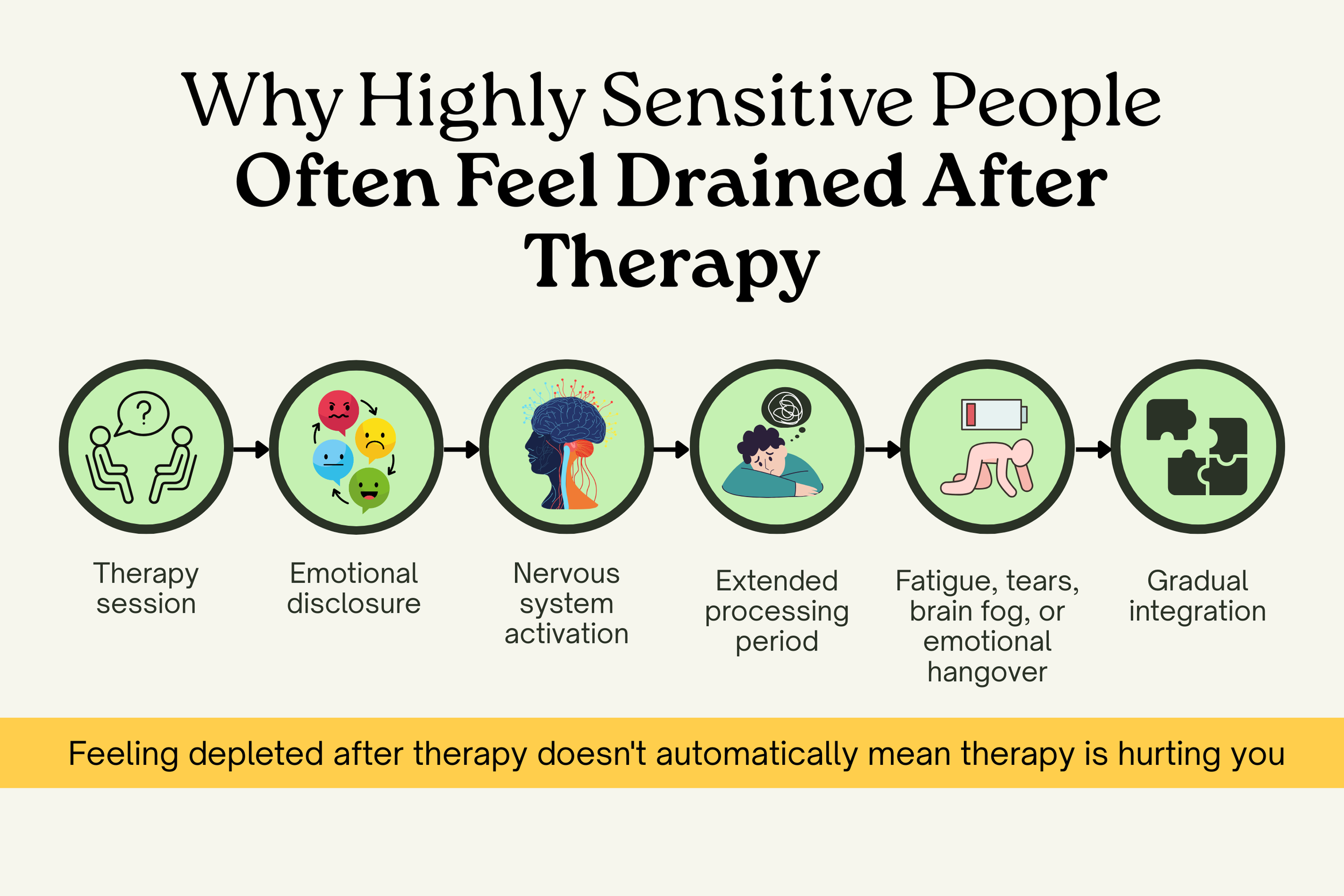
Then your mind misattributes the crash: "I felt awful, so it must be a bad fit."
However, research shows that who you're telling and whether you feel safe shapes whether telling helps or costs you (Pennebaker, 1997). For an HSP, an unsafe-feeling cold interview is close to a worst-case first impression.
An HSP-trained therapist is going to do their best to create a sense of warmth and safety as you begin opening up, but it may be hard to take it all in when you're in the midst of your story during that first session.
So when does fit actually become readable?
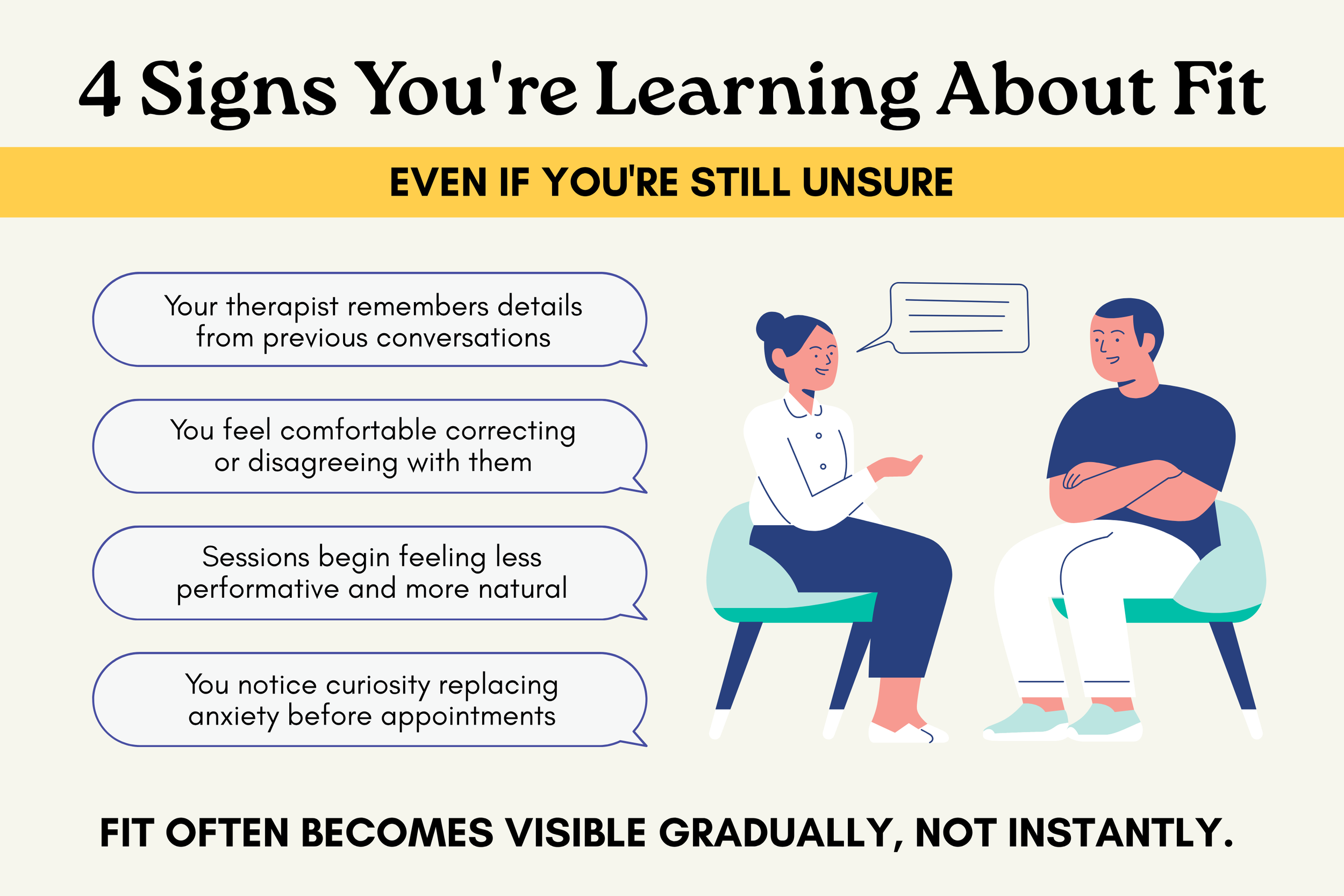
Fit becomes more recognizable as the alliance forms, typically over the first 3–4 sessions, not in the first. That first session tends to be a bit overwhelming and disorienting for an HSP.
There's the new setting, the new person, all the sensory input, and your brain working overtime. By the 4th session, you're familiar with the office, you've got a good sense of the therapist's approach, and your nervous system is more relaxed and can better determine how the pace and focus of the work feels to you.
Another option to get a sneak peek into the therapeutic alliance is our Fit Check session.
The Fit Check inverts the order, a short observation activity plus a free 20-minute conversation samples the thing you actually care about (how it feels to be met, paced, and understood) without the heavy first session and without recounting your trauma. It's a sample taste of the relationship, gathered gently, before you commit to a full intake session.
In our setting, we have the freedom to match the client's pace, even in the first session. (Insurance or certain healthcare settings have mandated requirements for what has to be covered in the intake session.)
We aim to connect with the client and adjust the session based on the client's needs. Some people are ready to tell their story and jump right in, and we make space for that. Others are hesitant or anxious and prefer to be guided by the therapist's questions.
Still others are in-between (Nakash et al., 2009). Whatever your preference, we do our best to be a guide through those first few sessions as we get to know each other and build a strong foundation for our working relationship. (More on how our intake is built differently.)
What you can do differently now
So what do you do with this, starting with your very next booking? A few things that help:
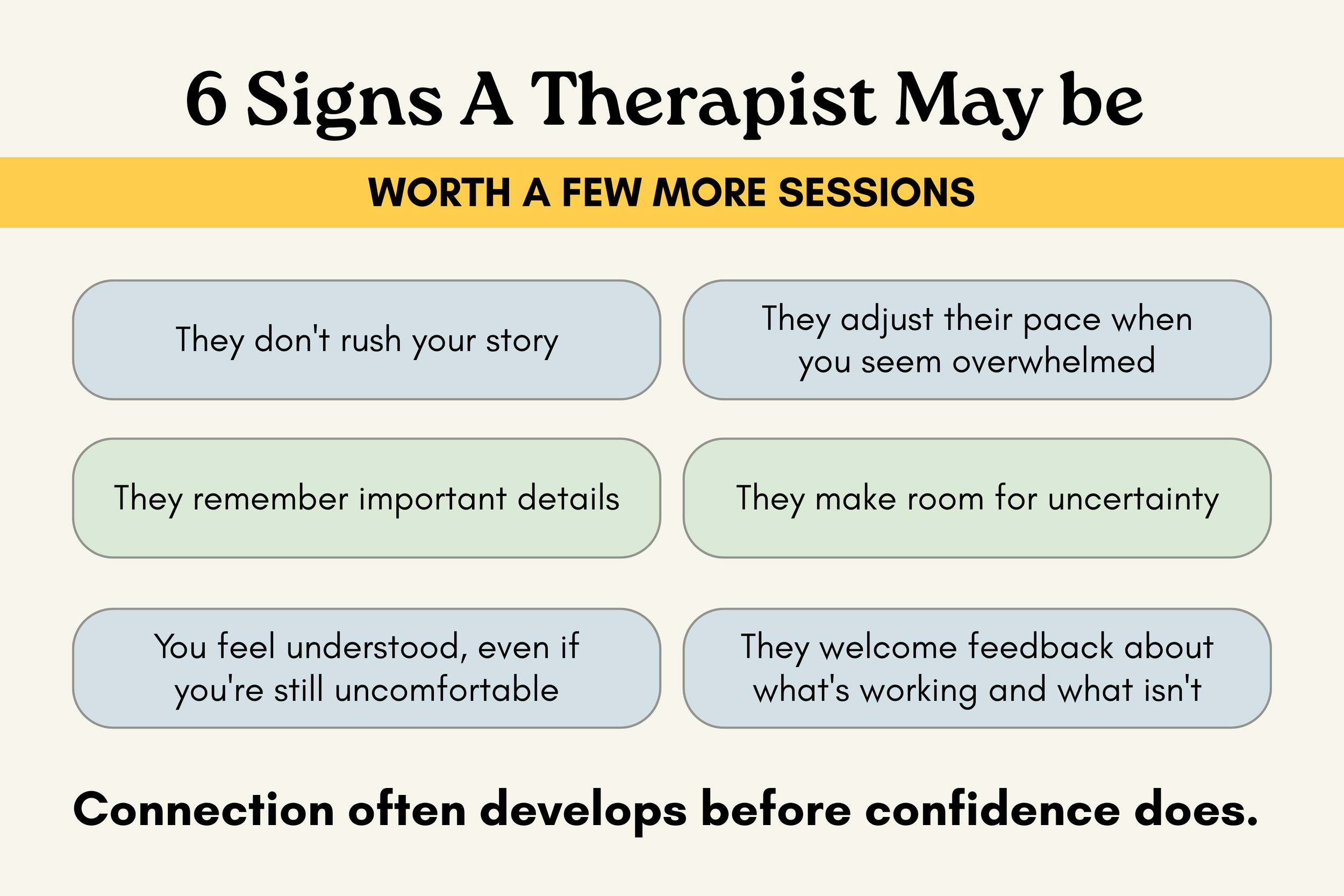
Don't grade fit on session one. Treat it as a first interview, not the relationship. Try to give a not-yet-clicking-but-not-wrong therapist 3–4 sessions before deciding. Of course, don't ignore red flags if your instincts tell you this is not your person, but if you feel worse afterward or are unsure, give it a few more sessions to really know. (How to tell a real red flag from ordinary intake-cost is its own topic, that's [Post 8].)
Go in knowing that the first session is only the beginning. It's a get-to-know-you overview, not the whole process. But a good therapist will still aim to match your pace and help you feel heard and understood.
You don't have to recount everything right then. Share what feels safe; you set the pace. If there are certain issues you're not ready to discuss, just tell your therapist you'd like to get more established before you go there. Your wishes and preferences matter. (And if they don't, that's a red flag to find someone else.) ([Post 3].)
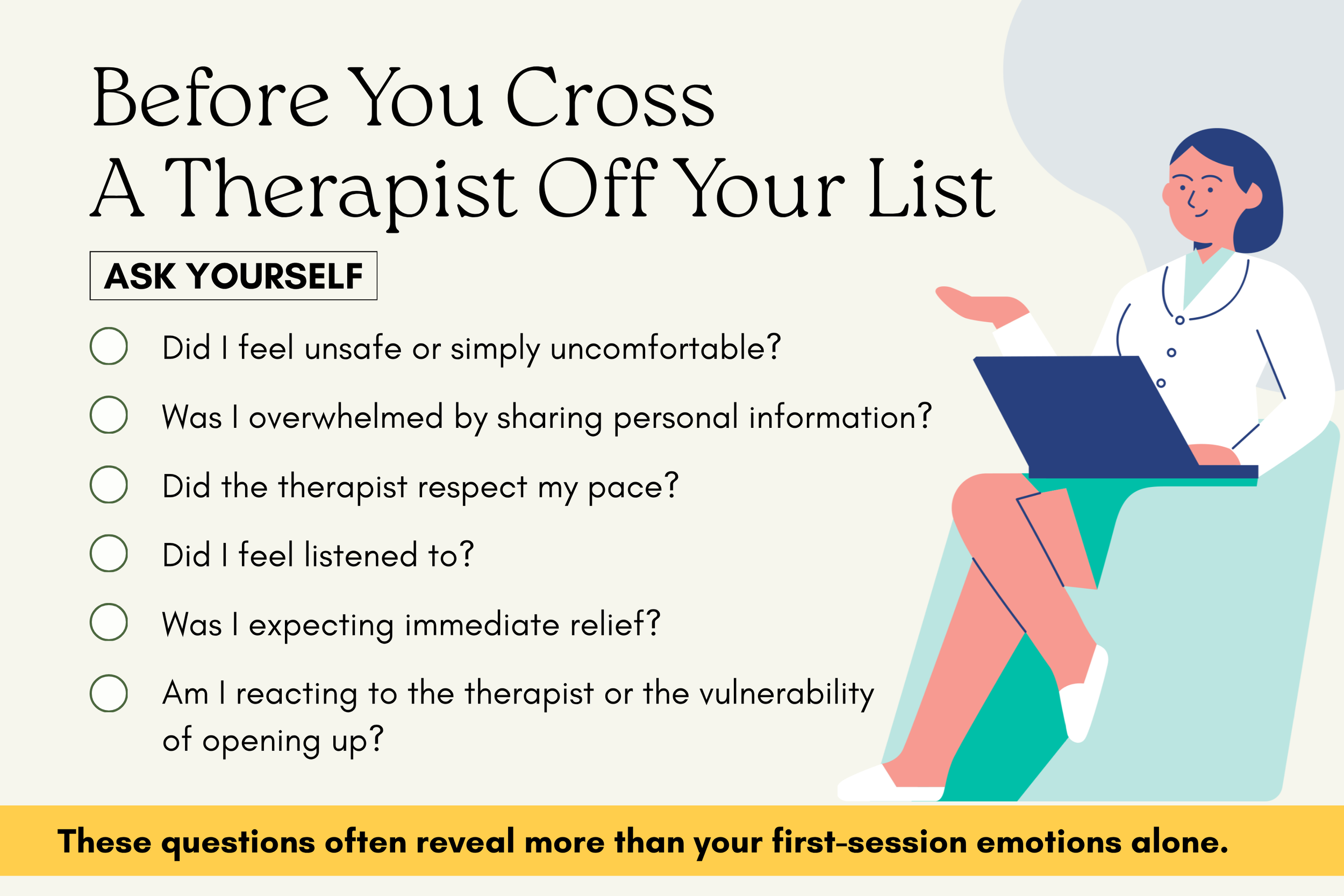
Notice the whole experience, not just the feeling. "I feel wrung out" is data about having a new experience with a new person, not necessarily about the fit with the therapist. Pay attention to whether you were heard and your pace was matched, and if so, try a couple more sessions to see what unfolds.
And if even the energy required by a first session still feels overwhelming, try our Fit Check + 20-minute conversation. It lets you focus on an issue you're struggling with and get a taste for how your therapist would proceed without having to share your full history yet.
Either way, our therapists care a lot about meeting each person where they are. We want you to feel safe and heard, especially during your first session. We'll match your preferences for pace, and you can lead the way or we'll guide you (with lots of checking-in), depending on what feels comfortable to you.
"But I really did feel something was off, are you telling me to ignore my gut?"
Validate your gut. A highly sensitive nervous system picks up on real signals; sometimes session-one discomfort means it's not a match. Please still pay attention to your instincts.
Draw the line. The point isn't "ignore what you feel" (which you've probably been told way too often as an HSP), it's "don't grade therapist fit on the one session structurally built to feel least like the relationship, and don't confuse the cost of sharing your history with a verdict on the therapist." How to tell genuine off-ness from intake-cost is its own topic, it's where [Post 8] picks up (red flags vs. productive discomfort).
Reframe what's safe. When unsure, you don't have to decide from one data point, a few sessions or a Fit Check conversation gives you broader information than a single heavy hour.
And if you're worried that 3–4 sessions of not-quite-clicking is wasting money: research has shown repeatedly that the relationship between the client and therapist is the most important aspect of healing, even more so than the method used or the issue being treated (Norcross & Lambert, 2018; Orlinsky & Rønnestad, 2005).
If you and your therapist are collaboratively identifying what you want to work on together, you feel a sense of warmth, and your preferences are being heard and understood, these first 3–4 sessions aren't a waste. They're establishing a powerful foundation for a working relationship. (If these components are not there, that can be a signal to discontinue with this therapist.)
A last word
You've slowed down your therapy search because you haven't found what you need, and you're exhausted. This is understandable, it's an adaptive response to stop when something isn't working. But instead of getting lost in your old story of self-blame, remember that the first session is focused on information-gathering, and you can use more comprehensive data to make an informed decision about therapy.
If you'd like a gentler first read on fit
If the first sessions so far have left you more unsure than settled, it's worth knowing they aren't the whole story. The Fit Check is a short activity you can do at your own pace, followed by a free 20-minute conversation with one of us, a way to feel whether we're a fit before sitting through a full first session and without retelling your history right away.
Schedule a Fit Check, or, if you'd rather reach out the usual way, contact us.
(Fit Check: thrivetherapyandcounseling.com/fit-check-session · Contact: thrivetherapyandcounseling.com/contact-us)
References
Nakash, O., Dargouth, S., Oddo, V., Gao, S., & Alegría, M. (2009). Patient initiation of information: Exploring its role during the mental health intake visit. Patient Education and Counseling, 75(2), 220–226. https://doi.org/10.1016/j.pec.2008.10.010
Norcross, J. C., & Lambert, M. J. (2018). Psychotherapy relationships that work III. Psychotherapy, 55(4), 303–315. https://doi.org/10.1037/pst0000193
Orlinsky, D. E., & Rønnestad, M. H. (2005). How psychotherapists develop: A study of therapeutic work and professional growth. American Psychological Association. https://doi.org/10.1037/11157-000
Pennebaker, J. W. (1997). Writing about emotional experiences as a therapeutic process. Psychological Science, 8(3), 162–166. https://doi.org/10.1111/j.1467-9280.1997.tb00403.x