
Why you don't have to retell your therapy history, and how Thrive matches you without it
Ivy Griffin
You don't have to tell your whole story all over again.
If you've looked up therapists recently and quietly closed the tab without reaching out — this post is for you.
Not because you don't want help.
You clearly do. You wouldn't be here otherwise.
But there's a specific thought that stops a lot of people right at the moment they're about to reach out. It usually sounds something like this:
"I'd have to start from the beginning again."
Or: "I've already told this story so many times. I don't have it in me to do it one more time."
Or, if you've been through multiple rounds of therapy that didn't quite work out: "What's the point of going through all of that if it's just going to end the same way?"
I want to talk directly to that fear, because it's one of the most common things we hear from people considering reaching out to Thrive. And it's one of the least-discussed reasons why people who genuinely want help stay stuck.
This blog is about showing you that the way Thrive is built changes what “starting over” actually means, and why the thing you're dreading may not be what you think it is.
Your reluctance makes complete sense
Let me say this clearly before anything else.
If the idea of re-telling your history to a new therapist feels like too high a cost right now, that is not avoidance or weakness.
It is a completely rational response to something that is genuinely hard.
You don’t have to figure everything out before reaching out; you can start with one simple conversation. Click here to contact our intake co-ordinator
Here’s what the research shows:
The therapeutic relationship is not just the container for the work. In many ways, it is the work.
The quality of the alliance between you and your therapist is one of the strongest and most consistent predictors of whether therapy works. Across decades of research, the therapeutic alliance accounts for a significant portion of therapy’s effectiveness, regardless of the specific approach being used (Norcross & Lambert).
Which means when you start with someone new, you’re not just “getting set up.” You’re rebuilding the very thing that makes therapy effective.
That takes time. And energy.
Your instinct that “starting over” is expensive? It’s clinically accurate.
There’s also strong research on emotional disclosure. Psychologist James Pennebaker’s work shows that context matters, who you’re telling, and whether you feel safe with them, shapes whether sharing helps or drains you. That’s why at Thrive, therapists move at your pace and meet you where you are, so you feel supported, not exposed.
And there’s a third piece: continuity of care. Research consistently shows that disruptions in care, switching providers, and gaps in treatment are linked to:
Worse outcomes
Lower engagement
Higher dropout rates
The people most likely to disengage are often the ones who’ve experienced the most interruptions.
All of this is to say: if you’ve been putting off reaching out because re-telling your history feels like too much, you’re not being irrational. You’re responding to something real.
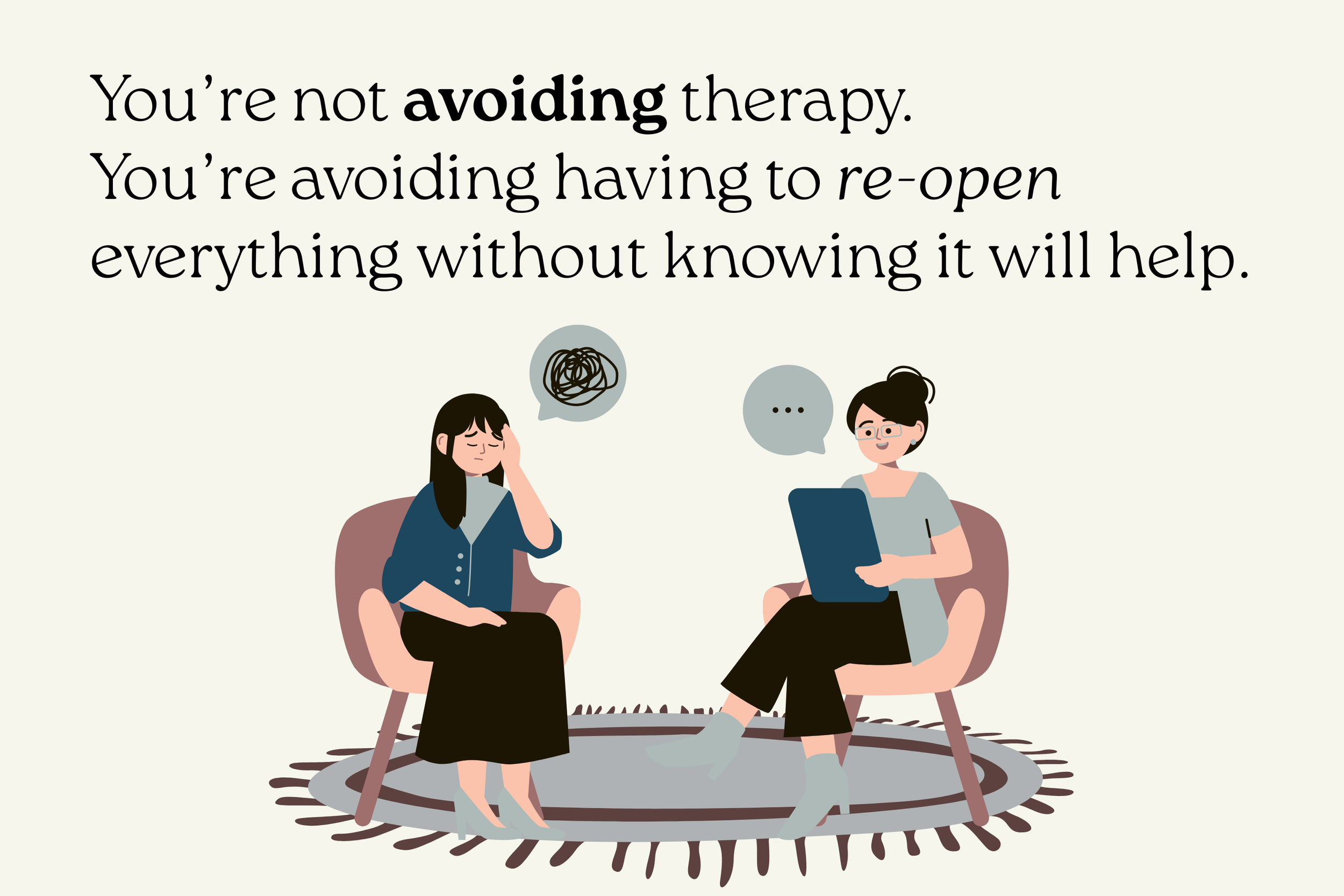
This fear hits at exactly the wrong moment
When people come in after multiple therapy attempts, I often see a kind of emotional fatigue. There can be numbness or a sense of disconnection from their own pain, which makes it harder to build that initial therapeutic bond. And on the other end, I also see people who’ve delayed therapy for so long that everything comes out at once, like the floodgates opening. They often say the same thing: “I wish I had done this sooner.”
Here’s what makes this especially hard: the timing of this fear is cruel.
It doesn't arrive when you're doing fine and have the capacity to navigate a new intake process. It arrives when you're already depleted, when whatever brought you to the point of searching has already taken something from you.
And yet the typical system asks you to do the most emotional work precisely when you have the least to give.
You research. You scroll through directories where every bio starts to sound the same. You work up the nerve to reach out. You wait. You get on a call. You explain your situation to someone you've never met. You hope it goes well.
And if it doesn't, you face the prospect of doing it all over again.
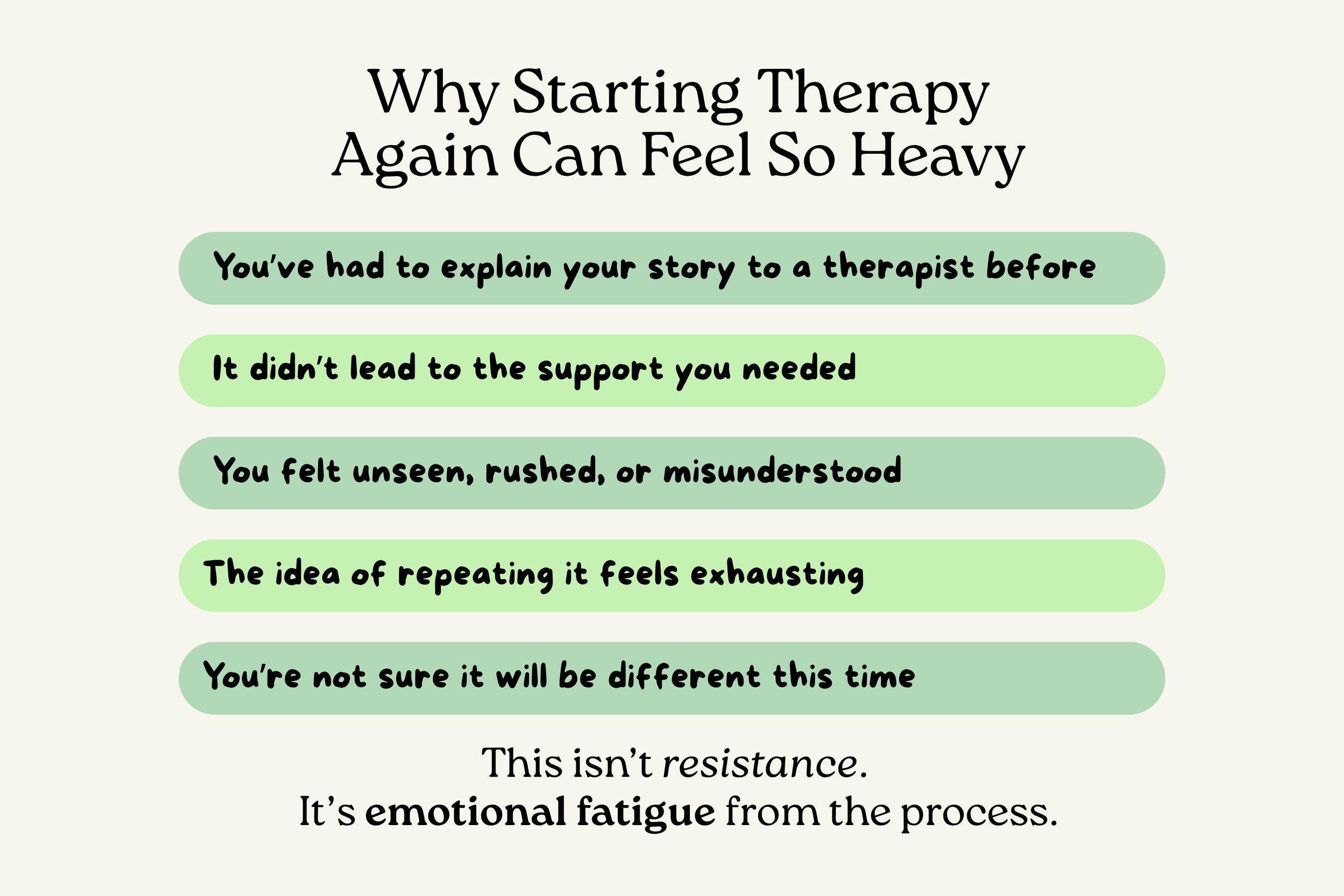
The re-telling is not just logistical. It means:
Being vulnerable before you feel safe
Re-opening things you’ve already worked hard to hold together
Explaining something complex in a compressed, first-session version
Sharing before trust exists
If you’ve done that multiple times already, it can be exhausting.
And the hardest part: the people who most need support are often the ones who’ve been through this cycle the most. The re-telling fear is highest in exactly the people who most deserve to finally find the right fit.
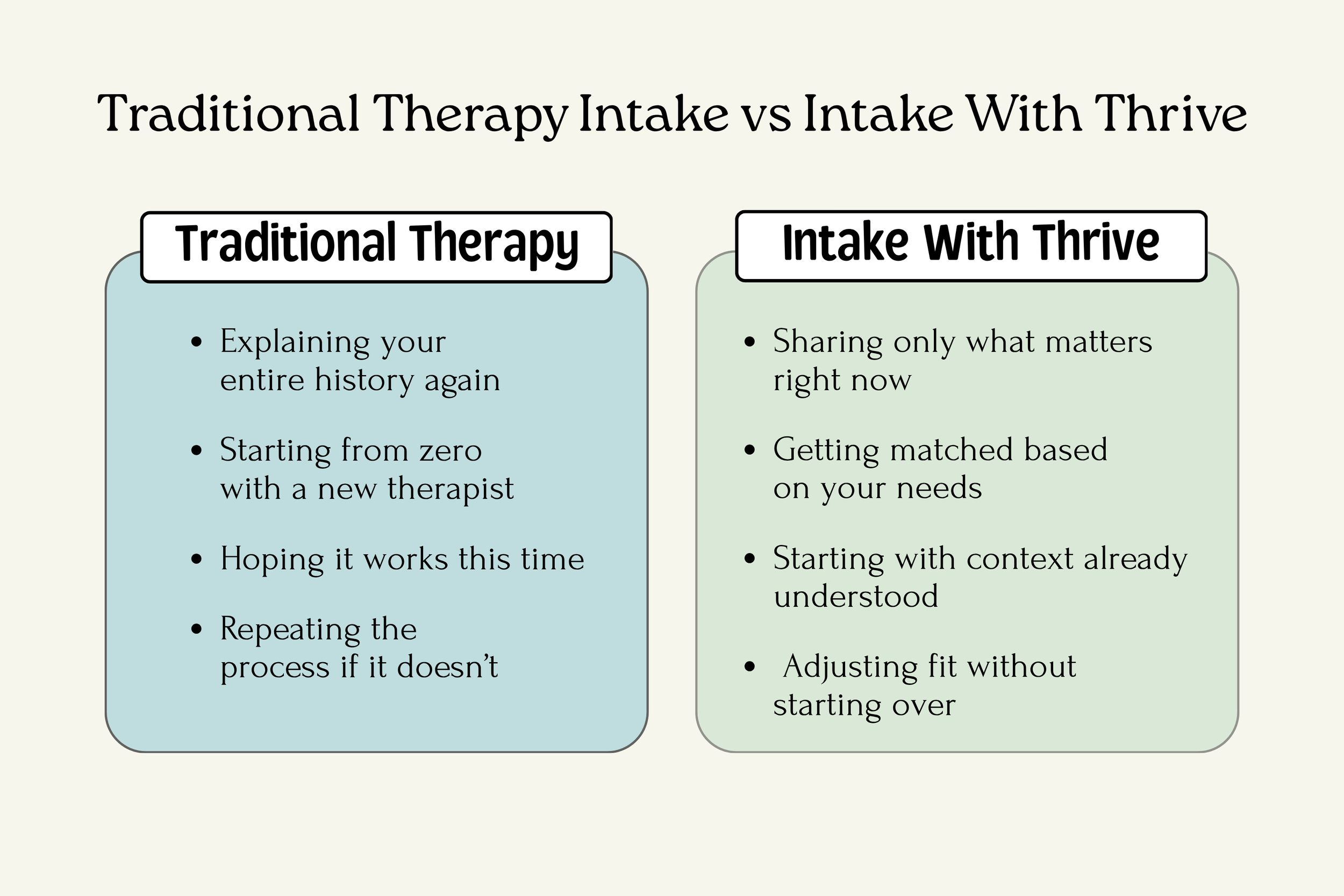
What most people imagine “starting over” means — and what it actually means at Thrive
The fear of re-telling is built on a reasonable assumption: that every new therapist means starting from zero. That you'll sit down in session one and spend the first hour doing a full recap: your history, your family, your previous therapy experiences, the thing that happened, the patterns, all of it.
In a solo practice, that assumption is largely accurate.
At Thrive, it is not how it works.
How the Thrive intake process actually works
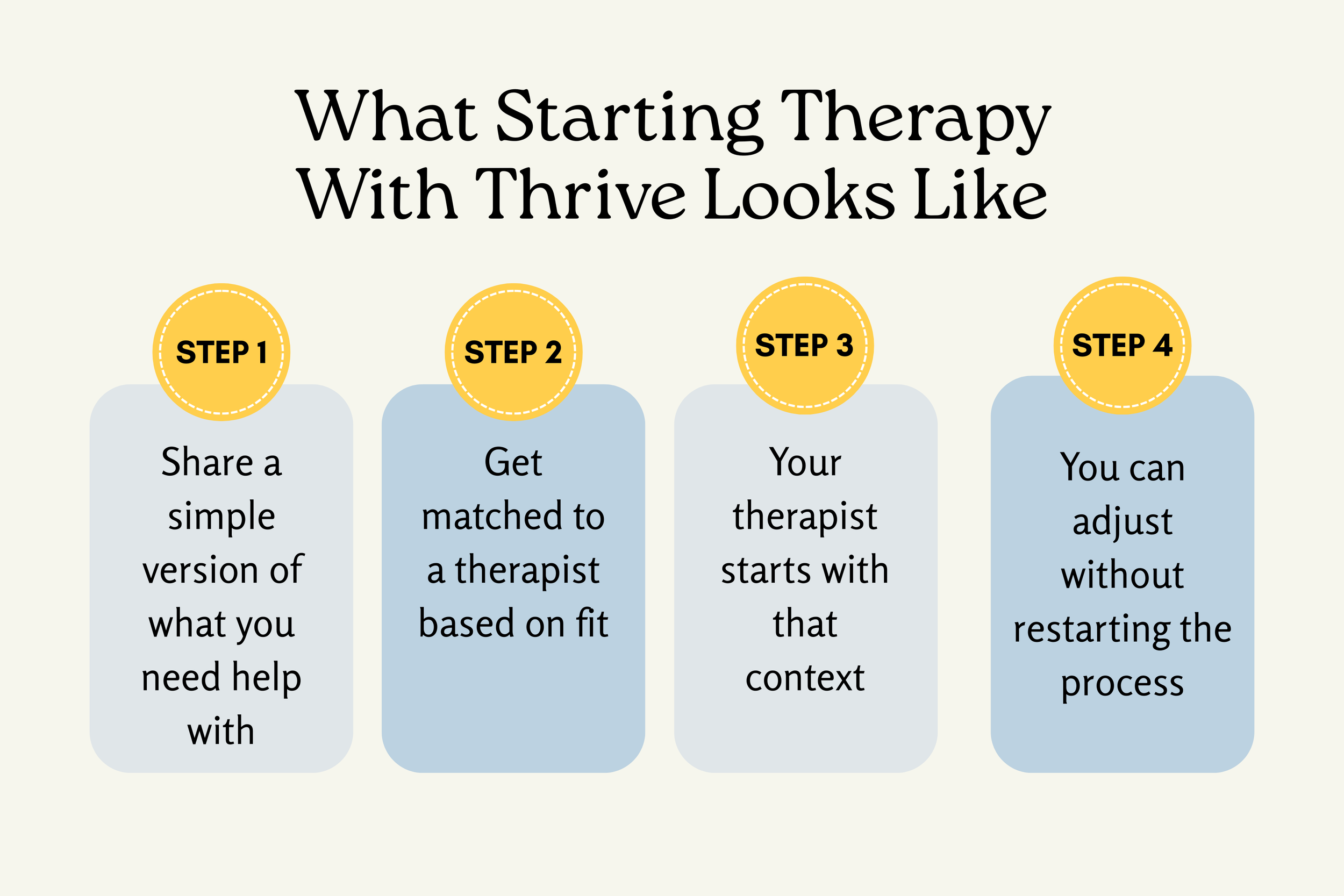
When you reach out to Thrive, the first person you speak with is our intake coordinator.
This is not a history-taking session.
You are not asked to recount your trauma.
You’re not walking us through your childhood.
You’re not asked to give a comprehensive account of everything you've been through.
What happens instead is a targeted conversation, one designed to help you share what's relevant right now without having to relive what's already been hard. Our coordinator asks specific questions that we know produce good therapy matches. Then, we walk you through each step of the process, so you know exactly what to expect.
We ask things like:
How you prefer to be contacted — call, text, or email
A brief sense of what you’d like support with (you can even select from a checklist)
Whether you already have a therapist in mind
Your availability and how often you’d like to meet
Payment preferences, so logistics don’t become a barrier later
That’s it.
The goal isn’t to gather everything. It’s to gather enough, so we can match you thoughtfully without asking you to relive what’s already been hard.
If you’re curious what that conversation would feel like, you can simply reach out to get matched, click here.
By the end of that conversation, we have enough to make a real, considered recommendation, not a best guess, not "here's whoever is available", but a match based on what you've told us and what we know about each therapist's approach, style, and clinical strengths.
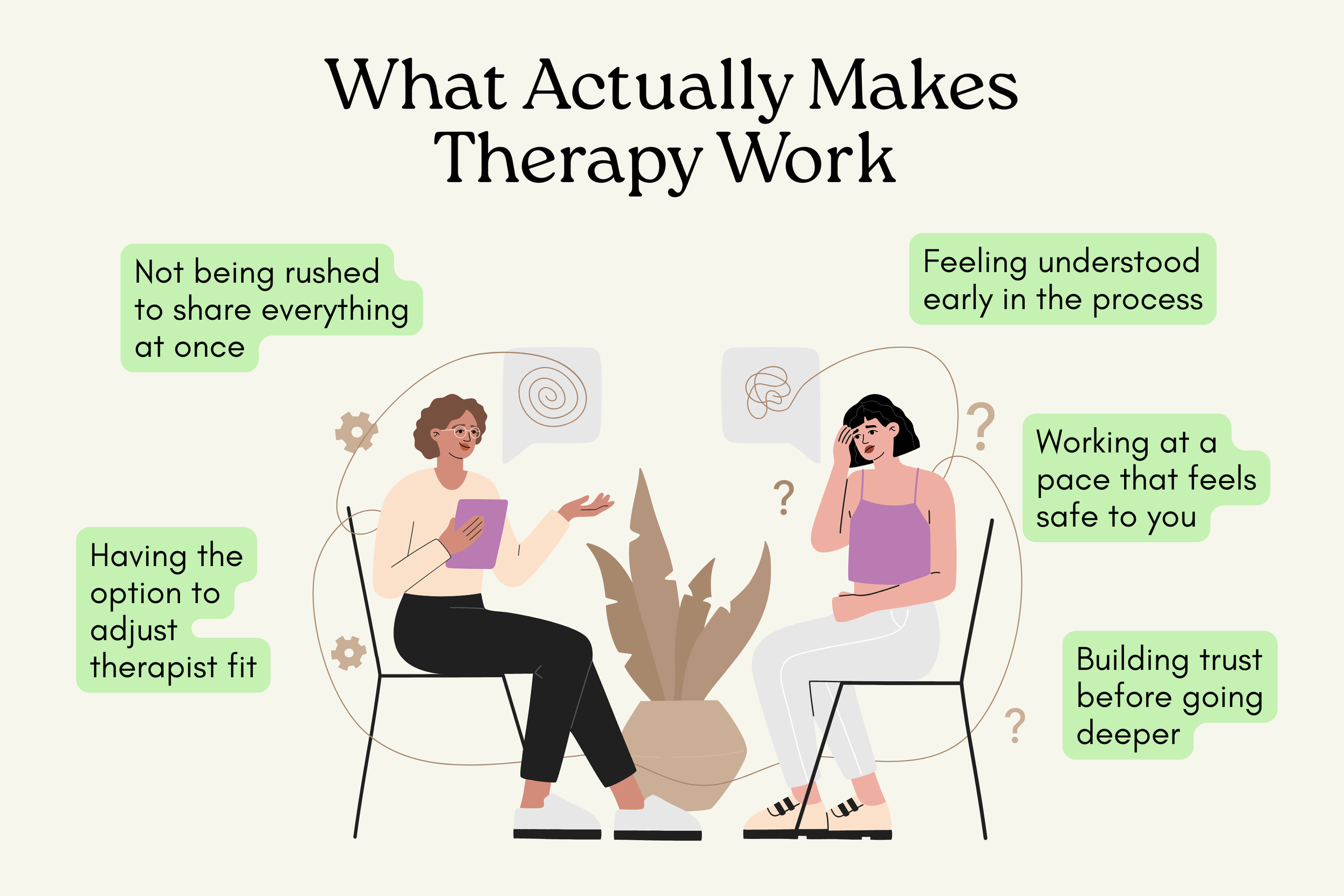
Here is something that surprises a lot of people who arrive braced for another bad fit:
At Thrive, therapist switches are rare.
Not because we discourage it, or because clients feel pressure to stay with a therapist who isn’t right for them.
But because the matching process produces relationships that actually hold. Many of our clients work with their therapist for months or years, not because they have to, but because they’ve built a strong alliance and therapy is making a meaningful difference in their lives.
That’s not accidental. It’s the result of how intentionally our practice is built.
Every therapist on our team aligns with Thrive’s standards for care and values, including a strong emphasis on collaboration and community. Our intake coordinator knows each therapist well, not just their specialties, but how they show up in the room. While we do maintain a detailed internal understanding of each therapist’s expertise, there’s also a level of instinct and judgment that helps create the right fit.
Most clients come in, meet their therapist, and stay. Not out of obligation, but because something clicks in a way it hasn’t before.
We take matching seriously. We understand how our therapists actually work, beyond what’s written in their bios. And we make sure key logistics are aligned upfront, so they don’t become barriers later.
Now — the safety net.
If the first match needs adjusting, you don’t have to start over. You can switch internally, without going back to directories or re-telling your story to someone new. With your consent, your context carries forward, so it feels like a continuation, not a reset.
That said, this safety net is rarely needed. We share it so you can reach out knowing the stakes of getting it slightly wrong are low, not because we expect you to use it.
What the first session actually looks like
A lot of the dread is attached to a specific image of what session one will be:
An hour of recapping everything. Having to perform your history for a stranger. Leaving feeling raw and not sure it was worth it. That image is worth examining, because it's not what a good first session looks like.
Your therapist comes in already having a sense of what you're dealing with and what you're hoping for, both from what you told the intake coordinator and from what you’ve shared on your new client forms. The first session builds from there. It's not a blank slate.
Your therapist will review some policies and expectations about therapy, so you can clear up any questions and start on the same page. Then, it depends on your preference.
If you’re ready to share, you can jump right in. Or, if you’re not sure where to start, your therapist will ask you questions and guide you through the session. You share what feels relevant, and you go at a pace you’re comfortable with.
And by the end of the session, something has usually happened that feels different: you leave with a real sense of whether this is a fit, not because you've been through an exhausting evaluation, but because the session itself was designed to tell you something true.
You don't have to tell your whole story. You just have to show up.
What's on the other side — a look at where you could be
I want you to be able to picture this.
Imagine it's a few weeks from now.
You made the call or filled out the form. You had a short conversation with our intake coordinator. It was not what you expected. Nobody asked you to relive anything. They asked about what's going on for you right now and recommended a therapist who they thought would be a great fit.
The conversation took less time than you thought it would. And it didn't cost you the way you thought it would.
Then you had your first session with the therapist they matched you with.
You didn't walk in and deliver a monologue. You had a conversation. The therapist asked questions that felt considered, not like they were working through a checklist. You talked about what's been hard lately. You talked a little about what you're hoping life looks like when things are better.
At the end of the session, they reflected something back to you, something you'd said in a way that made you feel, for the first time in a while, actually heard.
You left not drained in the way you'd braced for.
A little tired, maybe, the good kind of tired that comes from something real happening. And something else underneath it: relief. Like the part you'd been dreading turned out to be more manageable than the version of it you'd been carrying around in your head.
A few months from now, you're still going.
Not because you're forcing yourself. Because something is actually shifting. You're not recapping your week anymore, you're working. The relationship has built to the point where the shorthand exists. Your therapist knows your patterns well enough to notice when you're doing the thing you do. And you trust them enough to hear it.
The search is over. You found someone you can stay with.
And looking back, the thing that almost stopped you, having to tell your story one more time, turned out not to be the obstacle you'd imagined.
Consider Shannon. She’s a mom, a wife, and a busy government employee. She’d been in therapy before, knew she needed help to deal with her depression, but kept procrastinating because she couldn’t muster the time, energy, or motivation to get started. She finally sent a couple of emails to therapists one morning. Our intake coordinator got back to her before lunchtime and helped her get her first appointment scheduled by the end of the week.
She cried a lot of tears at the beginning, but by the end of her first session, she said, “I feel so much better. I’ve been carrying all this for so long, and now I don’t feel alone anymore.” Over a year later, she’s still in therapy, the depression is in remission, and she’s working on setting more boundaries to prioritize her well-being.
(All stories are composites of real-life experiences. We always protect client confidentiality.)
The question worth asking yourself
You will probably not feel fully ready to reach out. That feeling doesn't tend to arrive on its own, ahead of the action. It usually comes after. So the question is not "do I have the energy to start over?"
The question is simpler: Do I have enough energy to have one conversation, knowing I won't have to carry the rest of it alone?
That is what reaching out to Thrive actually asks of you. One conversation or email exchange. With someone whose job is specifically to make the next step as easy as possible.
The rest, the match, the first session, the work itself, we help you through. That is the whole point of building a practice this way.
If you’ve been waiting for the right moment, this can be it. One conversation is all it takes to get matched with a therapist who understands where you are. Ready to get matched? Click here.
Ready to take that one step?
If you've been sitting on the edge of reaching out, this is the nudge.
Contact our intake coordinator. Tell them you're looking for a therapist. You don't need to have your story organized. You don't need to know exactly what to say. You don't need to arrive with clarity about everything that's brought you here.
You just need to show up for one conversation.
We take it from there.
References
Norcross, J. C., & Lambert, M. J. (Eds.). Psychotherapy Relationships That Work: Evidence-Based Therapist Contributions. Oxford University Press. [🚩 Verify edition and year before publishing.]
Pennebaker, J. W., & Chung, C. K. (2011). Expressive writing: Connections to physical and mental health. In H. S. Friedman (Ed.), The Oxford Handbook of Health Psychology. Oxford University Press. [🚩 Verify page range before publishing.]
Wampold, B. E. The Great Psychotherapy Debate: The Evidence for What Makes Psychotherapy Work. Routledge. [🚩 Verify edition and year before publishing.]
Scott Miller and his research on the therapeutic alliance and his development of the Session Rating Scale and Outcome Rating Scale also speak repeatedly to this point. This article gives an overview:
https://www.scottdmiller.com/assets/uploads/documents/SessionRatingScale-JBTv3n1.pdf