
When a first session feels off: how to tell a red flag from the normal discomfort of starting therapy.
Ivy Griffin
As an HSP driving home from your first therapy session with a new therapist, you're tired, spent, and overwhelmed as you come down from the adrenaline rush of meeting someone new.
You feel heavy and a little depressed. Even though you really want to benefit from therapy, you always feel kinda amped up and on edge when talking about yourself with a stranger, or with most anyone, for that matter.
You question, "Did I do that right?" and "How do I know if this will help me?"
You talked a lot, but not much happened. You felt a spark of hope that things could be different, but how to get there is still really unclear. The therapist seemed nice, but it's hard to know anything more.
The sinking feeling in your gut has you wondering how to proceed.
If you recognize any of that, take a breath first: a so-so first session is incredibly common, and it doesn't mean you chose wrong, or that you're being too picky.
But it does leave you with a real question, the one you're turning over on the drive home. Was that off-ness a warning sign, or the ordinary cost of starting? And underneath it, a second question: if you go back, is that because the fit is right, or because leaving would feel rude?
The real mistake, and it leans one way for you
The mistake is probably not the one you think. The question you should ask yourself is not if you should stay with this therapist or start looking for a new one.
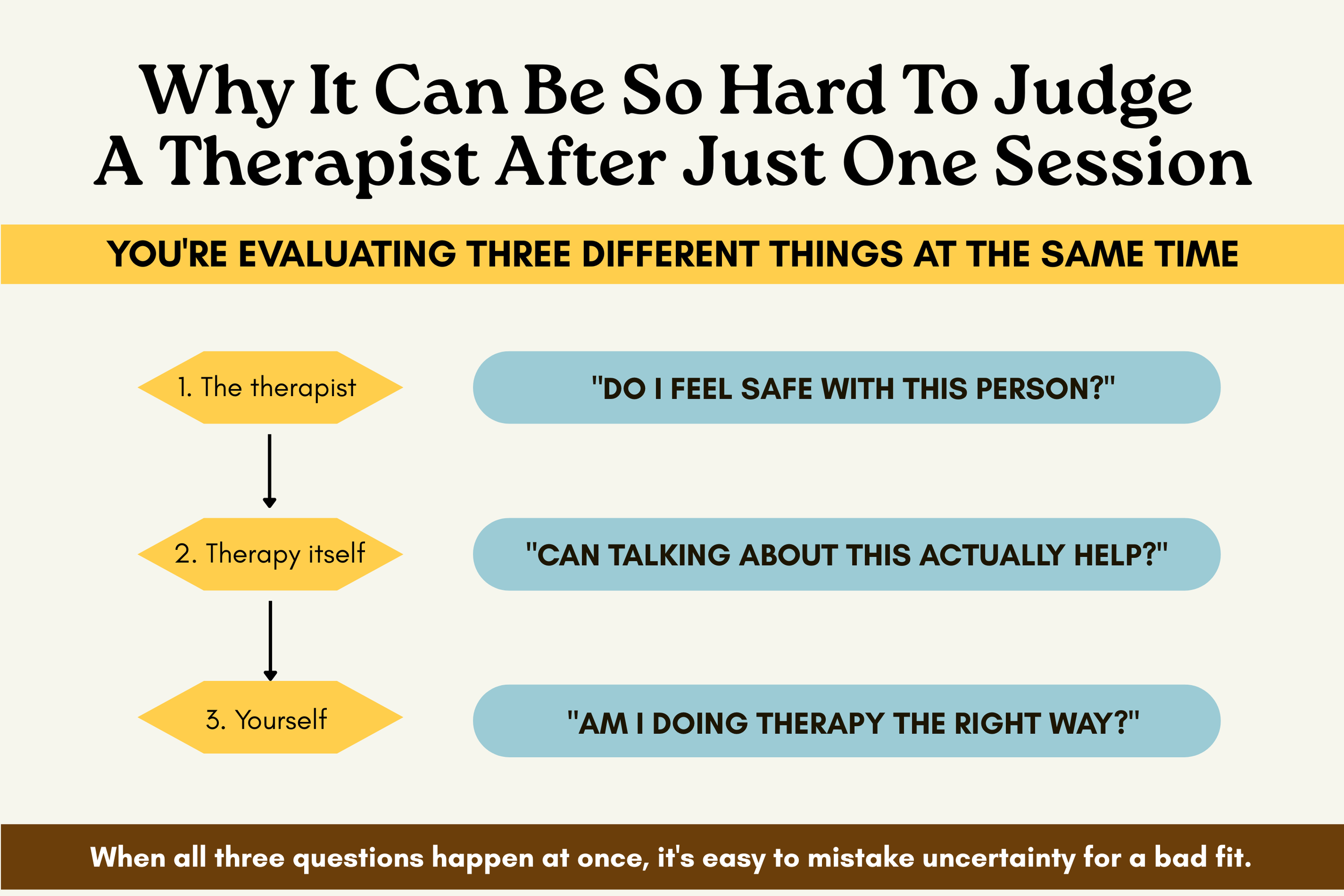
It's not knowing which signal you're reading, so you treat one uncomfortable session as a verdict before you know what it's telling you.
And as a people-pleasing HSP, you tend to stay too long to be polite.
You don't want to hurt the therapist's feelings, you worry that you're "not doing therapy right," and you tend to view the therapist as the "expert," deferring to their recommendations and suggestions without questioning them, without pointing out how that hasn't worked for you before, or asking more about why.
The biggest reason is that you don't want to hurt or disappoint the therapist, and you can tell that they're very nice and that they care about you. You're not used to identifying and prioritizing your own needs, so you default to putting others' first, which can keep you from getting what you really need.
The loyalty trap
So why do you stay, even when something feels off?
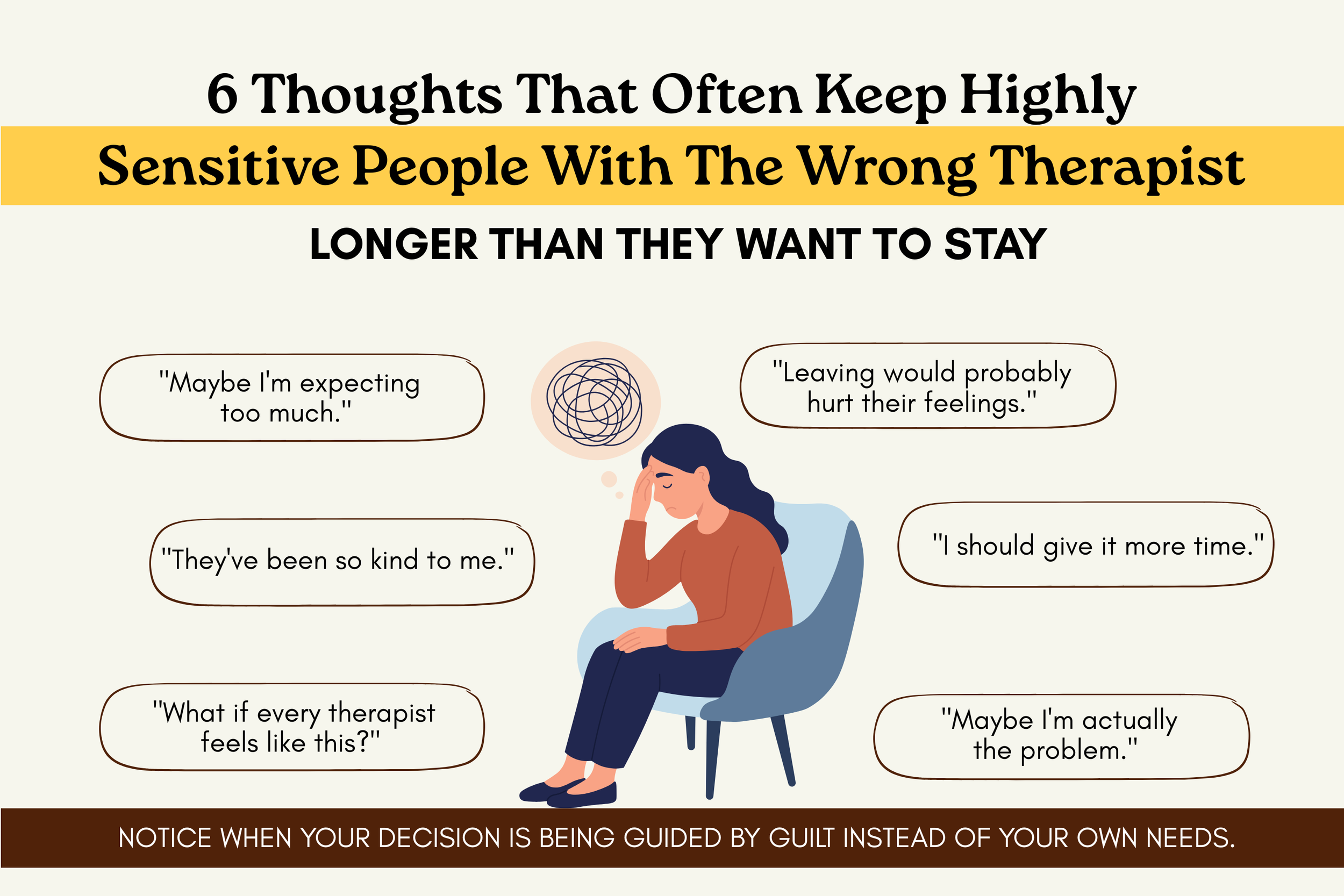
You don't want to hurt the therapist's feelings. You doubt whether you're "doing it right." You don't want to seem ungrateful or be rude. You want to please the therapist and be the "A+" therapy client.
And there's the pull of not starting over. What's familiar feels easier and more comfortable, even when it isn't working.
"I don't want to be rude" usually comes from a belief that setting boundaries, or gently saying "no," is rude. You haven't often experienced disagreeing with someone while you both stay respectful, so leaving can feel like rejecting the therapist. And the last thing you want to do is hurt their feelings.
So you think "I can't do that," or "that would be mean," and you feel anxious (jittery, butterflies in your stomach, tense) or heavy (some hopelessness, feeling stuck, disappointment).
There's a deeper layer, too. As an HSP, you've heard it your whole life: you're "too sensitive," you "overreact," you need to "let things go." Hearing that for years, even from people who love you, teaches you to doubt your own feelings and needs.
So when therapy stirs up something strong, it's easiest to assume you're the problem, instead of getting curious about what's off.
But overriding yourself to keep someone else comfortable isn't loyalty. It's the old pattern, showing up in the one place built to help you change it.
Staying isn't loyalty. The discomfort you feel deserves curiosity, not a verdict against yourself.
See it: the ordinary cost of starting vs. genuine off-ness
It helps to get specific, because discomfort and wrong fit can feel identical from the inside.
When researchers pool decades of studies, the relationship between you and your therapist turns out to be one of the strongest predictors of whether therapy helps (Flückiger et al., 2018). So paying attention to that relationship isn't fussy or ungrateful. It's the most important read you have.
One thing first: a single item below isn't a verdict. You're looking for a pattern.
The ordinary cost of starting (worth staying through):
Nervous, stiff, or uncomfortable, even during the first few sessions. Sometimes it takes a while for that discomfort to fade.
Feeling raw or tearful after going deep.
Feeling more depressed or anxious, or worse, after a session. Therapy can stir up the triggers and memories tied to your pain and amplify them at first. It takes time to build the resources and the therapeutic relationship that help those symptoms ease.
Feeling tired, heavy, or drained.
Being unsure you said it "right."
Feeling gently challenged or stretched.
The awkwardness of opening up to a stranger.
Genuine off-ness (the thing loyalty would have you ignore):
Feeling judged, dismissed, or minimized.
Being talked over or interrupted more than once, or without an apology.
Being talked at.
The therapist not checking in about how the session felt, what you need, or what your goals are.
Your identity not understood: a flicker of bias, or feeling stereotyped.
Being pushed past a clear "not yet."
Leaving feeling bad about yourself.
Read both lists and still can't tell which one you're in? That's normal. It's what the next step is for.
If you're an HSP who's exhausted from searching for the right therapist, you deserve a space where you don't have to explain or defend your sensitivity. Thrive Therapy & Counseling specializes in HSP-informed care and works with you at a pace that feels safe, collaborative, and supportive.
Read it: a few questions to ask yourself after a session
Your sensitive system registers everything. That's why "this is hard, important work" and "this is wrong for me" can feel identical in your body: the racing heart, the long comedown, the days of replaying every word.
More analysis won't sort it out. A few honest questions will.
After a session, sit with these and notice what comes up:
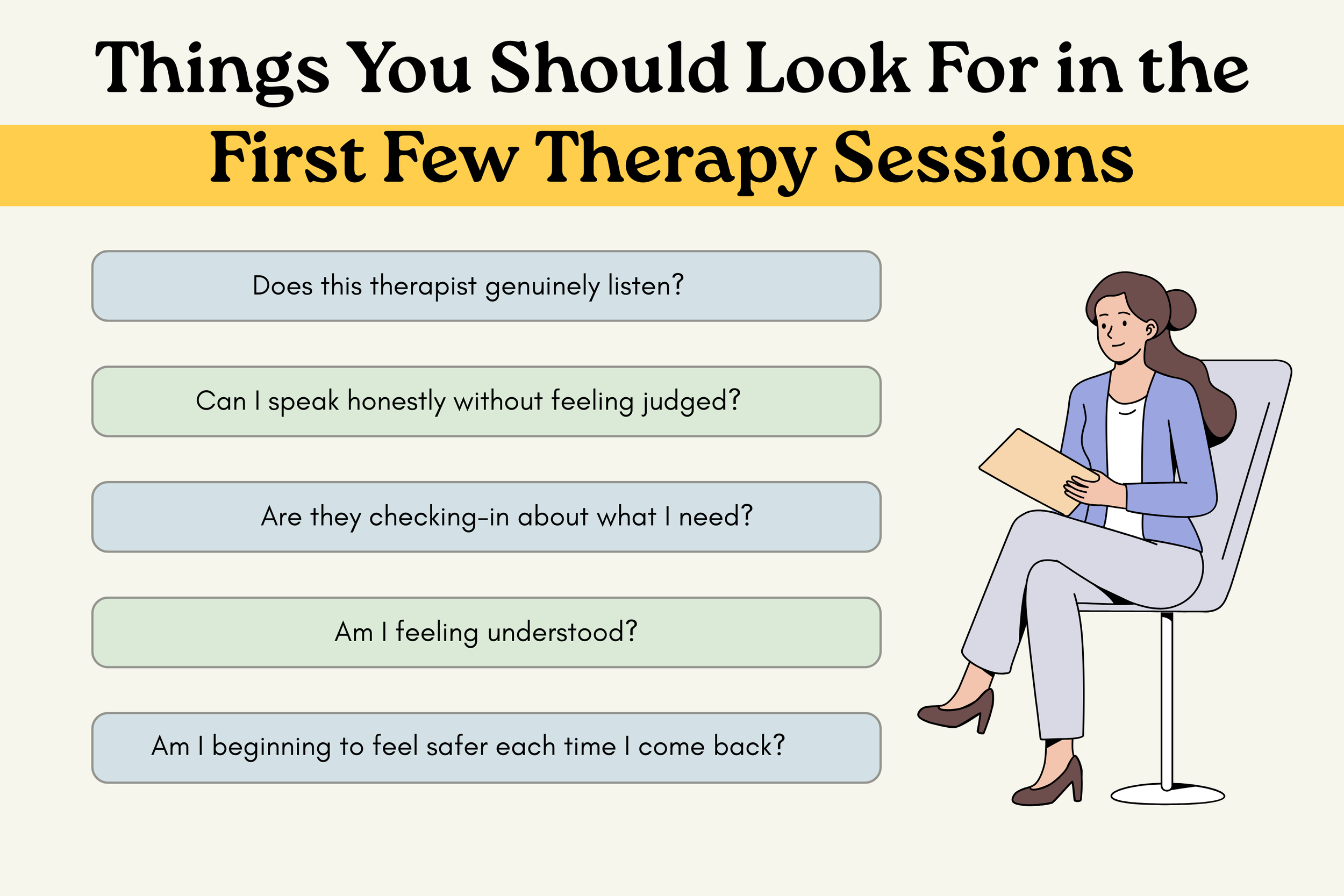
Did the therapist seem like someone I could eventually talk to as openly as I do with a good friend?
Even though I may not be ready yet, can I imagine being vulnerable with this therapist?
Did I feel heard and understood?
Did the therapist express a desire to work with me collaboratively toward my goals?
Did I feel cared about and considered?
And the one that cuts through everything: am I going back because this fits, or because leaving would feel rude?
If it's the second, that's worth paying attention to.
Test it: name it, and watch what happens
The relief: you don't have to decide all of this in session one. You have two fair tests.
You can book one more session and watch. Does the off-ness settle, or sharpen?
Or you can do the more direct thing: name it. Tell the therapist what felt off, and watch how they respond. That will tell you more than another three sessions of guessing.
So get curious about what's happening. Start by asking yourself how you're feeling, and let the feelings be there without judging them, even if they don't make sense in the moment. Then look at where they're coming from: is this more about something inside you, or about the other person? Finally, notice how the therapist is acting and engaging with you in session.
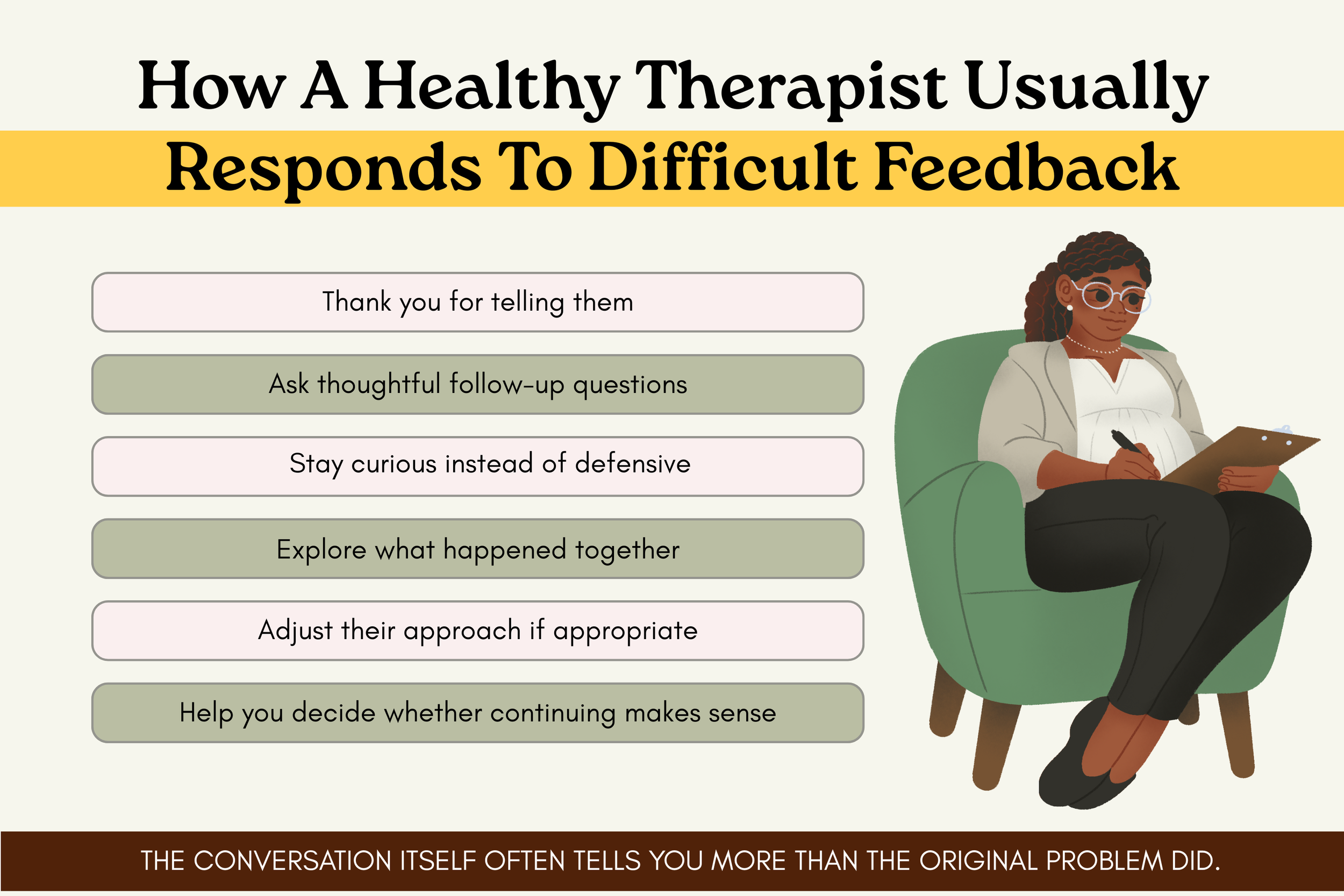
A good therapist is appreciative when you name discomfort. They might thank you for telling them, then get genuinely curious about what's off. They might ask what isn't working for you, or invite you to say more. A good therapist stays open and welcoming, works with you to see if the discomfort can be addressed, and treats it as a pivotal moment in the therapy. And if they're not the right fit, they'll point you toward therapists who might be.
When you name a strain and a good therapist works through it with you, the relationship usually comes out stronger, not weaker (Eubanks et al., 2018). Many people have never been able to work through and resolve a conflict like this before. Having that experience, in the safety of therapy, can be especially healing.
A red-flag response is the opposite: defensiveness, or blame pointed back at you ("you're being resistant," or "if you'd done the homework I gave you, this wouldn't be an issue"), ignoring or brushing off your feedback, or going withdrawn and shutting down. Basically, a lot of emotional reactivity, or a shutdown.
A good therapist will open that conversation with you, kindly, instead of shutting it down.
You're allowed to leave, and you don't have to start over
So you've done the reading and the testing, and the answer is honest: this isn't the one.
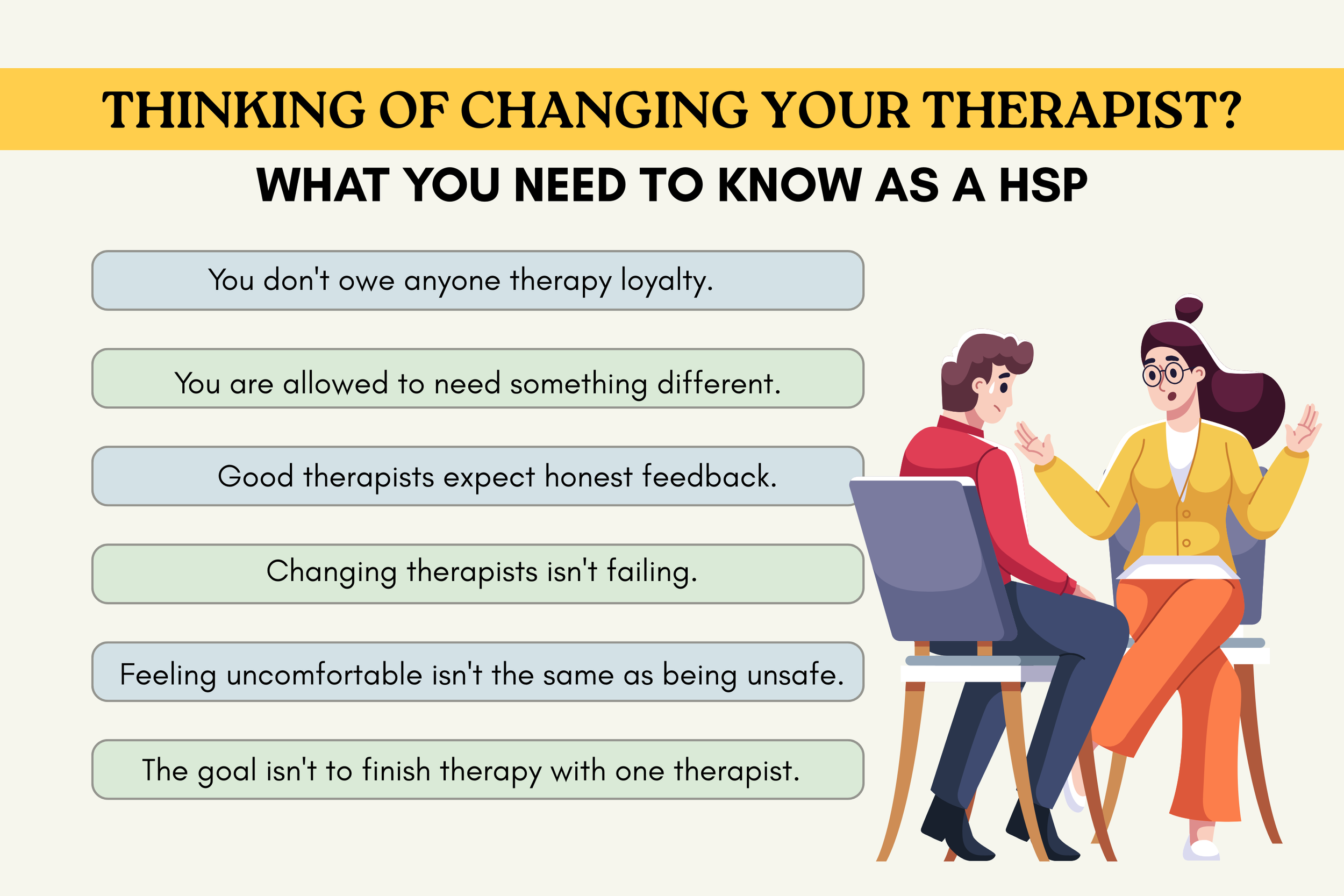
It is absolutely okay to stop working with a therapist who isn't a good fit. Therapy is a collaborative process, and you're a central part of the collaboration. What you want and need really matters, and you should feel that the whole way through.
As therapists, we want you to tell us when something is off. We're grateful when you push back or tell us you need something different, because it keeps therapy real and open. We want to build the therapy that you need, and that looks a little different for everyone.
When you give us feedback, we can adjust together. And if we're not the right therapist for you, we want to give you referrals to find the one who is. No therapist is the right fit for everyone, but we're all working toward the same goal: helping you find the help and healing you need.
Because we work as a team, we can help you switch to another of our therapists quickly and easily if yours isn't the right fit. This rarely happens because we work hard to make a great match the first time. But there's a lot of nuance to this work, so sometimes it needs adjusting.
You can tell either your therapist or our Intake Coordinator that you'd like to switch. The Intake Coordinator will schedule you with the therapist you'd like to see or recommend someone else based on our therapists' specialties and what you want to work on. Your record transfers internally, so there's no extra paperwork, and you don't start over.
We work to prevent a mismatch in the first place: through the carefully refined questions we ask at intake, and through our Intake Coordinator's knowledge of each therapist's skills and specialties. We know how much the therapeutic relationship matters, and our goal is to help you find the right match the first time.
When our Intake Coordinator schedules your first session, she'll also remind you: if anything about the fit feels off, let her know, so she can help you get scheduled with a clinician who's a good fit for you.
Be gentle with yourself
So you're sitting with that sinking feeling, deciding whether to schedule again. You're not back at square one. You're not too picky. You're paying attention.
A first session that feels off is information, not a verdict on you. Noticing it is the opposite of failing at therapy.
Be gentle with yourself, because starting therapy is hard. It is completely ok if you don't click with your therapist, or if you realize after a while that they're not the fit you need.
Your role is to focus on your healing, not to get stuck worrying about being loyal.
As therapists, we genuinely want you to share your feedback and put your needs first. Therapy is a place where you get to do that. We'd love to help you shift your focus to taking care of you. Just reach out.
And if you'd like a different way to try out the fit with a therapist, check out our Fit Check option.
References
Eubanks, C. F., Muran, J. C., & Safran, J. D. (2018). Alliance rupture repair: A meta-analysis. Psychotherapy, 55(4), 508–519. https://doi.org/10.1037/pst0000185
Flückiger, C., Del Re, A. C., Wampold, B. E., & Horvath, A. O. (2018). The alliance in adult psychotherapy: A meta-analytic synthesis. Psychotherapy, 55(4), 316–340. https://doi.org/10.1037/pst0000172
Horvath, A. O., & Symonds, B. D. (1991). Relation between working alliance and outcome in psychotherapy: A meta-analysis. Journal of Counseling Psychology, 38(2), 139–149. https://doi.org/10.1037/0022-0167.38.2.139