
The Real Reason Relationships Feel Harder for Highly Sensitive People (HSPs)
Chelsea Crowe
Highly Sensitive People Process Emotions More Deeply
HSPs’ brains are more responsive to other people, especially those they care about. Research shows that HSPs exhibit increased brain activity, including in the mirror neuron system, when responding to others’ emotions—particularly loved ones (Acevedo, 2014). This doesn’t mean you “overreact”; it means your brain is taking in more emotional information at once which can make your responses feel stronger. Everyday relational stress can feel intense as a result. Small conflicts, tense moments, or subtle shifts in someone’s mood land harder because your system is already operating at a deeper level.
Nervous System Overstimulation in Highly Sensitive People
For HSPs, the nervous system gets overwhelmed faster because it’s taking in everything—noise, conflict, tension in the room, even shifts in someone’s tone. It’s not that you’re “too sensitive”; it’s simply how your brain is wired. An HSP brain is more reactive to emotional cues and sensory input, a combination that usually results in your system filling up much faster. While emotional dysregulation is often about difficulty managing feelings, what HSPs experience is usually sensory overload—the system hits capacity quickly, making everyday interactions feel more intense and taxing than for others.
Highly Sensitive People Notice Emotional Micro-Shifts
Being an HSP may feel like both a social superpower at times and a curse at others. HSPs often notice the tiny things other people miss - subtle facial expressions or even a pause that feels a little too long. Often, the HSP brain automatically starts searching for meaning, which can easily turn into anxiety or overthinking. It’s like carrying an “invisible workload” of constantly scanning the room or attempting to predict the next move, even when no one else realizes anything has shifted.
The Emotional Mismatch That Causes Most Relationship Pain
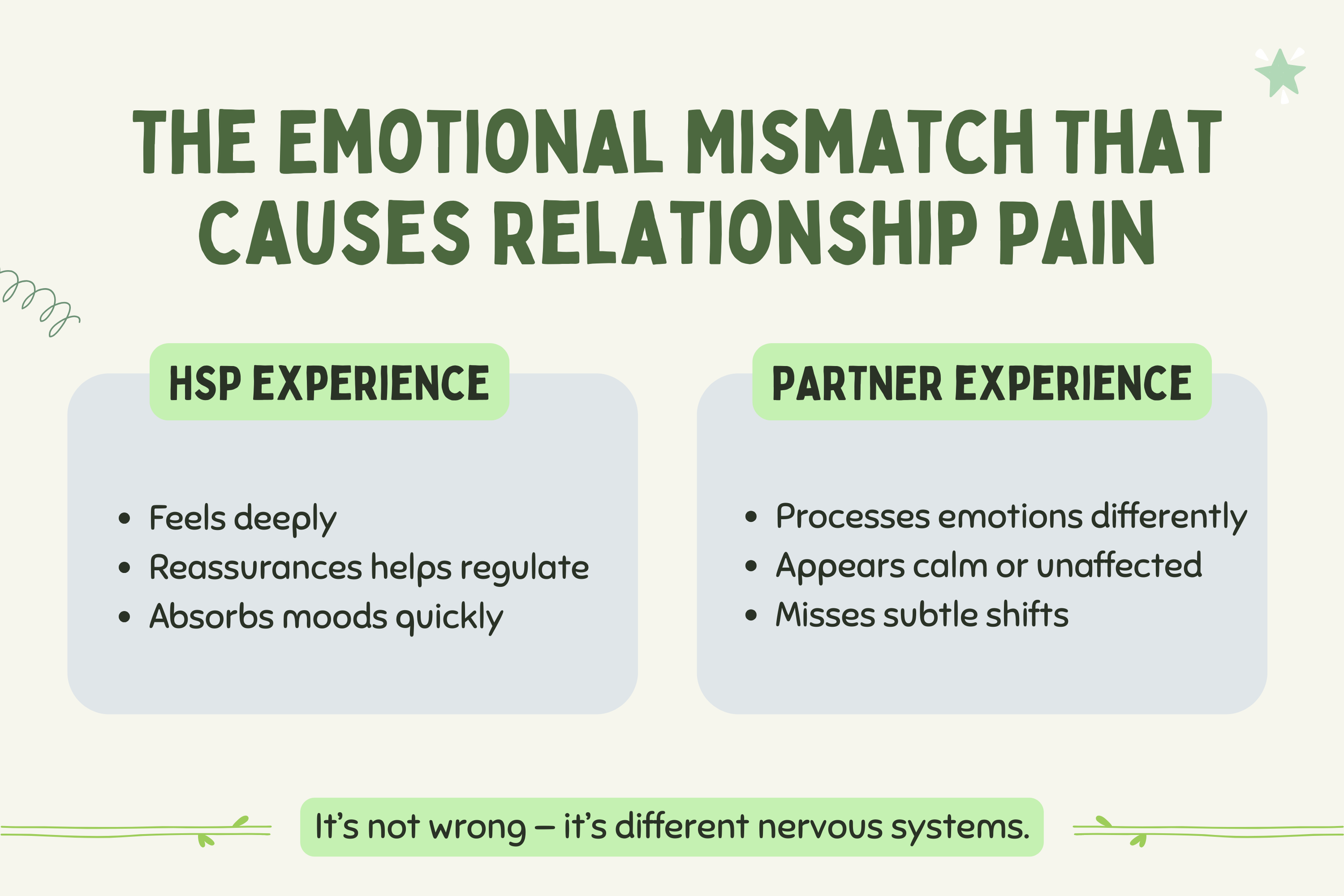
Feeling Deeply in Relationships When Your Partner Does Not
When you feel deeply but not everyone around you does, it can make for feeling especially isolated in your own emotions. Maybe you’re overwhelmed, anxious, or moved by something intense, and your partner seems calm, unfazed, or “fine.” It’s easy to interpret that as indifference or distance, but often it’s a difference in how you experience and process feelings. This emotional mismatch can create tension, frustration, or loneliness, even in the closest relationships.
Why Highly Sensitive People Need More Reassurance in Relationships
HSPs often need more reassurance than their partners realize, but not because of the all too common interpretation that “they’re fragile”. Rather, this tendency stems from being highly attuned to emotions and subtle cues. For you, reassurance isn’t about dependency; it’s a way to regulate your system, calm overwhelm, and feel safe in the relationship. Small affirmations or check-ins can go a long way in helping you feel understood and connected.
Absorbing Partner’s Mood
When you’re highly sensitive, you tend to absorb other people’s moods almost instantly. The image that comes to mind is like a sponge soaking up water, but for you that looks like soaking up whatever emotional tone is in the room. This emotional contagion makes dating someone moody or unpredictable especially exhausting, because their shifts don’t stay theirs; you end up carrying them, too. Even small changes in their energy can throw off your whole day leaving you exhausted without knowing why at times.
If you identify as a highly sensitive person (HSP) and find yourself internalizing your feelings, Thrive Therapy & Counseling can help. Book a call here to get the support you deserve.
HSPs Tend to Overgive—Then Feel Invisible
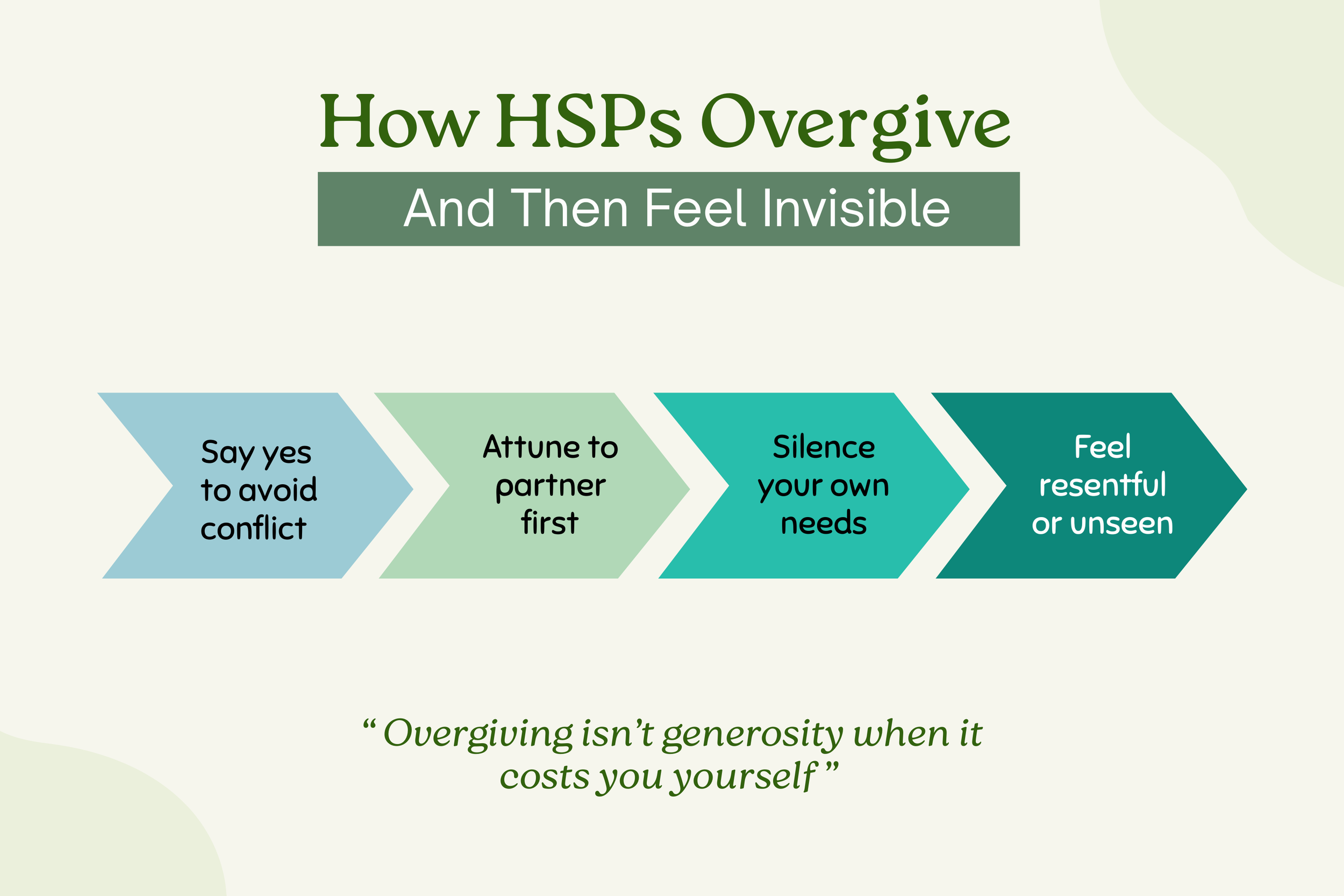
Saying yes to avoid conflict
Often highly sensitive folks can fall into the trappings of people-pleasing or automatically responding favorably in an effort to avoid conflict or disappointment. It feels easier to keep the peace than risk tension, so HSPs tend to overgive or overextend in an effort to maintain harmony.
The catch?
When your needs stay silent for too long, that conflict avoidance turns into resentment—you’re giving so much while feeling increasingly unseen or unappreciated. You are giving more than you’re getting.
Attuning to your partner more than to yourself
The “caretaker” reflex is often influenced through HSPs’ skill in attuning to those around them. This response can make HSPs quick to offer support, smooth things over, or put their partner first. Over time, prioritizing others can feel automatic—even necessary for safety—so self-abandonment can start to feel like the safest way to keep connection and avoid conflict. Unsurprisingly, however, this tactic only carries you so far– your system can only tolerate self neglect for so long before you start to feel the repercussions.
Why Highly Sensitive People Are Drawn to Emotionally Unavailable Partners
Though it may sound counterintuitive, HSPs can be drawn towards partners who are calm or even emotionally avoidant. These relationships can feel safer on the surface because they don’t demand the same degree of vulnerability or being fully seen that an emotionally available partner would.
Over time, though, that contrast can make deep emotions feel like “too much”—not because there’s anything wrong with you, but because of the contrast in emotional intensity.
Conflict Hits HSPs Differently (This Matters More Than You Think)
Conflict = overstimulation
Conflict hits HSPs differently, and it matters more than you might realize. During an argument, the sensory and emotional systems activate at the same time. This means simultaneously taking in tone, body language, words, and underlying tension all at once. That combination can make even small disagreements feel physically overwhelming and can create symptoms like racing heart, tense muscles, and spiraling thoughts (to name only a few).
Shutting Down or Withdrawing During Relationship Conflict
When conflict escalates, HSPs often shut down, freeze, or withdraw. This isn’t avoidance—it’s self-protection. So what's happening inside? The nervous system senses overload or may interpret the present conflict as even threatening. What can result is your system temporarily limiting the ability to respond, making it hard to speak or engage until you feel safe again.
How Partners Misinterpret an HSP’s Conflict Response
While shutting down serves as a means of survival for HSPs, partners can understandably misinterpret this response as withdrawal or disinterest. Explaining your conflict style—letting them know that stepping back is how you regulate—can help them understand. Asking for what you need, like a pause or gentle check-in, can make it easier to stay connected even when emotions run high.
What Makes Relationships Easier for Highly Sensitive People
(This is the “you can do something about it” part.)
Finding someone who values emotional safety
One of the biggest game-changers for HSPs is seeking out a partner who values emotional safety.
This can mean finding a partner who doesn’t shame you for your depth and who responds consistently, rather than with dramatic highs and lows. Emotional consistency matters more than intensity because consistency allows for a steady, reliable presence to support you with feeling seen, heard, and secure in the relationship.
Learning to communicate your needs early
Learning to communicate your needs early can prevent unnecessary overstimulation and overwhelm. Being clear about what helps you—like a check-in or a little reassurance—allows your partner to support you without guessing (and likely reduces frustration on their end, too).
While it may feel automatic to apologize for communicating a need, this may also convey to ourselves that we are a burden. Instead, try to keep in mind that expressing your needs is not only human, but a powerful way to stay connected.
Understanding Overstimulation Patterns in Highly Sensitive People
Before you can communicate your needs to others, you first need to understand your overstimulation patterns for yourself. This can include noticing sensory triggers like loud noises, temperature sensitivity, crowded spaces, strong smells, or tense conversations. This kind of awareness can help you anticipate when your system is likely to reach capacity faster.
Planning downtime before or after social events can also give your nervous system a chance to reset. This could mean a quiet walk, listening to calming music, journaling, or simply taking 15–30 minutes alone to recharge. By recognizing and preparing for these moments, we are often better able to stay more present, connected, and grounded.
Setting boundaries that protect your nervous system
Setting boundaries is key to protecting your nervous system. Micro-boundaries might look like asking for a few quiet minutes before a conversation, stepping away from a heated discussion, or saying no to extra commitments.
These smaller boundaries can prevent small stressors from snowballing into big overwhelm. And, while it may be easy to fall into the thinking trap that “small no’s” = selfish, I argue that it is these small boundaries that will support you with staying more present and intentional within yourself and your relationships.
If you’re an HSP who’s tired of thought spirals, book a call with Thrive Therapy & Counseling for HSP‑informed care. Thrive Therapy & Counseling offers a safe, supportive space to help you process your thoughts and find healthier ways to cope. Connect with us here.
When It’s Not You—It’s the Relationship
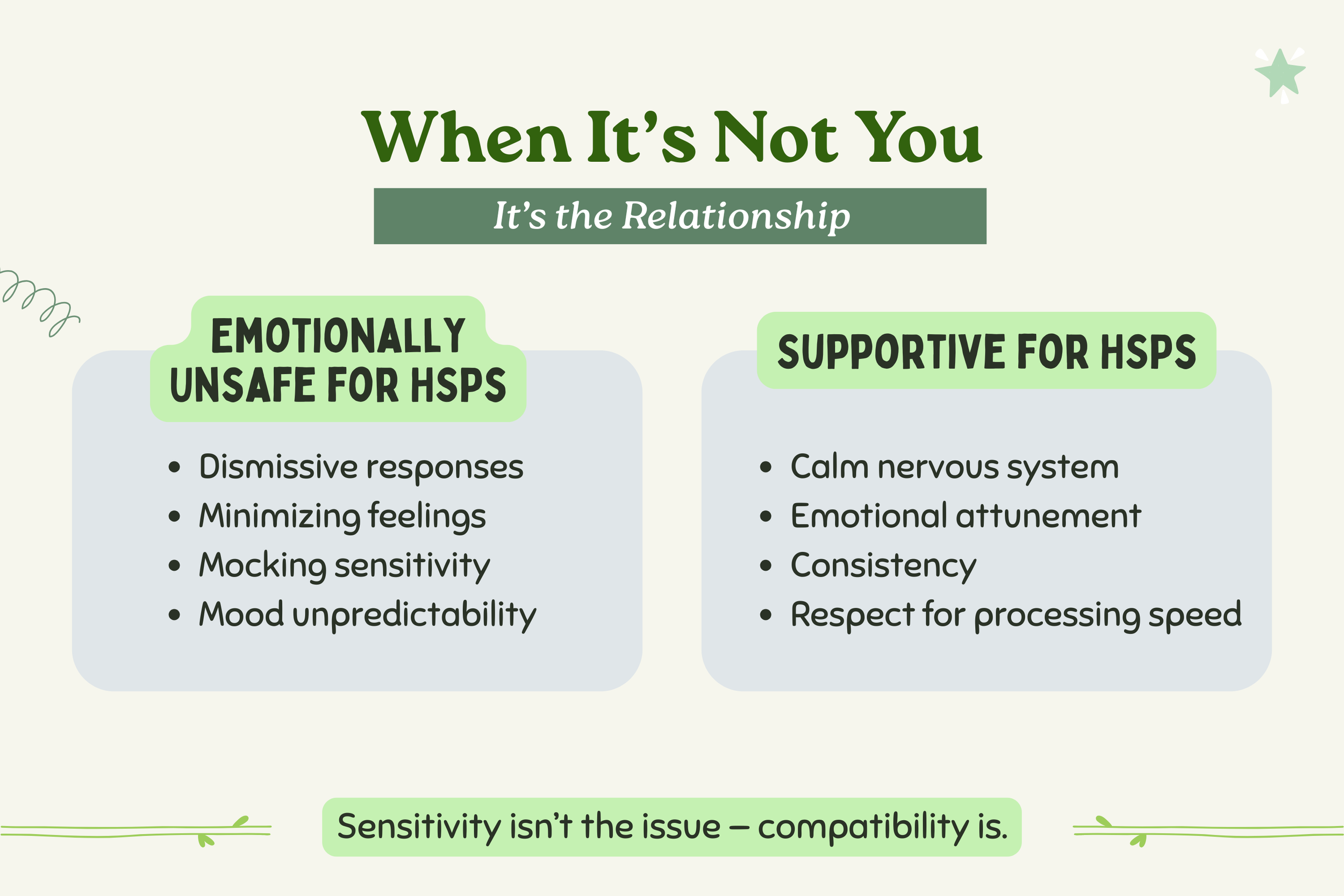
Signs you’re with someone emotionally unsafe for an HSP:
Dismissive responses
Minimizing your feelings
Mocking sensitivity
Volatility or mood unpredictability
Signs you’re with someone who can meet your sensitivity:
Calm nervous system
Emotional attunement
Thoughtfulness
Consistency
Respect for your processing speed
Zero shame around feelings
Sensitivity isn’t the issue—compatibility is.
Your sensitivity isn’t the problem, and you’re not “hard to love.” The truth is, you simply can’t thrive with people who refuse to understand or honor your emotional depth. When you’re with someone who dismisses, minimizes, or avoids feelings, your natural empathy and insight can feel like a burden instead of a gift.
Being with a partner who matches your capacity for connection allows you to show up fully, feel safe expressing yourself, and experience a relationship where your depth is appreciated rather than overwhelming. This kind of compatibility creates space for you both to grow, communicate openly, and truly enjoy each other without the constant friction that comes from mismatched emotional styles.
If you’re an HSP who wants relationships that feel calmer, safer, and more deeply connected, start with our free journaling guide for sensitive people.
Reference:
Acevedo BP, Aron EN, Aron A, Sangster MD, Collins N, Brown LL. The highly sensitive brain: an fMRI study of sensory processing sensitivity and response to others' emotions. Brain Behav.
2014 Jul;4(4):580-94. doi: 10.1002/brb3.242. Epub 2014 Jun 23. PMID: 25161824; PMCID:
PMC4086365. https://pmc.ncbi.nlm.nih.gov/articles/PMC4086365/