
Journaling for Overthinking (HSP Guide): Calm Spirals, Soothe Your Nervous System, and Navigate Relationships
Ivy Griffin
If you’re highly sensitive, overthinking isn’t a character flaw — it’s what happens when a finely tuned nervous system has too much unprocessed input. Journaling can become a regulating ritual that turns overwhelm into clarity.
Your highly sensitive brain is wired to think deeply. Biology has made you adept at noticing subtle cues, reflecting on them carefully, and then responding to small shifts in your environment. Not only do you take in a lot of information, but you think a lot about what you've experienced. You need time to integrate, but it means that your brain keeps “working” long after events end. And that can get tiring fast.
Here’s where journaling helps. With the right structures, expressive writing can reduce the emotional intensity you’re feeling and can help you organize your experience into a coherent narrative, which is a key part of healing. Plus, journaling gives your mind a momentary landing place — a way to step out of the spiral instead of getting swept inside it and prepare you for healthier conversations with better boundaries, which can prevent future overthinking.
Keep reading for daily calming practices, tips to get clarity about your relationship, common pitfalls for HSPs to avoid, and step-by-step exercises. This is your guide filled with journaling tips for highly sensitive people.
Skip to exercises
Find an HSP‑informed therapist
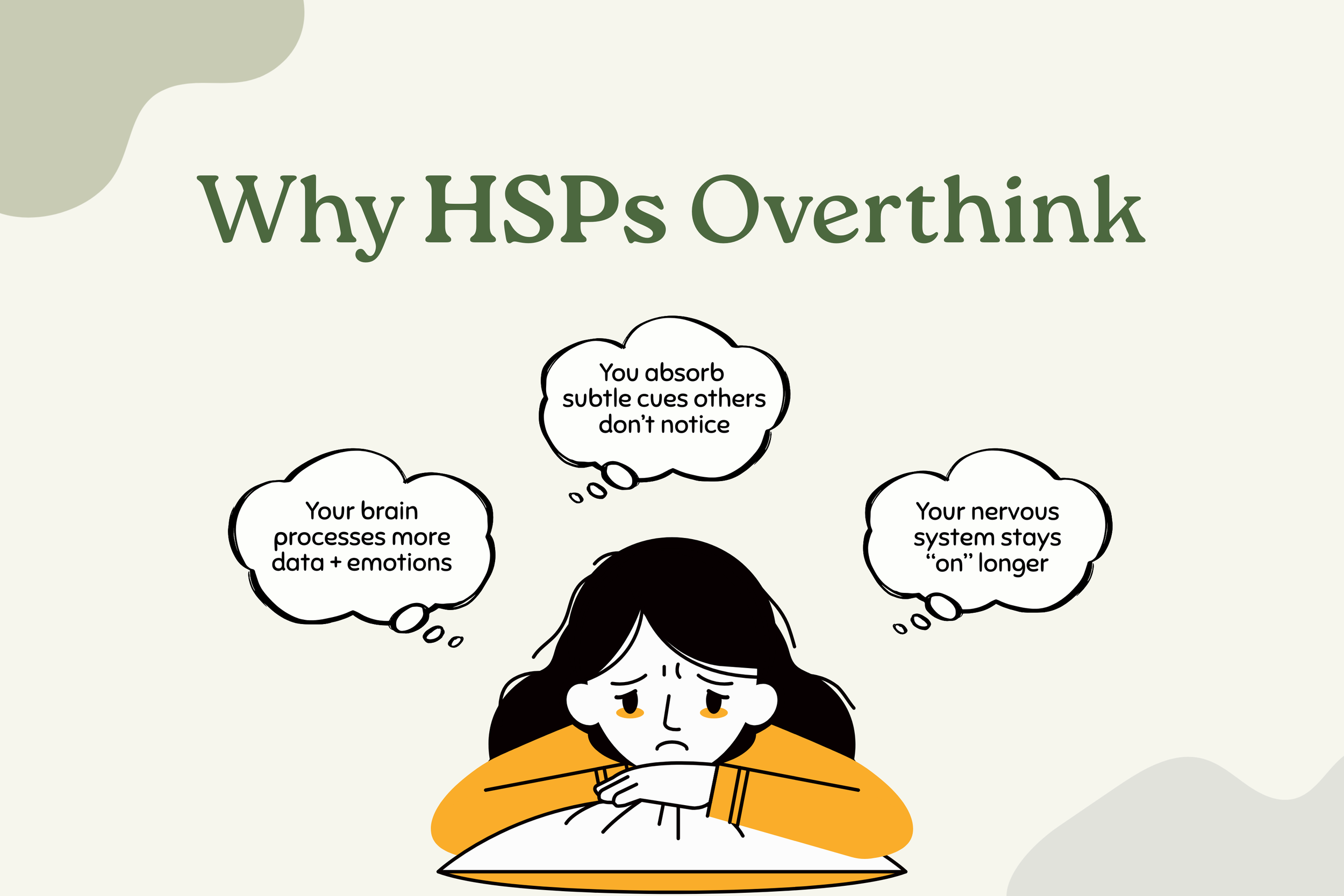
HSP 101: Why Overthinking feels Different When You’re Highly Sensitive
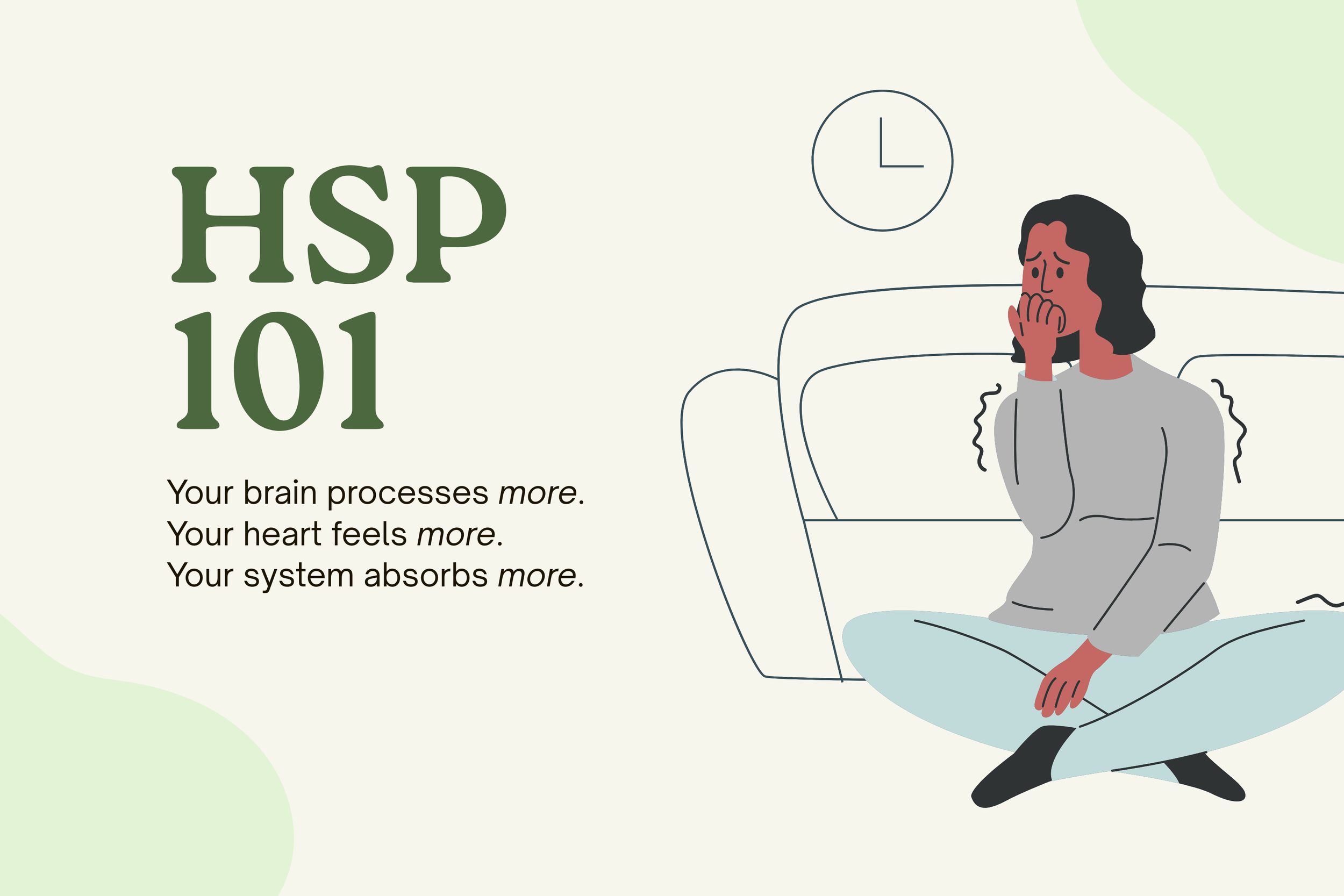
Depth of Processing:
Your tendency to analyze and think deeply is reflected in how your brain works. Brain scans show that HSPs have more activity in the insula region of the brain, which is known as the “seat of consciousness.” Yes, there is evidence that documents all of the careful thinking you do. You are neurodivergent because your brain reacts differently than people without this personality trait, and you may spend a lot of time thinking through all the details, exploring the different outcomes, weighing the pros/cons, and considering the impact on others before you make a decision or take any action.
Writing is a tool to externalize all these thoughts and help you sort through this data so your body can downshift and regulate. Read on to learn more about journaling for anxiety relief.
Emotional Intensity + Empathy:
Being a highly sensitive person also means feeling a lot of empathy and emotional intensity. This is part of your personality. You feel your feelings in a big way, whether it’s a rush of excitement or a flash of anger. Feelings arrive fast, and they can last longer than they do for less sensitive folks.
So, it’s crucial that you have healthy ways to process those big emotions so that they don’t take over. Naming and describing your feelings, also known as affect labeling, in your journaling helps reduce the intensity of emotions and can help you use more self-compassion and be kinder to yourself.
Overstimulation & Recovery Time:
This personality trait means that you respond more to sensory experiences like bright lights, loud sirens, or a room that’s too cold. Meanwhile, your brain hones in on emotional and relational micro-cues in the people around you.
If there’s some slight tension in a meeting, you’ll notice it, or you’ll observe a quick shift in your partner’s body language and pick up on their frustration. All of this awareness happens unconsciously, but it’s still a lot of information that your body absorbs. Because of this, even if you’re having fun and enjoying yourself, you need more time to decompress. As you go about your day, your nervous system is more alert and receptive to cues from other people and the environment around you, so you become more worn out just from living your life.
Journaling can provide a safe container to help you rest and recover, especially when you use expressive writing as a time-bound ritual.
Relational Attunement:
You feel so much empathy for other people and animals because you can easily imagine how it would feel to be in their shoes. This makes you very attuned to others and to how they’re thinking and feeling. You don’t do this intentionally; it’s simply part of how you’re wired. Such attunement can be a beautiful gift to your loved ones as you offer them just the right amount of support, and it can leave you feeling like a sponge that’s wrung out because it’s draining to feel everyone else’s emotions so acutely.
You may be especially aware of shifts in someone’s tone of voice or body language, and that can trigger old narratives from your past about how you’re “not good enough,” a “failure,” or “broken.” Journaling can help you interrupt these outdated stories, stop overthinking, and separate your present reality from negative past experiences.
Key Reframe: Please know that you don’t need less sensitivity; you need better containers for holding all the thoughts, feelings, and experiences that accompany your sensitivity. Journaling is a container big enough to hold it all.
Evidence Snapshot: Why Writing Helps
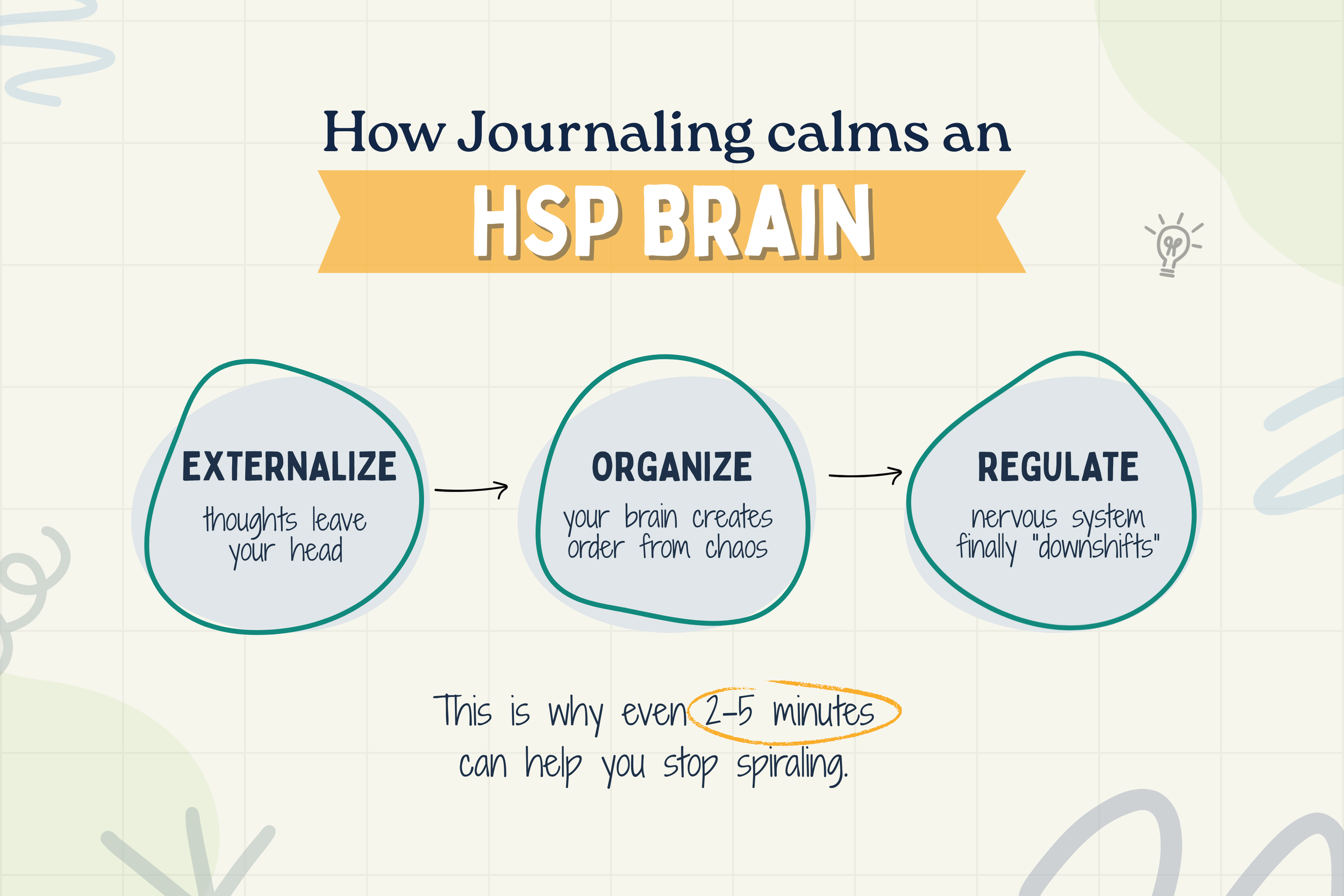
Expressive Writing → Lower anxiety, depression, stress; stronger self‑understanding
Numerous studies have explored the benefits of journaling on improving mental health. You can find relief for anxiety and stress through journaling, and the research backs this up.
Expressive writing can help you have more emotional awareness and more self-understanding while giving you a container to work through difficult thoughts and feelings - breaking old patterns, seeing new perspectives, and helping you find your way through.
Journaling also interrupts the patterns of overthinking and helps ground you in the present moment, instead of being stuck fixating on the past or the future.
Therapeutic Mechanism:
Journaling is a tool to help you identify, label, and externalize thoughts and feelings. By writing about what’s happening internally, you get some distance from the experience and can observe what’s happening more objectively.
This process leads to reframing any distorted thoughts or beliefs and developing a coherent narrative about your experience, both of which help you integrate your experience and bring relief to your nervous system.
Therapist Note:
In trauma healing, creating a coherent narrative of what you’ve been through is an essential component. I’ve witnessed this again and again in my nearly two decades as a therapist.
Journaling offers a safe micro-practice to write your story.
For a deeper dive, see Blog 1 summary below →
If you’re an HSP who’s tired of thought spirals, book a call with Thrive Therapy & Counseling for HSP‑informed care. Thrive Therapy & Counseling offers a safe, supportive space to help you process your thoughts and find healthier ways to cope. Connect with us here.
The HSP Journaling Framework (3 Layers)
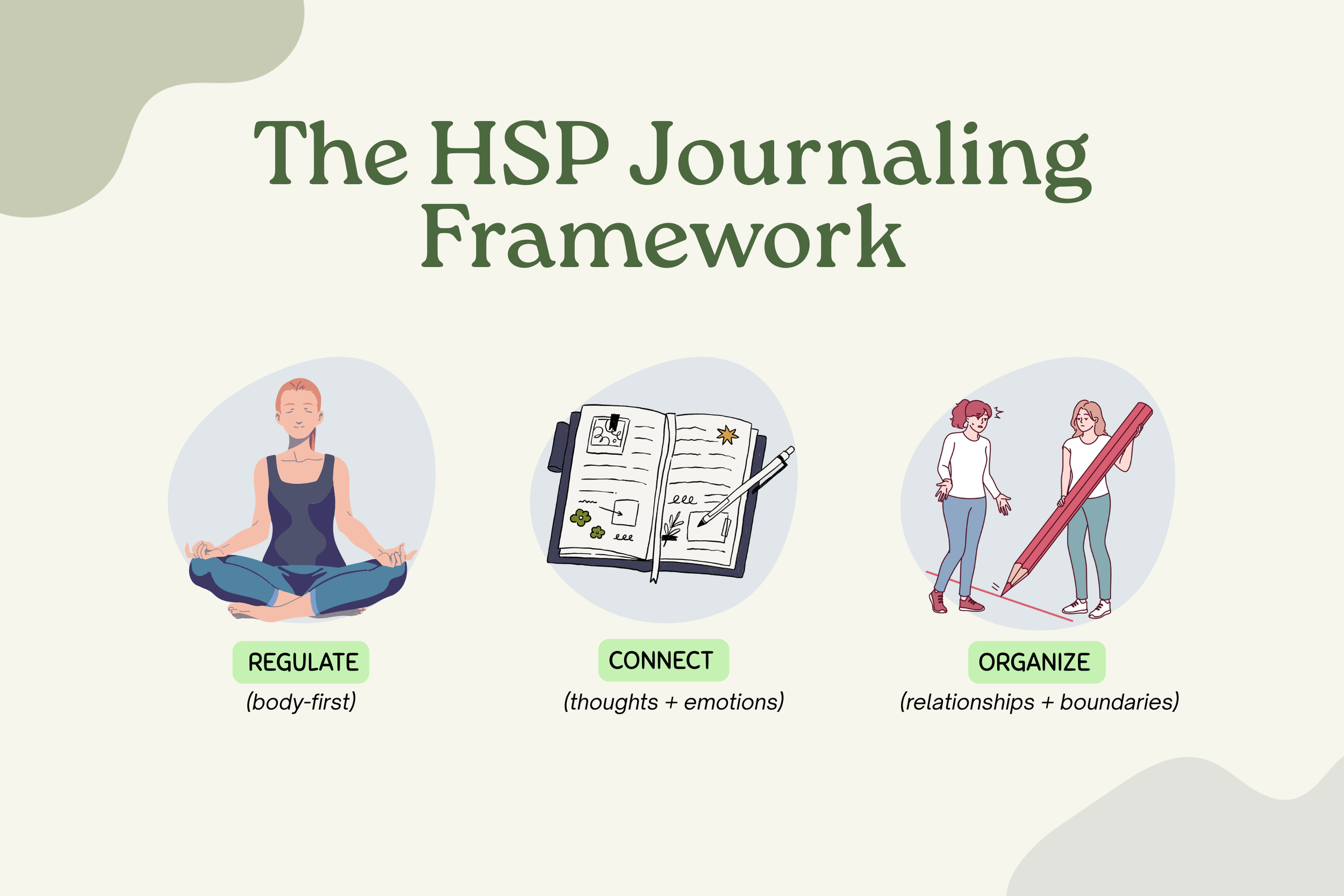
Follow this step-by-step framework to help your sensitive nervous system get the most benefit from journaling practices.
Layer A — Regulate (body‑first)
1. Dialectical Behavior Therapy (DBT) Observe–Describe–Participate mini‑ritual (2–5 minutes).
Observe - Notice your 5 senses and your thoughts, feelings, body sensations, and urges.
Describe - Put words to your observations.
■ I see _______________
■ I hear _______________
■ I’m having the thought that _______________
Participate - Ask yourself:
■ What is my hope or intention? _______________
■ What will I do next? _______________
2. "Notes from My Body" check‑in (somatic noticing + one caring action).
First, notice what is happening in your body right now. Then, offer yourself one caring action to help.
■ The feeling that is stepping forward today is _______________
■ I noticed this feeling in my body in my (name location) when ______________
■ When I feel it in my body I want to _______________
■ Things that make that part of my body feel better are _______________
Next step - It’s helpful to practice these skills consistently and pair them with a timing cue/activity, such as practicing when you first arrive home, after a meeting, or before going to bed.
Layer B — Organize (thoughts + emotions)
1. 20‑minute Time‑Boxed Rumination: allow spiral → stop on timer → close notebook → move body.
This exercise is great for managing repetitive, ruminating thoughts. Begin by setting a timer for 20 minutes, and allow yourself to write any thoughts or feelings that arise, even if you’re repeating the same worry or fear. It’s ok to write absolutely anything, no matter how silly or extreme it might seem later.
When the timer goes off, close your journal or exit out of your Notes app. Stand up and stretch. You’re done for today. Any time thoughts or feelings about the same topic arise, remind yourself that you’ll have more time to think about them tomorrow, but you’re done focusing on this issue today.
2. Feelings Log (captain’s log)
This practice is akin to Bullet Journaling. It’s about making short, consistent entries to help you look for patterns and themes, and identify any micro-shifts you want to make. You add a word or phrase to fill in each blank, and then you can do weekly or monthly reviews.
■ Date: _______________
■ Trigger: _______________
■ Themes: _______________
■ Other exacerbating factors: _______________
■ One thing I want to shift is: _______________
3. T.O.M. (Thought–Opposite–Middle) to find grounded middle thoughts.
Write the thought you keep focusing on. Usually, this is some version of the worst-case scenario. Don’t judge or change it, just write it down.
Next, write the exact opposite of that thought. This is probably the best-case scenario.
Last, write the thought or belief that’s in between. This helps you see that there’s not only a middle ground but a whole range of possibilities for the situation, which is really helpful in giving perspective.
Layer C — Connect (relationships + boundaries)
1. Assumptions vs. Reality grid
You can test out whether a past experience is triggering you or whether your thoughts and feelings are based in reality by doing this quick exercise to note the evidence for and against an assumption. Try to come up with 3 pieces of evidence for each.
I’m making the assumption that (examples: She’s mad at me, I made a mistake, He’s not interested in me.)
Evidence 1: Evidence 2
1. 1.
2. 2.
3. 3.
If it becomes clear that an assumption is at play, you can then write a compassionate letter to yourself, speaking to yourself like you would talk to a friend. In this letter, offer yourself the encouragement, validation, and support that you need to hear.
2. Uneven Dynamics Prep
This technique helps with identifying your own feelings, needs, and boundaries, which can guide how you want to respond to someone else when you’re upset. Journal your answers to these questions:
■ How am I feeling? _______________
■ What happened to trigger this feeling? _______________
■ Why did this bother me? _______________
■ What do I need? _______________
■ Have I said it plainly? If not, what makes it hard? I can try putting my answers to these questions in “I” statements to make my needs clear.
If I do this and there’s still no change, what self‑limit will I set (e.g., 5‑minute reply delay)?
3. Advice From a Friend
This practice is a tool to offer yourself the same kindness and compassion that you would give to a friend or loved one. Because we’re usually pretty hard on ourselves, this intentional writing exercise can help flip the script:
■ Name the worry: _______________
■ If someone came to me with this worry, what emotional support would I offer? _______________
■ If someone came to me with this worry, what practical advice would I offer? _______________
■ What do I need to hear right now? _______________
How to Use the Framework:
Choose one practice per layer per day (2–10 minutes total) or set themed days (Monday = Regulate; Wednesday = Organize; Friday = Connect).
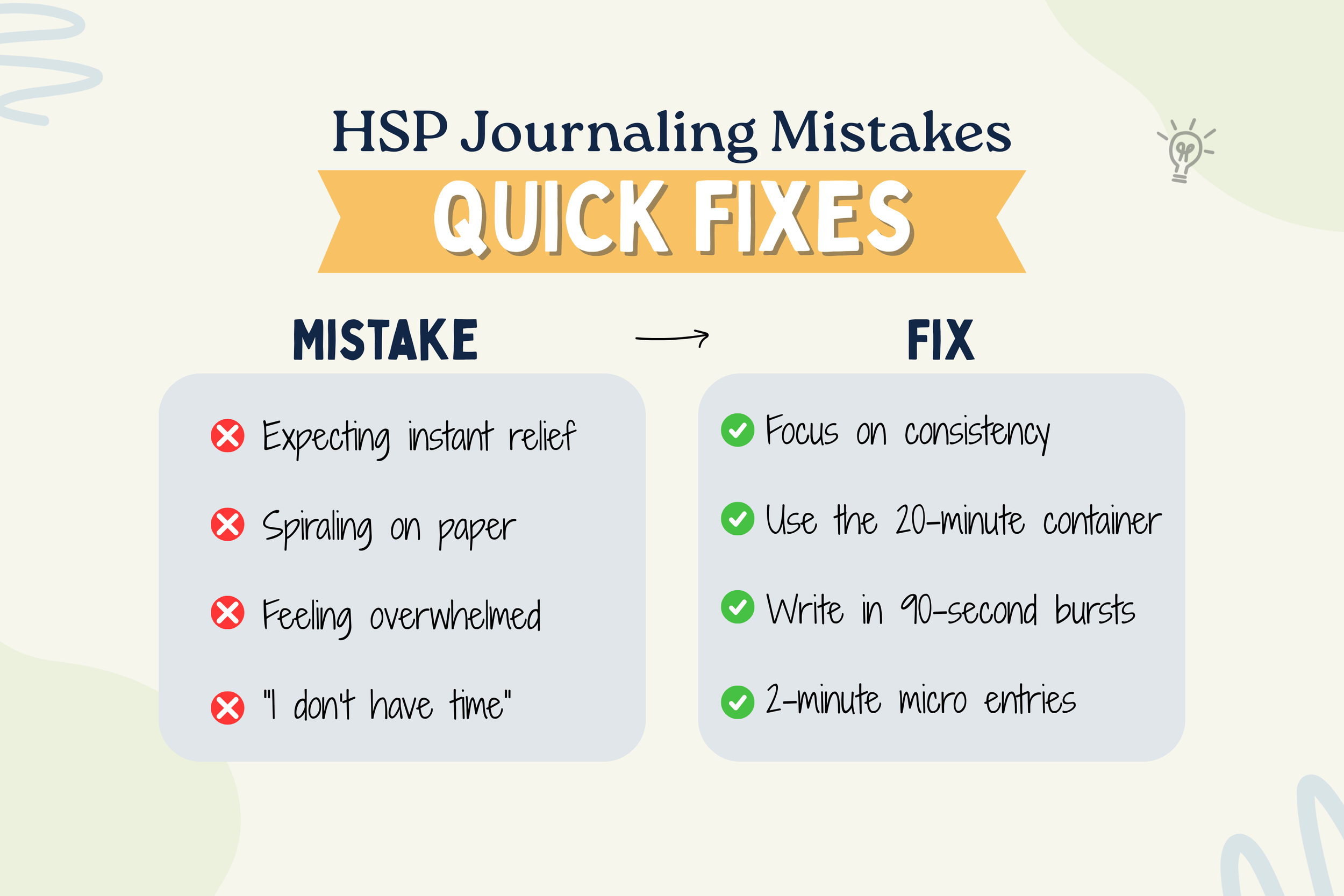
Common HSP Pitfalls (and What to Do Instead)
1. “If I don’t feel better after 3 entries, it’s not working.”
You’re building new neural pathways and safety cues. It’s hard at first. Measure success by showing up, not feeling perfect. Start with 5 minutes, and remember that every small step makes a difference.
In fact, change is not usually big and dramatic. Instead, it happens in the incremental, consistent practices that we do over time. In therapy, clients are often surprised by the immense progress they make over time because it consists of one baby step after another.
2. “My journaling just repeats the spiral.”
Sometimes when you journal, you get stuck writing the same repetitive thoughts that are looping in your head. This is normal, but it’s important to notice. If you find yourself in this pattern, I recommend that you do this instead.
Use the 20‑minute rumination container. Set a timer, write whatever you’re
worried about for 20 minutes, regardless of how ruminative it is. When the timer goes off, stop writing. Then close the loop with a regulating action (stretching, rinse your face, step outside).
3. “Blank page paralysis.”
It can feel overwhelming to sit down to write and stare at a blank page or screen. If you find yourself freezing because you don’t know where to start, try this.
Start with structures: 3‑to‑1, Catch the Good, or a single DBT Describe line. Use
bullet points, voice notes, or doodles—words are optional.
The key is to find an entry point that feels doable and start small.
4. “Proactive vs. Reactive confusion.”
YYou might be uncertain about whether to write on a consistent basis, even when you’re feeling good, or to focus on writing when you’re struggling. If you’re not sure which would be helpful, try both: have a small, daily proactive journaling ritual + a reactive emergency page (pre‑written prompts ready).
In my work with HSPs, folks often notice how helpful habits are. Not only do habits give you structure, but they’re comforting to your sensitive nervous system. When you have a pattern of writing regularly, your writing muscles are already strengthened, so that when they’re having a really bad day, it doesn’t feel like starting from scratch. Plus, your brain is already accustomed to using expressive writing to process your experiences.
5. “I’m ‘too sensitive’ to look at big feelings.”
Big feelings are exactly that - big and overwhelming. As a sensitive person who sometimes can get consumed by big feelings, you might feel like the last thing you want to do is give more time or space to those feelings. You may worry that the emotions will overtake you or that you’re simply too sensitive to tolerate all the feels. It’s really normal to feel this way.
No one wants to get lost in overwhelming emotions, but there really is a trick in how allowing yourself to feel them tends to take the power out of them.
So, if you’re worried, try this. Go titrated: do 90 seconds of writing, 30 seconds grounding (deep breathing, body scan, notice your 5 senses); repeat. Or use third‑person/letter formats to lower intensity. Write a letter about the problem upsetting you, or write a letter to yourself from a caring and supportive loved one.
6. “I don’t have time.”
In our hectic lives, it’s so understandable to feel like you don’t have time to add one single thing to your schedule. Please know that small, micro practices are still really helpful.
Tiny is plenty: Try writing for 2 minutes after brushing your teeth, jotting down one feelings‑log line at lunch, or one T.O.M. row before replying to a text.
Guided Exercises & Prompts Library (HSP-Tuned)
(Mix and match; present as boxes/accordions in the live article)
A) Quick Calm & Clarity
Observe–Describe–Participate (DBT)
○ Observe: 1 sensory cue per sense + 1 inner cue (thought/urge).
○ Describe:
I’m having the thought _______________
I’m feeling _______________
My body is _______________
○ Participate: One next kind action is _______________Notes From My Body
Feeling stepping forward → where in body → urge → one soothing action.3‑to‑1
Three small “goods” + one constructive next step (keep it neutral, not self‑critical).
B) Spiral Containers & Cognitive Balance
Time‑Boxed Rumination (20‑minute method)
Write freely; when the timer ends, close; move; tell thoughts: “We’ll meet tomorrow at the same time.”T.O.M.
T: initial thought → O: exaggerated opposite → M: likely middle. (Example provided in Blog 2.)Cite the Evidence
Worry → anxiety’s evidence → five alternative explanations; end with “unknowns I can tolerate.”
Name the Elephant
The fear is _______________
It matters because _______________
One confidence‑boosting action is _______________
Catch the Good (Word of the Week)
Choose a value/quality (e.g., considerate, humor) → log moments of giving/receiving it
C) Relationship‑Ready Clarity
Slow Reactivity Break
Pause; journal: “Biggest emotion right now is…” (give it physical traits); write a kind introduction to your feeling; ask what it needs.
Assumptions vs. Reality Grid
Situation | My story | Evidence for | Evidence against | A kinder hypothesis.
Uneven Dynamics Prep
What do I need? Have I said it plainly? If not, what makes it hard? If yes and no change, what self‑limit will I set (e.g., 5‑minute reply delay)?
Advice From a Friend
Name the worry → write compassionate emotional + practical advice as if to a friend; adopt 1 line as a self‑mantra.
Tip: If journaling spikes activation, switch mediums: speak into your phone, draw boxes/arrows, or write as a letter to your future self.
Micro‑Rituals for HSP Nervous System Care
Taking small steps is the best approach, especially if starting a new journaling practice feels overwhelming. And as an HSP, it’s common for something new to feel overstimulating.
So, take a breath, and plan to implement one new tiny habit. You deserve to be well cared for, and your sensitive nervous system will thank you for giving it another opportunity to decompress.
Bookend Your Day: 2–5 minute morning intention (Participate line); 2–5 minute evening debrief (Feelings Log).
Post‑Interaction Decompress: After social contact, do a 90‑second body note + one grounding action.
Relational Boundaries Cue: Create a sticky note: Pause • Check body • Choose middle thought.
Environmental Tweaks: Soft light, pen you love, blanket/weighted lap pad; a consistent “journaling seat” to cue safety.
If overthinking continues to interfere with your daily life, or if you identify as a highly sensitive person (HSP) and need tailored support, Thrive Therapy & Counseling can help. Book a call here to get the support you deserve.
How This Integrates With Therapy (and When to Get Support)
Journaling is a skills-based practice. It can stand on its own as a tool to process day-to-day stress and help your nervous system relax, or it can be a helpful adjunct to therapy.
However, expressive writing is not a substitute for trauma treatment. If writing surfaces very painful or overwhelming memories, dissociation, or feelings of panic, please reach out to work with an HSP‑informed therapist.
How therapy helps
In therapy, we can determine our pace based on exactly what you need, and we can vary that pace from week to week. We might co‑create journaling prompts and process what arises in the safe space of a therapy session, pace out exposure to gradually build tolerance for difficult situations over time, process your history and narratives as you feel ready, and rehearse relational scripts to help you put your learning into practice.
Safety Plan Box
If you’re journaling and you become overwhelmed, follow this plan: Stop writing/do a grounding exercise/have a self-check-in/repeat grounding exercises as needed. Then, reach out for support. You don’t have to face this alone. We’d be honored to walk with you in your journey to healing.
FAQs (HSP‑Specific)
1. What if journaling makes me more anxious?
Sometimes, mindfully tuning in to our experiences does bring up strong feelings. If this happens, use titration (90 seconds of writing/30 seconds of grounding), switch to writing in the third‑person or drawing, or consider getting more support in therapy.
2. How long should I journal?
There is no right or wrong amount of time. You can write as much as feels helpful, but remember that tiny doses count (2–5 minutes). Consistency matters more than duration.
3. What if someone finds my journal?
If you’re writing your most private thoughts and feelings, naturally, you don’t want anyone to stumble upon your journal. Try using phone notes with a lock, shred loose pages, or use voice memos. Feeling safe to express whatever you need to is more important than aesthetics.
4. Is it okay to voice record instead of writing?
Absolutely! There is no one-size-fits-all approach. It’s perfectly fine to use a pencil and paper, type on your laptop, make notes on your phone, do bullet points, voice record, you name it. Find what works best for you. Then, capture a one-sentence summary to help externalize and consolidate what you’ve been expressing.
5. How do I journal when I’m exhausted?
Be gentle, and use one line: “Today my body needs…,” Then, do one kind action for yourself.