
How to Be Less Sensitive in a Relationship — Without Ignoring Your Needs
Ivy Griffin
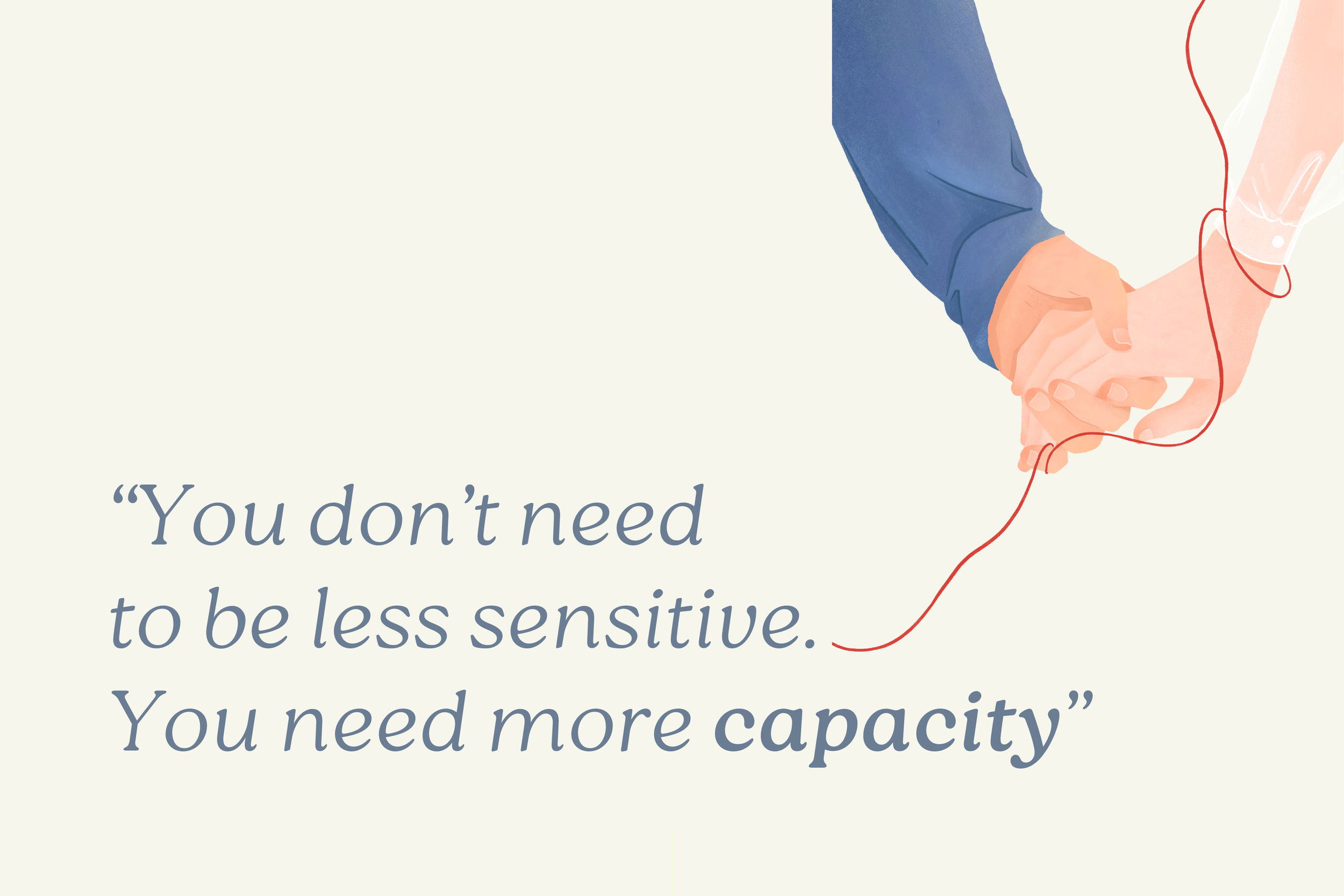
You don’t need to “be less sensitive” to have healthy relationships - what you need is a different way of managing overwhelm, conflict, and emotional intensity so your sensitivity stops feeling like it’s running your life.
The goal isn’t to toughen up or care less. It’s learning how to stay grounded, regulated, and connected without suppressing what makes you you.
Here’s how to make your sensitivity feel like a strength - not a source of stress.
First, Sensitivity Isn’t the Problem—Overwhelm Is
You’re taking in more information than others are
As an HSP, you have more emotional-processing depth. You feel your emotions intensely - more so than the average person. You also feel more empathy towards others, which corresponds with more regions of your brain firing (Acevedo, 2014). In addition, you think deeply as you process situations and consider numerous factors and outcomes.
Your nature makes you sensitive to sensory input. You’re more likely to be jumpy if a loud siren goes by, and you’ll probably have a harder time concentrating if you’re too cold or in a noisy coffee shop. You’ll notice more sensory details, and you’re more impacted by your sensory experience than the typical person.
Your capacity to have a lot of empathy makes you more aware of changes in other people, like a shift in their tone of voice or a subtle facial expression. You constantly take in all of this information, whether you’re consciously aware of it or not, and this can easily lead to overstimulation and overwhelm.
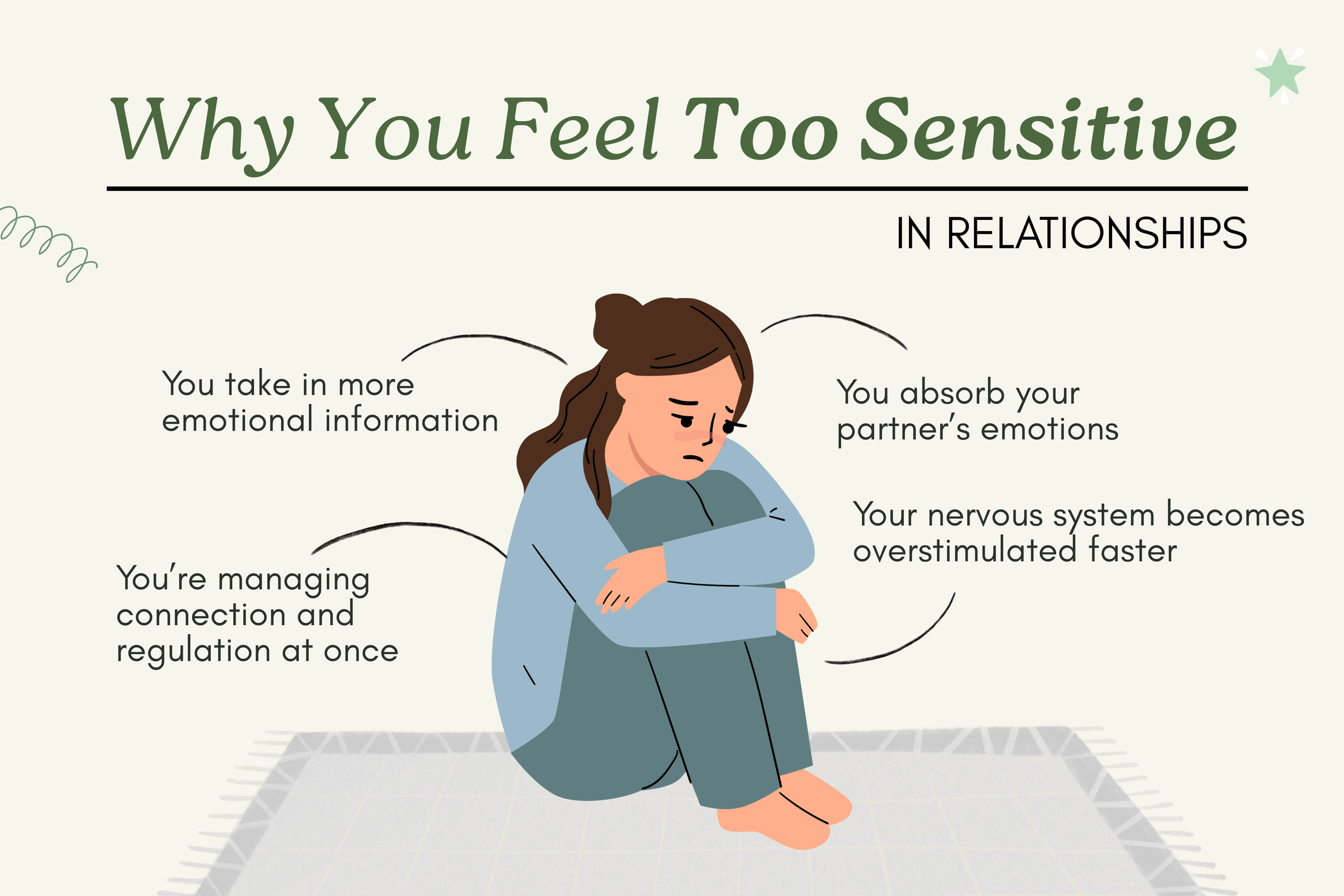
Your nervous system is firing faster
Because you take in so much information, you get overstimulated more easily. Consider this example:
An introverted person who prefers quiet nights at home goes to a party for their best friend’s birthday. It’s loud and crowded, but they stay to support their friend. They have a good conversation with another close friend and spend some time in the kitchen with their bestie. They mostly enjoy themselves, but after a couple of hours, they’re depleted and go home.
A highly sensitive person goes to the same party. The hsp is extraverted (30% are!) and enjoys the party, even feeling energized by it. However, they start to get a headache from the pounding music, and the smell of someone’s perfume makes them nauseous. On their way to get a drink, they run into other friends and get pulled into conversations they have a hard time exiting (because they’re so used to giving their full attention to the other person). Meanwhile, their throat is dry, and they subtly keep checking the time because they’re in charge of bringing out the cake.
They struggle to enjoy themself because they’re stressing about when the “right” moment is to initiate singing “Happy Birthday!” By the end of the night, they’re completely exhausted. In this scenario, overstimulation isn’t emotional weakness. It’s about too much - too much focus on others, too much sensory input, too much perfectionism.
Saying “calm down” never works because -
The real problem isn’t anxiety
HSPs perform well but experience more stress in demanding situations (Xiao, 2025), and
If most people knew what to do to calm down when they’re feeling intense emotions, they would do it without being told. The challenge is that they don’t know what they need to feel calmer.
You’re trying to manage your emotions and your partner’s
Because you have more empathy for others, especially those you love, you feel the pain when your partner is struggling. You absorb their feelings and emotional intensity like a sponge. When you don’t realize this is happening, it’s really tough to sort out which feelings are actually yours vs. which are your partner’s.

If you’re overwhelmed with everyone’s feelings, it’s hard to address conflict. You internalize your partner’s feelings, which prevents you from connecting to your own thoughts, emotions, and needs. If you’re not grounded yourself, it becomes difficult to identify the issue, and it can feel impossible to be able to communicate clearly and directly enough to work through conflict.
Instead, you may catch yourself internalizing all the frustration, which can quickly build into resentment.
If you identify as a highly sensitive person (HSP) and find yourself internalizing your feelings, Thrive Therapy & Counseling can help. Book a call here to get the support you deserve.
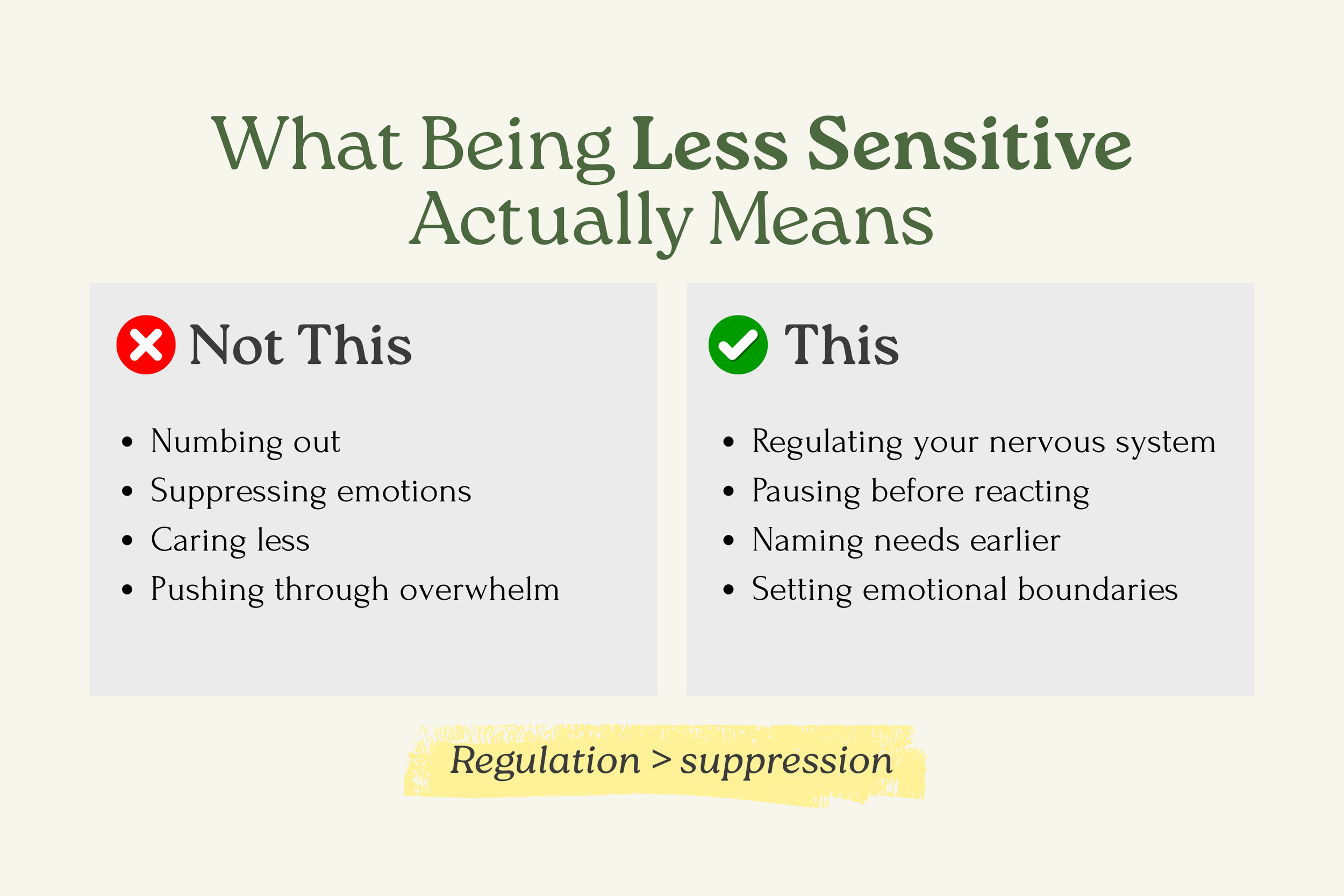
What “Being Less Sensitive” Actually Means (It’s Not What You Think)
It means reducing overwhelm, not reducing emotion
The goal is to reduce how frequently you feel overwhelmed and how intense it feels when you do get overwhelmed. You’re not aiming for numbness. On the surface, numbness might look like emotional regulation, especially if you’re comparing it to the roller coaster of emotions you sometimes feel, but it’s not. Numbness is actually avoidance and dissociation - both of which cause lots of other problems (even if they may seem appealing when you’re caught up in the feels!).
Instead, you’re aiming for emotional capacity. The goal is to have the tools and resources to be able to hold and work through the emotions that arise. Part of these tools includes self-awareness of your needs and limits, so you can interrupt the cycles that lead to overwhelm more often. This is genuine emotional regulation for HSPs.
It means learning to pause instead of react
There is so much empowerment in the art of the pause. You can take charge of the overwhelm and be true to your values and beliefs by learning to slow down your reactions and build a buffer between feeling → interpreting → responding.
A self-check-in using these questions is a great start:
How am I feeling?
What is the intensity? (Rate 1-10. 10 = really strong)
What am I thinking?
What happened before these thoughts and feelings started (i.e., what was the trigger)?
What do I believe about these thoughts and feelings?
What do I need?
Then, distract yourself for 10 minutes, and check back in. Has anything changed?
It means caring without carrying
As an HSP, you’re so good at caring for other people, but sometimes you’re too good at prioritizing others at your own expense. There can be a fine line between being giving and losing yourself.
Support is not self-abandonment.
Instead, you can create healthy emotional boundaries that allow you to love others and yourself. In fact, you’ll be a more loving and supportive partner when you make sure that you’re also meeting your own needs.
Knowing when you have the capacity to give and when you need to focus on yourself creates a foundation for a strong relationship. Having these emotional boundaries keeps the doors open for communication to flow between you and your partner, rather than building emotional walls that neither of you will be able to move through.
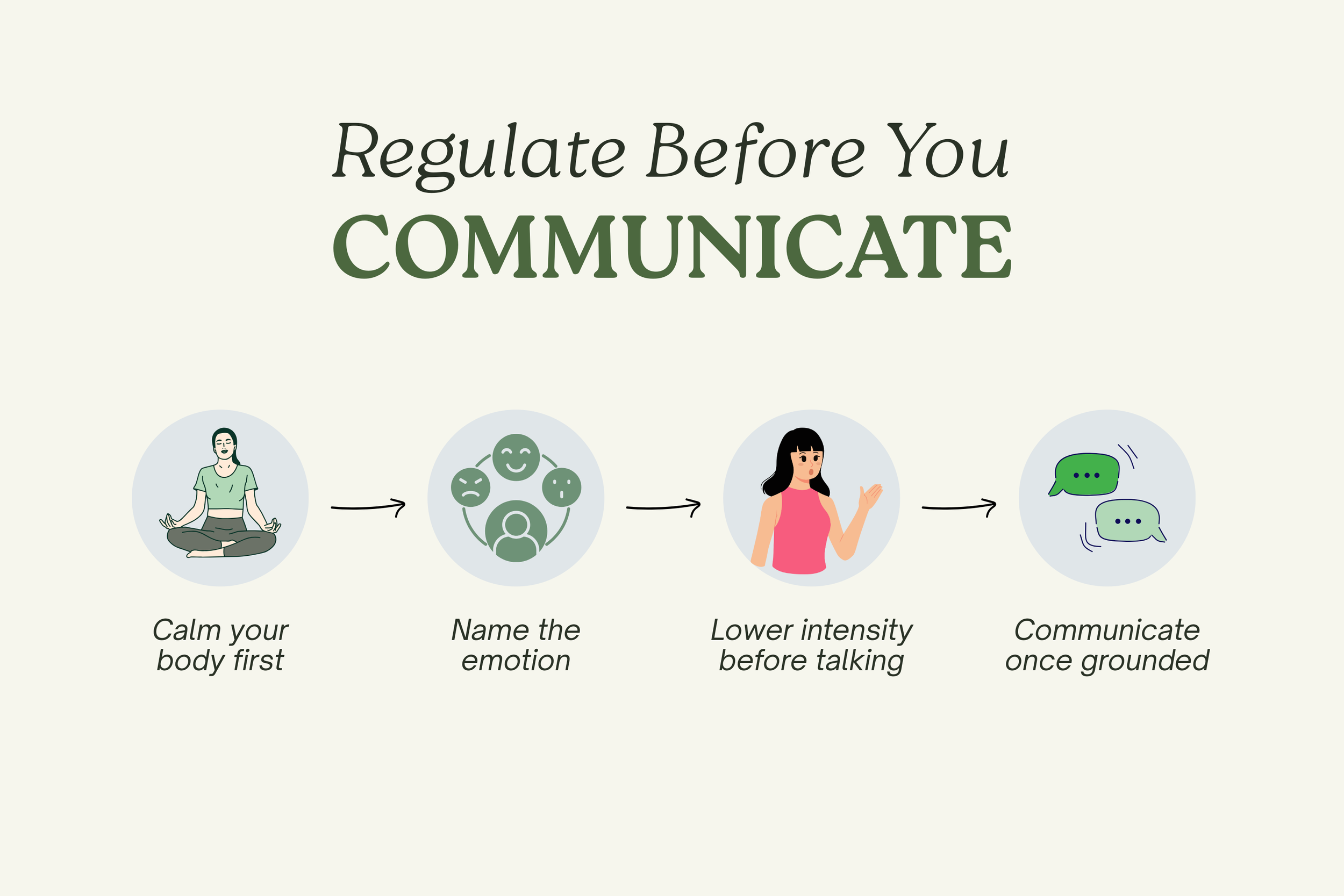
Step 1 — Regulate Before You Communicate
Your nervous system must be calm before clarity is possible
If you’re overstimulated, your nervous system is on high alert. Adrenaline and stress hormones are pumping through your body as your sympathetic nervous system prepares to deal with the danger.
Our brains haven’t evolved to distinguish well between a-tiger-is-about to-eat-me-RUN danger, and I’m-frustrated-with-my-partner danger. So, if you’re already amped up, it can escalate an argument fast. Watch out for these physiological signs that you’re overstimulated:
Feeling panicked or a strong sense of urgency (especially if the feeling doesn’t match the seriousness of the situation)
Racing heart
Tense muscles
Being sweaty, overheated, or shaky
Feeling exhausted
Desire to escape or hide
Quick self-regulation practices for HSPs
90-second emotional reset - Neuroscience has found that when we feel an emotion, the chemical surge connected to that emotion lasts about 90 seconds, unless we add fuel to it with our thoughts and actions. The next time you’re overcome with a strong feeling:
Place both feet on the floor.
Imagine that roots are growing out of your feet, connecting you to the earth and grounding you.
Breathe slowly (inhale for a count of 4, exhale for a count of 5).
Continue for 90 seconds to 2 minutes to allow the wave of sensations to pass.
54321 - This is one of my favorite ways to use your senses to ground yourself. It’s simple, quick, and requires enough focus to distract you from what else is going on.
Name 5 things you see.
Name 4 things you hear.
Name 3 things you feel with your sense of touch.
Name 2 things you smell.
Name 1 thing you taste.
Creating space before responding
It’s important to slow down before you react, so you don’t say or do something that you’ll regret later.
Try this self-check in (listed below):
— How am I feeling?
— What is the intensity? (Rate 1-10. 10 = really strong)
— What am I thinking?
— What happened before these thoughts and feelings started (i.e., what was the trigger)?
— What do I believe about these thoughts and feelings?
— What do I need?
— Then, distract yourself for 10 minutes, and check back in. Has anything changed?
Learn your early warning signs of overwhelm
The best way to learn your warning signs is to imagine you’re a scientist and gather data about your experience. When you start to feel overwhelmed, get curious about the body sensations you’re experiencing and any urges you’re having.
Common early signs are:
Tightness in the chest
Fast breathing (shallow breaths, may feel like you’re panting)
“Shut down” impulse (urge to escape, hide, or freeze)
Step 2 — Communicate Your Needs Clearly (Before You Hit Overwhelm)
HSPs often communicate too late
Because you don’t want to upset anyone and you tend to put other people’s needs ahead of your own, it’s common to wait too long to communicate. When you delay, the feelings and resentments build, and you start from a place of being overloaded and overstimulated, which doesn’t usually go well.
When this happens, partners feel blindsided. They can’t read your mind and may have had no idea that a frustration was brewing, especially because they may not be as adept at noticing small cues as you are. For your partner, it can seem completely out-of-the-blue when your frustration suddenly erupts, even if it’s been building gradually over time.
It’s very common to assume that our partners understand us and know what we need, but please remember that no one is a mind-reader, even if they know you really well. It’s actually more helpful to you and your partner when you communicate clearly and explicitly.
Scripts for calm, clear communication
It’s easy to overthink how to communicate, and these are not skills we’re taught in school (although I really wish they were)! When you’re feeling overstimulated and overwhelmed, try these simple statements to explain and ask for what you need:
“I need time to process this, but I’m not disconnecting. Can we follow up tomorrow?”
“I want to talk about this, but I need 20 minutes to reset.”
If you’re not sure what to say in the moment, a good phrase to have in your back pocket is: “Let me think about it, and get back to you.”
This gives your nervous system the time it needs to reset and allows your deeply thinking brain precious time to reflect and process. And, this statement works in most situations!
How to ask for reassurance without apologizing
Please know that reassurance is not neediness. It’s very human to need reassurance and validation from time to time, especially from the people you’re closest to.
When you’re intentional about occasionally asking for reassurance, it can go a long way toward helping you regulate your emotions. There’s nothing quite like hearing how much your partner loves or appreciates something about you. And, keeping your requests intentional and occasional can give you the reassurance you crave while not becoming draining for your partner.
Step 3 — Build Boundaries That Protect Your Nervous System
Sensitivity becomes painful when boundaries are missing
Watch out for these signs that you’re boundary-depleted:
Resentment
Feeling drained, like you have nothing left to give
People-pleasing
Overcommitting
Chronic stress or anxiety
Saying “yes” quickly leads to resentment when you don’t take time to pause and reflect on what you want and need. The immediate “yes” is often about pleasing someone else, instead of considering what is best for you.
Conversely, you may agree because you get excited (you really do feel emotions more strongly), but when you slow down and think about it, you realize there are legitimate reasons why it’s better for you to decline this time.
Micro-boundaries for everyday situations
If you notice that you’re becoming overwhelmed, it’s ok to leave or take a break. You can end a conversation early with a simple, “Excuse me, I need to check on something,” or you can make an early exit from a party with an “I’m wiped. I need to get some rest. So good to see you!”
Remember your phrase to keep handy? “Let me think and get back to you” is an excellent way to create a pause, and buy yourself time to reflect on how to respond.
Taking sensory breaks is another helpful micro-boundary. Closing your eyes for a few minutes, putting on noise-cancelling headphones, creating a scent-free space in your home, or practicing slow, rhythmic breathing are great options to help you regulate.
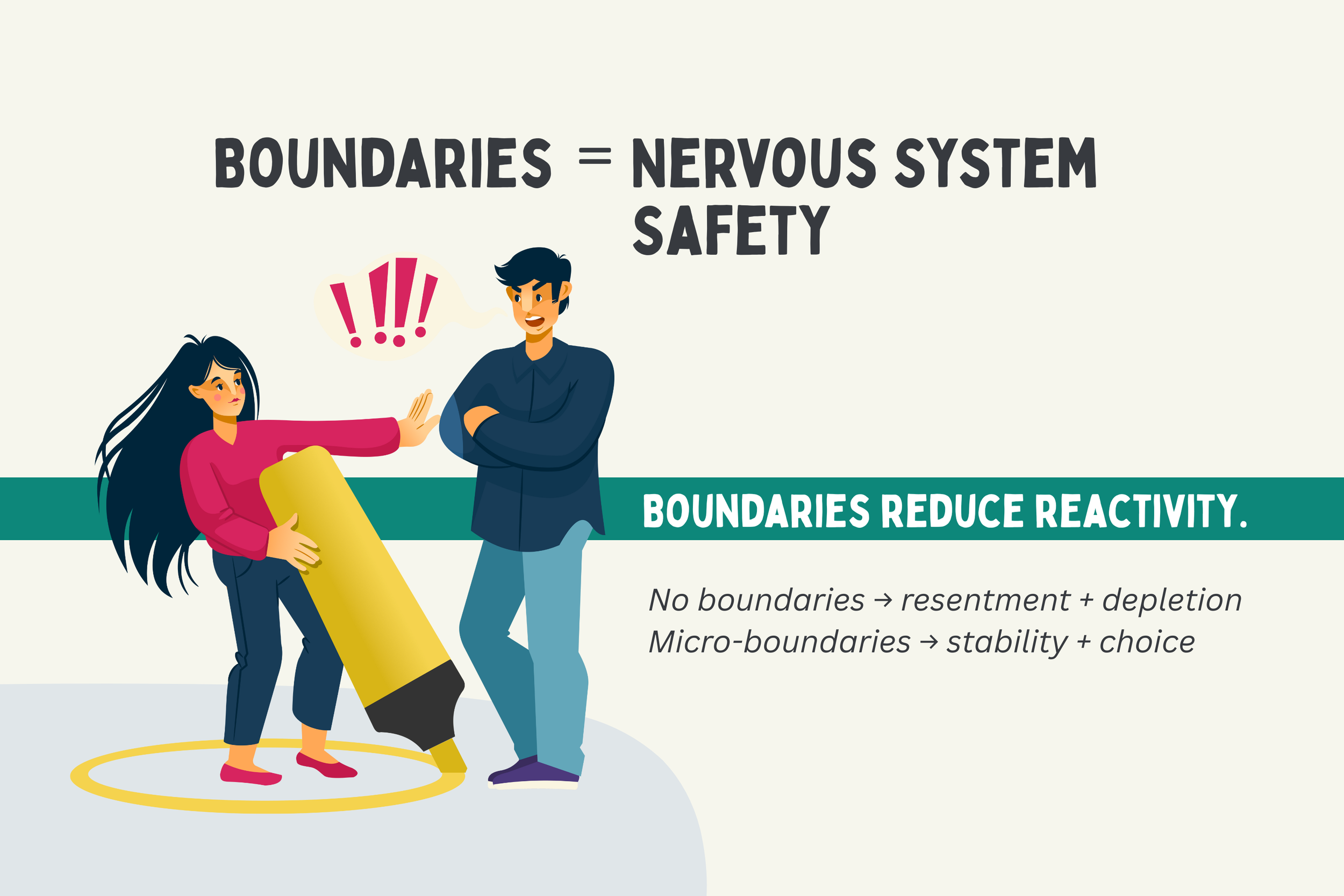
Boundaries make you less reactive—not more rigid
Boundaries reduce emotional volatility because they create space for you to check-in with yourself. Thus, you can identify your own thoughts, feelings, and needs. This doesn’t mean that other people’s needs are unimportant. It’s just about you considering your own needs. As an adult, it’s your responsibility to take care of yourself.
Boundaries also create calm. You don’t have to rush around and overextend yourself when you’re setting healthy boundaries. You also don’t have to overgive to the point of exhaustion, burnout, or depression. Boundaries can help you stay in the sweet spot between overwhelm and underwhelm more often.
Step 4 — Stop Attuning to Your Partner More Than Yourself
The HSP autopilot: monitoring other people’s emotions
Because of your nature, you pick up on moods instantly. Plus, your empathy makes you want to help other people out and smooth over the rough edges.
So, you adjust before they ask. You shift your response, or you give more to accommodate others. This is all very nice and supportive, but it can drain and overwhelm you. After all, it takes a lot of emotional energy to take in all this info and make adjustments.
Ask yourself this question daily:
“Is this my feeling or someone else’s?” It seems simple, but it’s so easy for HSPs to lose track of what is yours vs. what is someone else’s.
How to stay connected without taking responsibility for their emotions
Healthy empathy is about checks and balances. It includes asking your partner or loved one, “How can I help?” or “I want to support you. What do you need?” Then, check in with yourself about whether the request is doable for you. This helps you maintain a healthy balance.
Emotional overfunctioning happens if you try to mind-read. You get caught up in assuming what your partner needs, doing that, and then you may feel angry or resentful if it doesn’t help.
Allow your partner to have their moods. Of course, you care, and you want to help. And, you prefer it if everyone is calm and well-adjusted, so it suits you when your partner is in a good mood.
But remember that your partner is their own person with their own emotional ups and downs. This is part of being human. When you’re close to someone, you naturally see these fluctuations with a magnifying glass.
If you feel yourself pulled in too much or trying to fix it, repeat this mantra:
“This is not mine to fix. It’s ok for _______ to be upset. I will help when I can, and I will re-focus on myself when I need to.”
Step 5 — Reduce External Overstimulation Before It Becomes Relationship Overwhelm
Your sensitivity is impacted by sleep, noise, and sensory input
Your emotional regulation is physical. As an HSP, you have sensory sensitivity, which means that you’re more negatively impacted than the average person when you don’t get enough sleep, are in a loud environment, or experience strong sensory input like strobe lights, smoke, or sirens.
You also get overwhelmed faster in conversations because you’re taking in so much information. You’re focused on the discussion, plus you’re noticing all the cues your partner is giving, especially nonverbals; adjusting your responses, AND you’re picking up on the other details in the environment. It’s a lot!
Create a pre- and post-conflict routine
To soften the “impact” on your nervous system, give yourself time and space to pause before and after a difficult conversation. When you create such “bookends,” you can use the time to ground (deep breathing, pressing your feet into the floor, doing a body scan). and reconnect with your values about why it’s important to you to address this issue.
This is also a great time to practice self-compassion mantras like:
This is hard for me.
Many other people struggle with conflict too. I’m not alone.
May I be kind to myself (or may I accept myself) in this moment (Neff, n.d.).
Build a weekly recharge plan
Even for extraverted HSPs, it’s really helpful to build in some alone time each week. This gives you time to process your experiences, and it offers you the ability to connect to yourself without all the constant input from other people. Journaling can be an especially meaningful exercise during this time (Check out these ideas for journaling prompts to help you get started.).
Having a quiet sensory space is also very helpful for HSP emotional regulation. This can be anything from creating a corner of a room that feels cozy to you (think warm blanket, comfy seat, soft music, beverage you enjoy) to having a favorite park bench where you can be in nature - birdwatching, seeing the clouds go by, or noticing the changing seasons (maybe having some noise-cancelling headphones at the ready for times when it’s not as quiet as you would prefer).
Predictable routines are yet another strategy to help you recharge each week. HSPs tend to take comfort in having a familiar routine and knowing what to expect. This can be as simple as enjoying a bedtime meditation practice, taking a walk each Saturday morning to your favorite coffee shop, or indulging in a bubble bath once a week. The routine doesn’t need to be grandiose, just something you look forward to and can take refuge from its predictability.
When “Being Less Sensitive” Isn’t Healthy to Try
If your partner minimizes your feelings, you will naturally feel overly sensitive
While any partner will occasionally miss the mark by minimizing your feelings or not understanding you, this should be the exception, not the norm. If your partner regularly and consistently invalidates your feelings, it may be a sign that your relationship is unhealthy. You don’t need to adjust to being mistreated.
If your partner frequently criticizes or mocks you and you feel “too sensitive” when you get upset, this is about them, not you. Healthy relationships center on mutual respect. We all need to hear constructive feedback sometimes (which might sting like criticism to your sensitive nervous system), but the purpose of such feedback is to offer insight and help you grow. When the criticism is mean or mocking or too frequent, it’s not helpful, and you don’t need to accept it.
If you’re an HSP who’s tired of thought spirals, book a call with Thrive Therapy & Counseling for HSP‑informed care. Thrive Therapy & Counseling offers a safe, supportive space to help you process your thoughts and find healthier ways to cope. Connect with us here.
If you're constantly overstimulated at home
Loud, chaotic, unpredictable environments can be very difficult for HSPs' emotional regulation. If this describes your home environment, it’s more helpful to tweak your environment to be less overwhelming, rather than you trying to be less sensitive in response (which doesn’t align with your nervous system). If you have a big family, roommates, or are in an especially chaotic season of life, look for small changes you can make - a few minutes of alone time in your car before you come inside, saying “no” to something you would normally agree to, time each week in a space you find soothing.
You can’t regulate when you’re in chronic stress because your parasympathetic nervous system never gets a chance to come online. Chronic stress = hypervigilance = overwhelm and overstimulation for highly sensitive people.
Sensitivity is a signal—not a flaw
If you’re feeling overstimulated, your body is telling you something. Try to pause and ask yourself what you need. It might be necessary for you to take a break and do some
self-soothing to decrease the overwhelm. A world of caution - if you ignore your body’s cues, they’re likely to get louder and more problematic.
At times, your sensitivity might point to misalignment. If you are chronically stressed and overwhelmed at work or at home, there may be something about your environment or the relationships you’re in that needs to change. Sometimes it’s possible to make changes within your environment so that it better aligns with your sensitivity. At other times, the best choice for you might be to exit the problematic situation, in order to get emotionally regulated again.
The better self-care and boundaries you have, the more emotionally regulated you’ll be and the less that pesky overwhelm will pop up.
It truly is possible to care for your sensitive self within the context of your relationships.
References:
Acevedo BP, Aron EN, Aron A, Sangster MD, Collins N, Brown LL. The highly sensitive brain: an fMRI study of sensory processing sensitivity and response to others' emotions. Brain Behav.
2014 Jul;4(4):580-94. doi: 10.1002/brb3.242. Epub 2014 Jun 23. PMID: 25161824; PMCID:
PMC4086365. https://pmc.ncbi.nlm.nih.gov/articles/PMC4086365/
Neff, K. (n.d.). What is self-compassion? https://self-compassion.org/what-is-self-compassion/
Xiao, L., Baetens, K., & Deroost, N. (2025, October 21). Caution under pressure: How highly sensitive people stay focused. Sensitivity Research.
https://sensitivityresearch.com/caution-under-pressure-how-highly-sensitive-people-stay-focused/