
How to Stop Feeling “So Sensitive and Emotional” in Your Relationship
Lauren Ash
Intro
You feel “too sensitive” or “too emotional” in your relationship because your emotional system is working overtime—not because you're dramatic or overreacting.
There are real, neurological reasons HSPs experience emotions more intensely, and once you understand what’s happening beneath the surface, you can shift out of overwhelm and into grounded emotional clarity.
Here’s how to stop feeling hijacked by your emotions without shutting them down.
Feeling ‘Too Emotional’ Doesn’t Mean Something Is Wrong With You
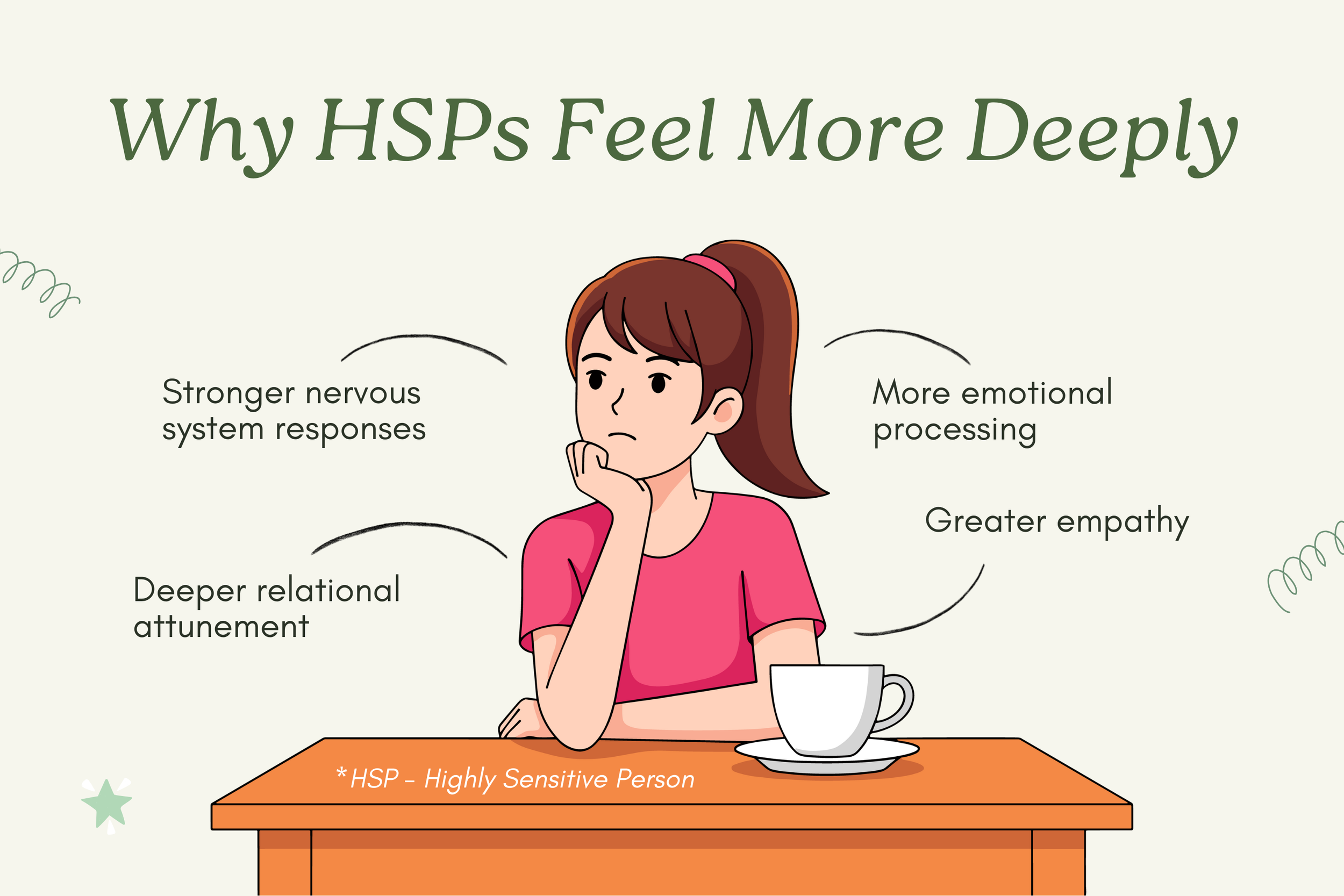
HSPs process emotions more deeply than 80% of people
20-30% of the global population are HSPs. Not only do HSPs have more brain activity in response to other people’s emotions (Acevedo, 2014), but you also show more interpersonal sensitivity. A 2022 study concluded that HSPs have more empathy, a better understanding of what other people are thinking, AND are more anxious to please others (Tabak, 2022). Yes, the science confirms that you really do feel more deeply than other people!
As an HSP, you might be familiar with how intensely or deeply you feel things, which is a gift and can also be challenging at times! You probably experience profound highs and lows when it comes to feelings–intense joy, deep empathy for others, rich connections with those you care about, and you might also experience pain and overwhelm more acutely than others.
Many HSPs feel that because they have strong reactions to things, be it feelings, situations, or other people, that their reactions are automatically wrong, which is not the case! You might compare yourself to others who have “less intense” reactions, framing your own reactions as
bad or “too much,” but instead of putting yourself down, what if you just considered that your reactions are different from those of others, and that’s okay!
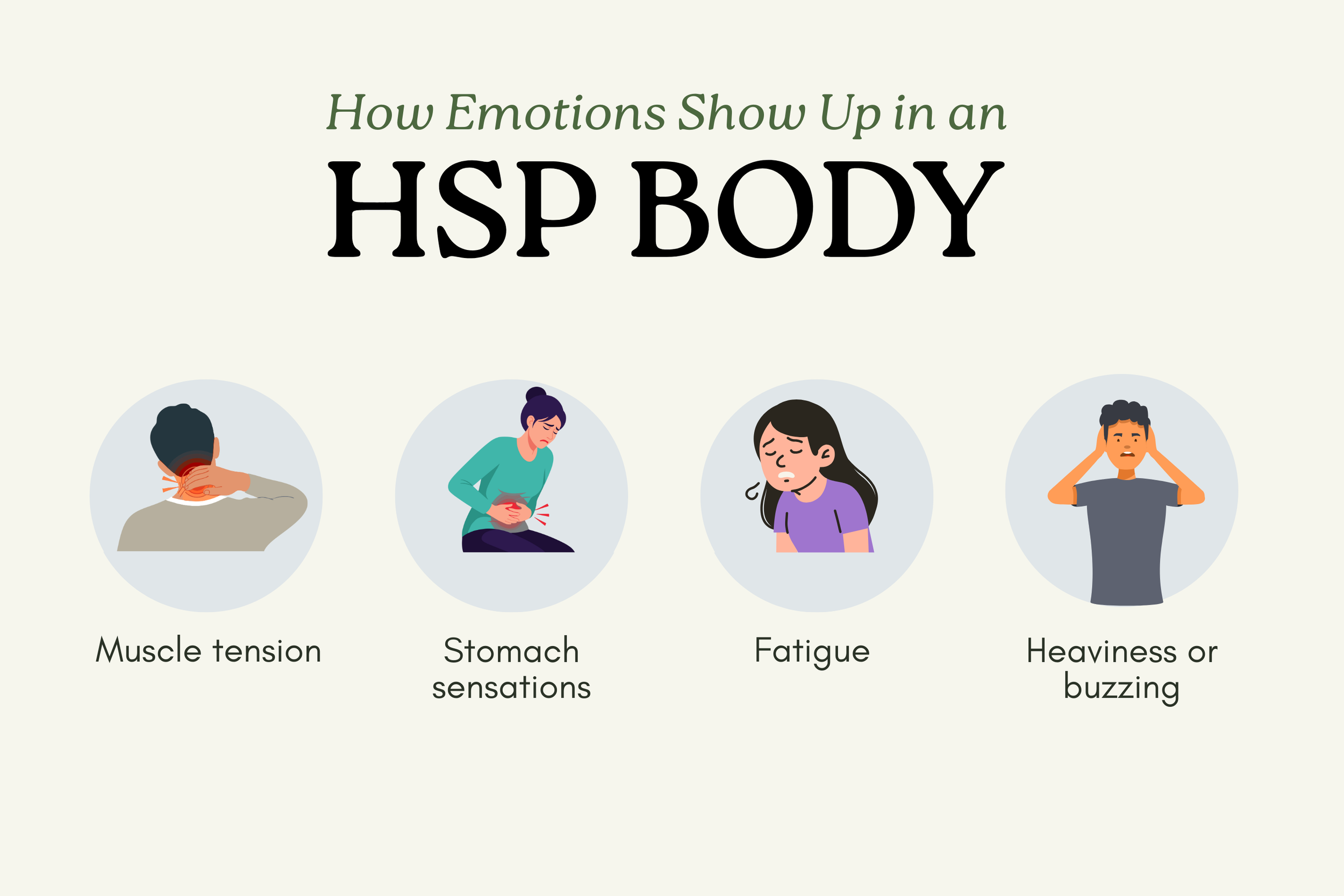
Your body feels emotions with more force
As an HSP, you might experience emotions in a more physical way due to your nervous system processing stimuli more intensely than others. What someone else might register as mild stress, you might experience as muscle tension, sensations in your stomach, or overall fatigue. Your body takes emotional experiences and translates them into physical sensations that you can identify. You might need more time than someone else to come down from intense feelings, so practice self-compassion when you feel particularly flooded by feelings and physical sensations.
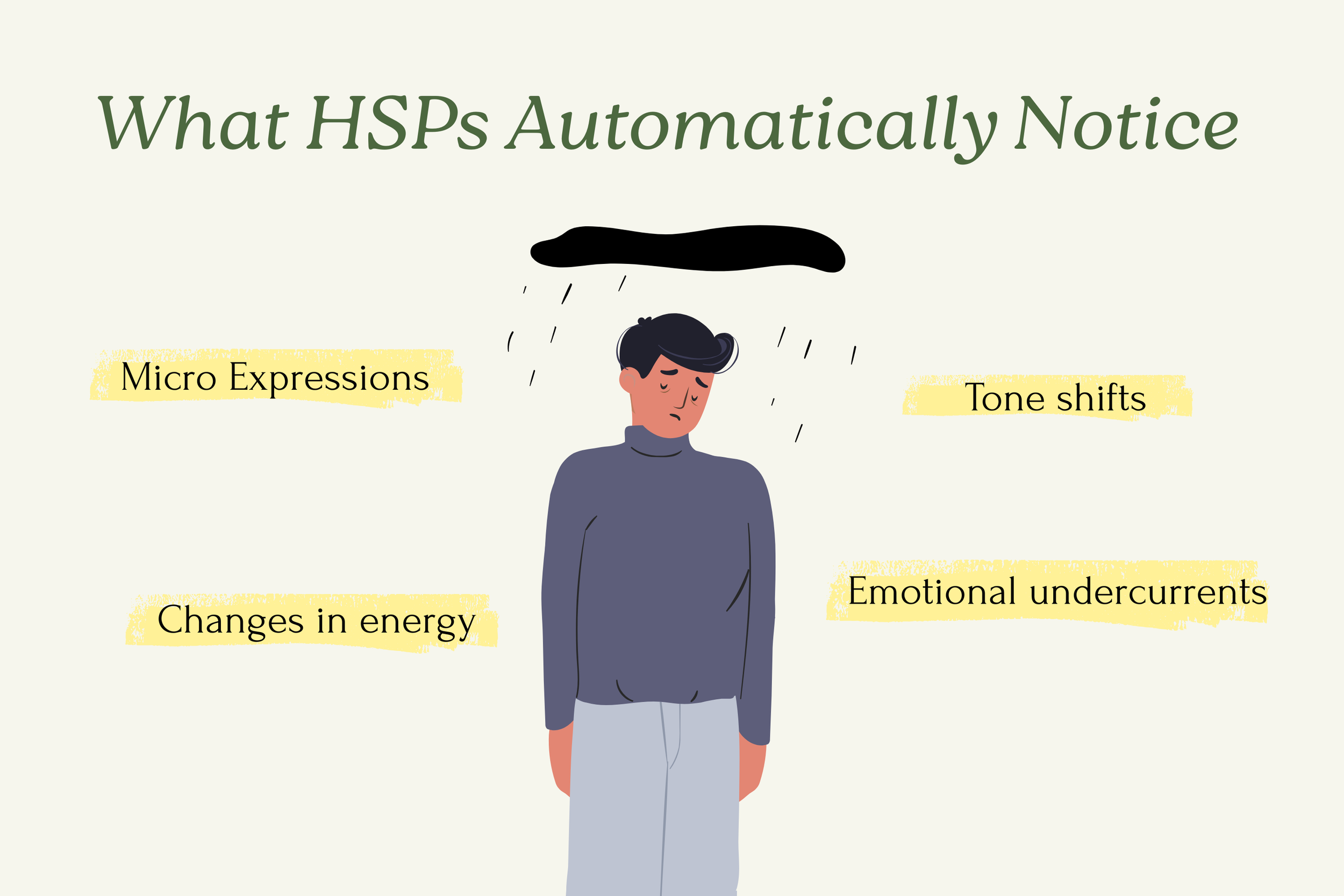
You're reacting to more data than others are
Because your nervous system reacts to stimuli more intensely than others might, it’s also helpful to consider what types of stimuli you might be registering at any given time. Things like tone shifts in people’s voices, micro-expressions of others when you’re speaking to them, and even the emotional undercurrents of people you’re around might impact you more intensely than they would someone else.
Have you ever been spending time with someone and felt as though you’ve taken on their energy, even though it’s wildly different from your own? That is probably your deep sensitivity at work! Having more understanding about why you might feel drained after social interactions can be helpful in building self-awareness and also recognizing ways you can care for your needs.
If you’re an HSP in a relationship who’s tired of thought spirals, book a call with Thrive Therapy & Counseling for HSP‑informed care. Thrive Therapy & Counseling offers a safe, supportive space for HSPs to help you process your thoughts and find healthier ways to cope. Connect with us here.
Why Your Emotions Feel So Big in Relationships
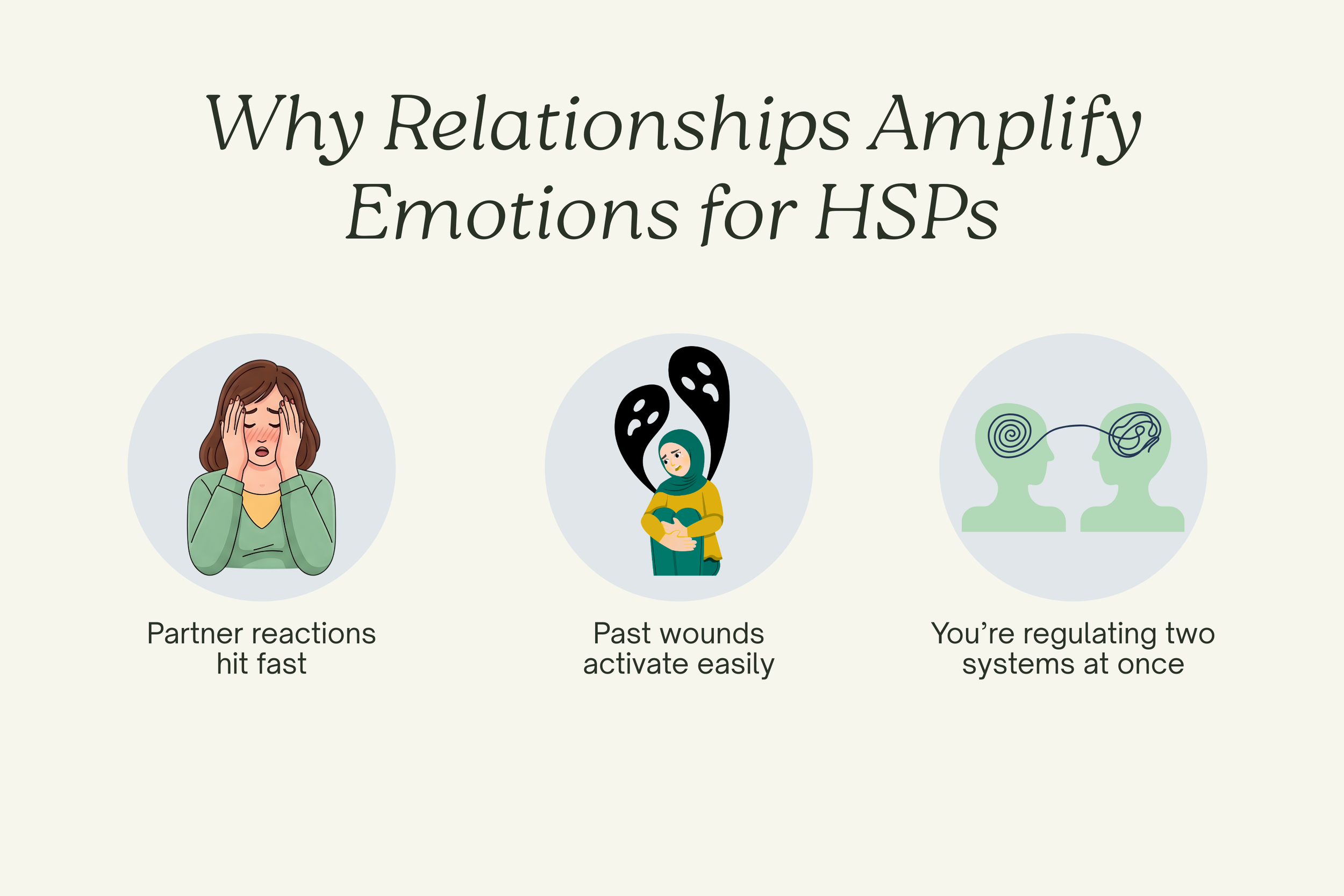
Your partner’s reactions hit your nervous system quickly
Because you’re wired to pick up on these subtle stimuli from others, relationships can sometimes be challenging to navigate. While your sensitivity is incredible for fostering connection, it might also lead to conflict feeling like a literal threat, or silence from your partner feeling like a harsh disconnection.
This is due to the neurological reality that HSPs process interpersonal dynamics differently than others, and they often absorb and mirror the emotions of others. Understanding that your nervous system can become dysregulated very quickly can be helpful for your partner in recognizing that your reactions are authentic responses to the stimuli you’re receiving, not random overreactions.
You’re carrying past wounds into present moments
If you grew up highly sensitive, there’s a good chance you weren’t always treated kindly by those around you, especially if they didn’t understand your sensitivity. Your parents may have reacted poorly to your “big feelings,” or perhaps you’ve been told you’re “too much” or have a history of chronic invalidation by others.
Even one experience like this can be painful, but if you’ve had them spread across a lifetime, there’s a good chance you’ve been impacted in significant ways. We often carry our childhood experiences with us into adulthood and don’t even notice how they’re playing out or impacting us in the present. This is where building self-awareness can help!
You’re trying to regulate yourself and the relationship
As an HSP, you might have a tendency towards constantly monitoring your partner's emotional temperature, or scanning for signs of upset or disconnection before conflict even arises. This sort of hypervigilance can lead to exhausting emotional multitasking—simultaneously managing your own feelings while trying to anticipate, absorb, and regulate your partner's mood.
You might find yourself trying to avoid "ruining the vibe," or suppressing your own needs or reactions to keep the relational atmosphere smooth and comfortable. While this might create a sense of harmony in the short term, it often comes at the cost of losing touch with your own emotional truth and building resentment over time. Learning to balance your natural attunement with healthy boundaries means recognizing that you're not responsible for managing everyone's emotional experience, including your partner's.
Step 1 — Learn Your Emotional Triggers and Patterns
HSP triggers are faster and sharper
You might notice that certain communication styles can feel like sensory or emotional assaults that immediately activate your nervous system. A raised voice or harsh tone doesn't just signal anger—it can feel physically jarring, triggering an intense reaction in your body even when the content of the message isn't particularly serious. Sudden surprises, whether positive or negative, can be overwhelming because HSPs need time to process and prepare for transitions, making spontaneity feel destabilizing rather than exciting.
Criticism, even when delivered in the most gentle way, often cuts deeper and lingers longer for HSPs, who tend to internalize feedback intensely and replay critical moments repeatedly in their minds. Understanding these triggers isn't about asking others to walk on eggshells around us, but rather recognizing that what feels like a minor interaction to some can register as a major event in an HSP's sensitive system.
Write down what sets off your biggest reactions
Try exploring what you notice about what triggers you–either by making a list or freestyle journaling. Think about moments with loved ones or simple daily interactions with others that stand out to you and what reactions you had to them. Self-awareness around your patterns can lead you toward empowerment vs discouragement.
Emotions are messengers, not emergencies
When we feel activated, it can feel so overwhelming in the moment that our system reads it as a reason to panic. HSPs, being more prone to reactivity, can be more likely to sense an emergency where there isn’t one. Remind yourself to practice curiosity instead of self-judgment, and ground yourself in the moment.
Step 2 — Create a Pause Between Feeling and Responding
The emotional “gap” is where you regain control
Try giving yourself an “emotional gap” of at least 10 seconds so you can practice grounding (by doing deep breathing or another favorite grounding technique) and regain a sense of control over yourself. Just by allowing yourself this brief delay can reduce your reactivity in a significant way.
Simple grounding practices that work quickly
You can experiment with different grounding techniques like deep breathing or sensory anchoring experiences. One great example of this is holding ice in your hands or submerging your hands in cold water. Do this for a few moments and notice the sensations in the moment, and take note of how you feel after. You might notice you feel less activated than before the activity! If you feel up for it, taking a brief cold shower can also be an effective way to regulate overwhelming sensations, such as heightened emotions. Finding a grounding activity that fits your specific needs can provide so much empowerment, because you know it’s always there for you when you need it.
How to let emotions pass without getting swept away
It can be easy to feel like your emotions are running the show when you feel activated, and you might not even be able to accurately identify what it is you’re feeling in that reactive state.
Practicing grounding can allow you to take a step back and actually label your feelings, which reduces their intensity. It’s not about taking away the feeling entirely, but feeling it without spiraling.
Step 3 — Understand What Your Emotion Is Actually About
Not all strong emotions come from the present moment
For highly sensitive people, it's important to recognize that not all intense emotional reactions are truly about the present moment—sometimes current situations trigger old wounds that haven't fully healed. A partner's late response to your text might activate deep-seated abandonment fears from childhood, or a minor conflict can resurrect emotional memories of past relationships where you were disappointed or hurt.
HSPs often carry these historical hurts close to the surface, and their sensitive systems can struggle to distinguish between past danger and present safety. This means that what looks like an overreaction to a small incident is often actually a response to layers of accumulated pain being activated simultaneously.
Ask this question:
“Is this reaction about now or about something I’ve felt before?”
Emotional layering is common for HSPs
Emotional layering is an incredibly common experience for highly sensitive people, where a single moment in the present can activate multiple emotional memories simultaneously, creating what feels like an overwhelming response. You're not overreacting—you're over-layering, meaning your current frustration about your partner forgetting plans isn't just about today; it's also carrying the weight of every other time you've felt forgotten, dismissed, or deprioritized throughout your life (imagine experiencing your present feelings of disappointment, plus memories of being left out in middle school by a friend group, overlooked by a parent, or let down by a previous partner).
Your sensitive nervous system has catalogued these experiences with vivid detail, and when something in the present even remotely resembles a past hurt, all those layers get activated at once, all stacked on top of each other like bricks. Understanding this layering effect helps you recognize that your intense feelings are valid responses to accumulated experiences, not evidence that you're too sensitive or broken—you're simply processing multiple timelines of pain in a single moment, which is incredibly overwhelming!
Step 4 — Communicate Your Emotions Without Apologizing for Them
You don’t need to justify emotional experiences
HSPs often fall into the trap of minimizing their own feelings because they seem disproportionate to the trigger, but your internal experience is real and worthy of compassion regardless of the circumstances. Trust that if something matters to you emotionally, it matters, period—you don't need permission or a compelling case to honor what you feel. You don't need to justify your emotional experiences or prove they're "big enough" to deserve attention and care.
How to express emotion honestly and calmly
Practicing how to express emotions in an honest and calm way can be helpful, especially when navigating interpersonal relationships. Try using phrases like “I’m feeling overwhelmed, and I need a minute,” or “This brought up a strong feeling, but I’m not upset at you.” You’re still communicating your feelings, but in a grounded and calm way.
Emotional honesty builds safety, not chaos
It’s a common experience for HSPs to believe that expressing their true emotions will create chaos or burden their partner, but emotional honesty actually builds safety and trust in relationships. Partners want clarity about what's really going on with you—they want to understand your inner world, not navigate around a perfectly curated version of you that hides your struggles or needs. When you share your feelings authentically, even the messy or complicated ones, you give your partner the chance to truly know and support you rather than leaving them guessing or feeling shut out. Pretending everything is fine when it isn't creates more distance and confusion than simply saying "I'm having a hard time right now and here's why."
Step 5 — Strengthen Your Emotional Boundaries
Emotional boundaries reduce intensity
It might seem a little scary to imagine setting emotional boundaries with your partner, but it actually reduces the intensity of your emotional experiences rather than increasing distance. When you practice less fusion—recognizing where your feelings end and your partner's begin—you stop absorbing and carrying the emotional states of others as if they were your own.
This differentiation creates more inner clarity, allowing you to respond to situations from your own true self rather than from a place of anxiety about every perceived shift in your partner's mood. Think of boundaries as helpful containers that help you stay grounded in your own experience while still maintaining deep connection with your loved ones.
You can care without absorbing everything
It is very possible to have a healthy amount of empathy for others while not over-identifying with their emotional landscapes. Practicing grounding into the self in moments of overwhelm so you can truly differentiate your feelings from those of others can help with this. Learning to hold space for someone else's struggle without merging with it is one of the most important skills HSPs can develop in relationships.
You get to decide what feelings are yours to hold
Just because you can sense your partner's anxiety, frustration, or sadness doesn't mean it's your job to absorb it or fix it. HSPs often unconsciously take on the role of emotional regulator in relationships, believing that if they can just manage everyone's feelings well enough, everything will be okay—but this is deeply exhausting and ultimately impossible. You can be compassionate and supportive without making yourself responsible for another person's emotional balance; sometimes the most loving thing you can do is let them sit with their own feelings while you tend to yours.
Step 6 — Build a Support System Outside Your Partner
Your partner cannot regulate all your emotions
It’s important to remember that your partner cannot regulate all your emotions, and expecting them to creates an unsustainable dynamic that's unhealthy for both of you. Placing that level of responsibility on them generates enormous pressure—they might start walking on eggshells, afraid that any misstep will send you spiraling, which can lead to resentment and exhaustion over time. For you, this level of emotional dependency keeps you from developing your own internal resources and leaves you perpetually vulnerable, as your stability becomes entirely reliant on another person's availability and mood.
Emotional hygiene for HSPs
Having multiple outlets for your emotional experiences lightens the load on any single relationship and prevents you from overwhelming your partner with every feeling you have. Emotional distribution means you're not funneling all your processing, venting, validation needs, and support-seeking through one person, which creates unsustainable pressure and can make your partner feel like they're constantly failing you. When you spread your emotional needs across different sources—talking through a work frustration with a friend, processing childhood wounds with a therapist, working through daily anxieties in your journal—you come to your partner with more clarity and less desperation.
When ‘Feeling Too Sensitive’ Is Actually a Sign of Misalignment
If your partner dismisses your feelings, the intensity increases
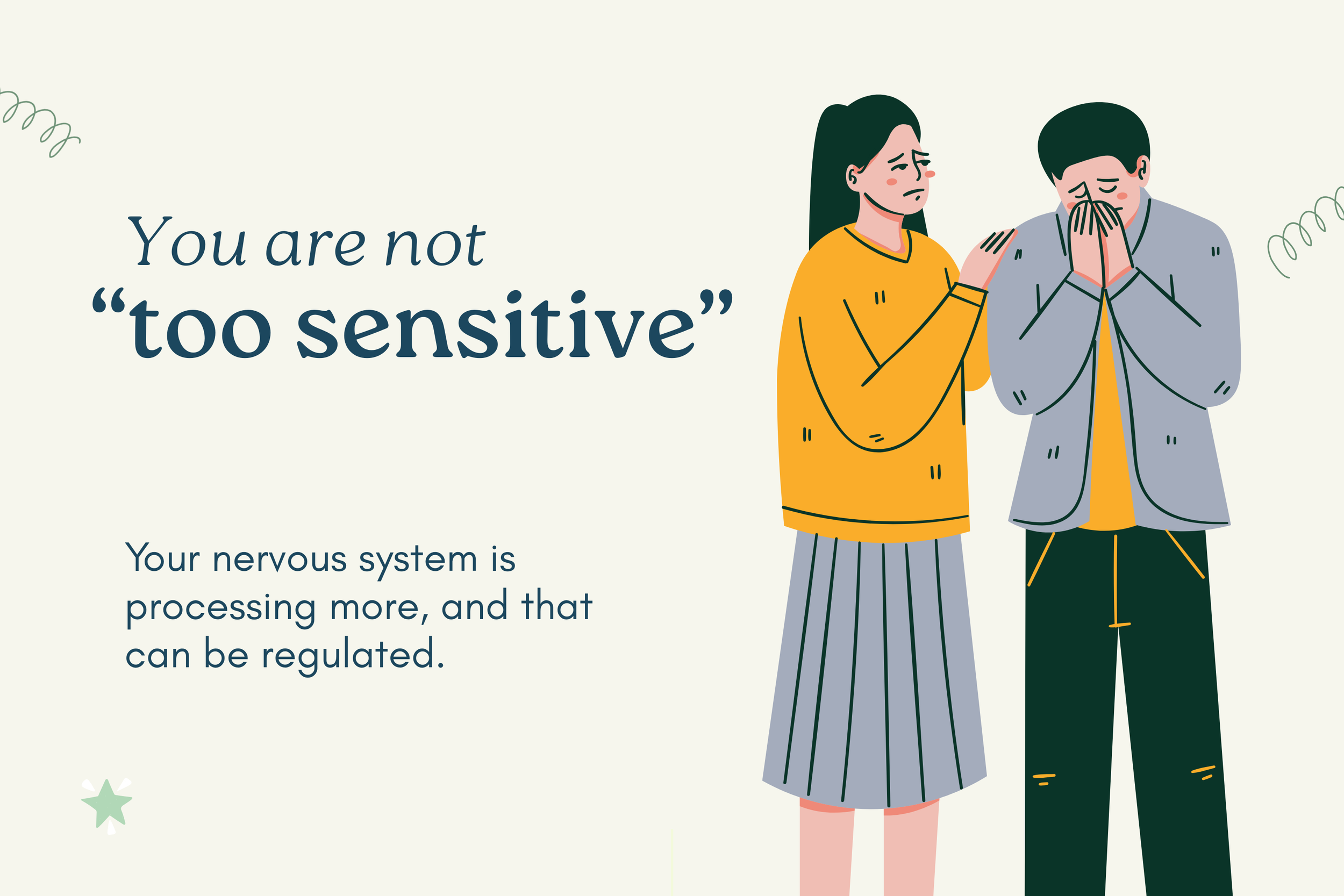
If your partner dismisses your feelings or minimizes your reactions, the intensity of your emotions will almost always increase rather than decrease. Emotional invalidation—being told you're "too sensitive," "overreacting," or "making a big deal out of nothing"—doesn't make HSPs calm down; it triggers panic, shame, and an even stronger need to be heard and understood.
When you feel unseen or misunderstood, your nervous system escalates in an attempt to communicate just how real and significant your experience is, creating a cycle where dismissiveness breeds intensity and intensity invites more dismissiveness.
A partner who can say, "I hear you, this matters to you, help me understand," will often witness your emotions naturally settling because you feel safe enough to let them move through you rather than fighting to prove that they’re legitimate in the first place.
If you’re always overstimulated at home
If you're always overstimulated at home—whether from clutter, noise, unpredictability, constant activity, or too much time spent scrolling on your phone—your emotional reactions will naturally be more intense because your nervous system never gets to rest. High chaos equals high emotion; when your environment keeps you in a state of sensory and mental overload, you have no bandwidth left to regulate challenging feelings, making small frustrations feel catastrophic.
Creating pockets of peace, predictability, and sensory calm in your living space and daily routines isn't indulgent—it's essential in order to allow your nervous system to regulate so you can show up in your relationship with more resilience and peace.
You’re not too emotional—you’re under-supported
When HSPs are told repeatedly that they're "too much" or "too sensitive," they internalize shame about their nature rather than recognizing they may simply be in environments or relationships that don't provide adequate emotional safety, understanding, or stability. Sensitivity thrives in safety; when you have partners, friends, and spaces that honor your needs, validate your experiences, and provide the calm and consistency your nervous system requires, your emotional intensity often naturally regulates to manageable levels. The problem isn't your sensitivity—it's trying to exist in circumstances that constantly trigger rather than soothe you.
If you identify as a highly sensitive person (HSP) and need tailored support, Thrive Therapy & Counseling can help. Book a call here to get the support you deserve.
References:
Acevedo BP, Aron EN, Aron A, Sangster MD, Collins N, Brown LL. The highly sensitive brain: an fMRI study of sensory processing sensitivity and response to others' emotions. Brain Behav.
2014 Jul;4(4):580-94. doi: 10.1002/brb3.242. Epub 2014 Jun 23. PMID: 25161824; PMCID:
PMC4086365. https://pmc.ncbi.nlm.nih.gov/articles/PMC4086365/
Tabak, B. A., Gupta, D., Sunahara, C. S., Alvi, T., Wallmark, Z., Lee, J., … & Chmielewski, M. (2022). Environmental sensitivity predicts interpersonal sensitivity above and beyond Big Five personality traits. Journal of Research in Personality, 98, 104210.