
Insurance Therapy vs. Private Pay in Sacramento: How to Choose What’s Right for You
Ivy Griffin
If you’re searching for a therapist in Sacramento and filtering for “takes my insurance” first — you’re not being “cheap.”
You’re being practical.
For a lot of people, insurance isn’t a preference. It’s the only option that feels possible.
At the same time, a lot of people also hit a confusing wall:
“I have insurance… so why is it so hard to get in?”
“Why are my options so limited?”
“If I do find a therapist, why does it feel like I’m not getting the level of support I hoped for?”

This post is here to give you clarity — without ripping on insurance therapy and without pretending private pay is for “other people.”
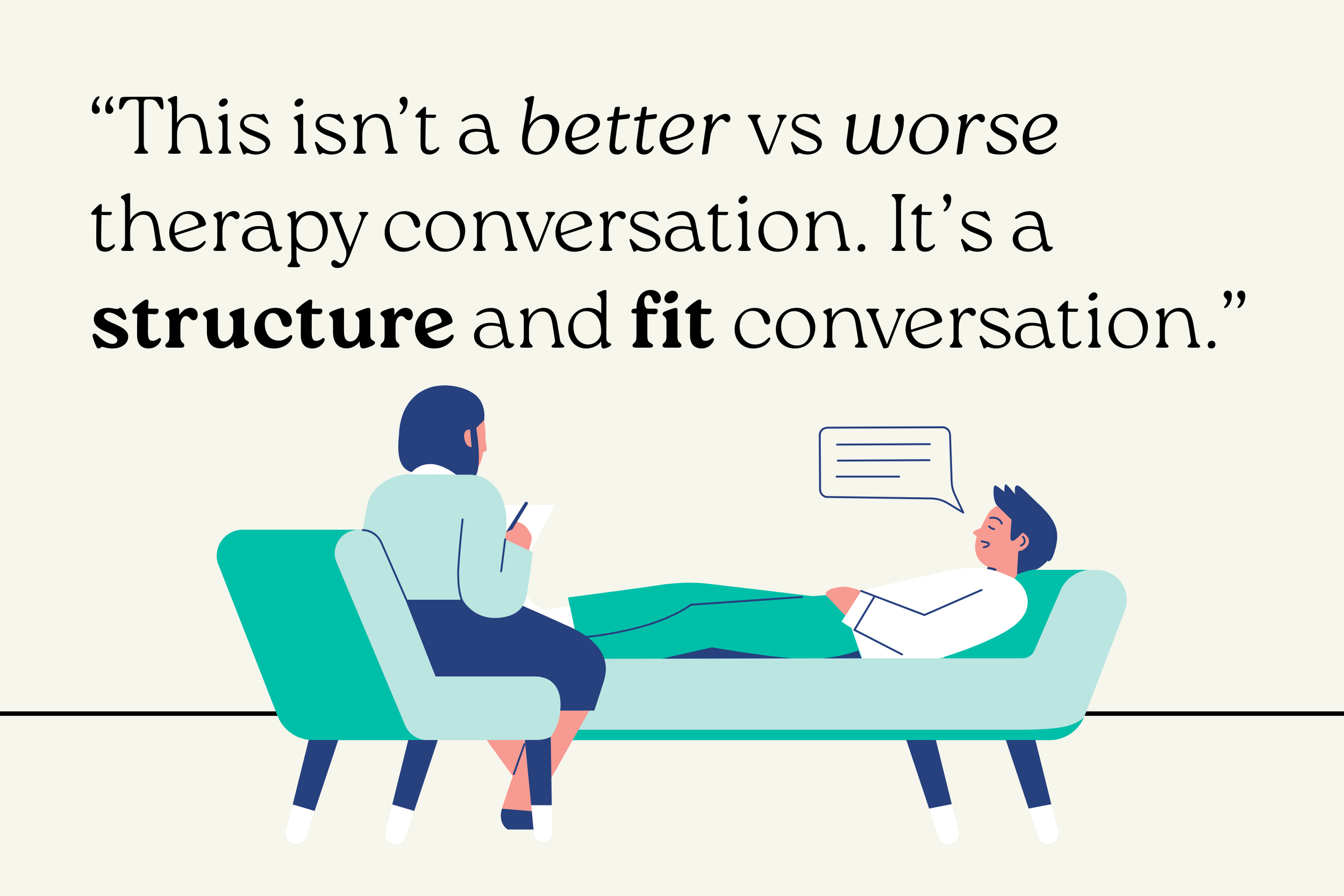
This isn’t a “better therapy vs worse therapy” conversation.
It’s a fit + structure conversation.
Because the truth is: insurance therapy and private-pay therapy are often different care models with different constraints.
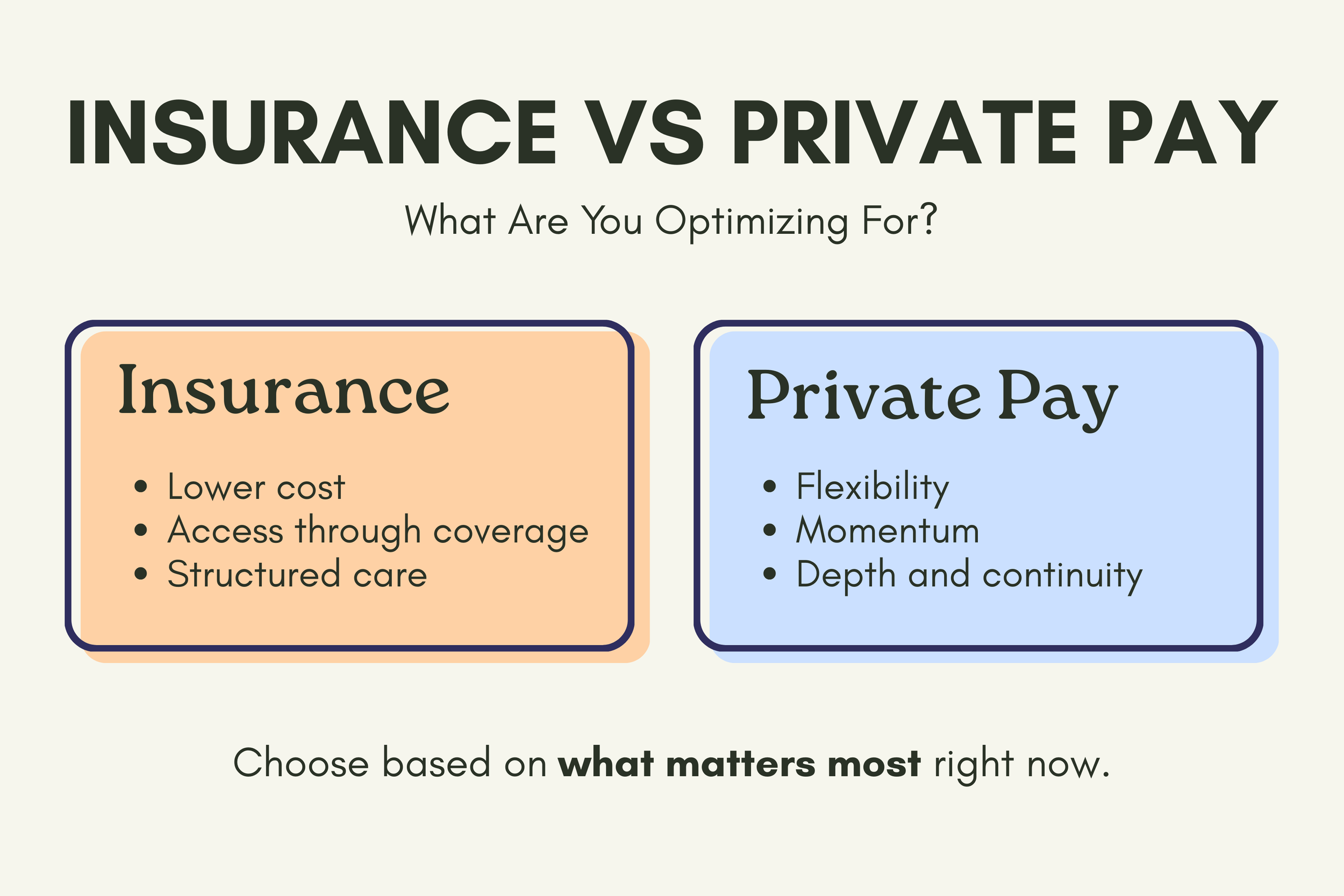
And once you understand the trade-offs, you can make a decision based on what you’re optimizing for right now:
access vs. flexibility
lowest cost vs. momentum
short-term support vs. deeper, longer-term work
system constraints vs. full choice
I’m Ivy, founder of Thrive Therapy & Counseling in Sacramento. We’re a group practice serving teens and adults, and we help clients make this decision every week.
The objection under the objection

When someone asks, “Insurance or private pay?” what they’re often really asking is:
“What if I choose wrong and waste time?”
“What if I spend money and it still doesn’t help?”
“What if I can’t afford this… but I also can’t keep living like this?”
That’s not indecision.
That’s you trying to protect your time, your nervous system, and your future self.
So here’s the reframe that makes this decision cleaner:
You’re not choosing between better or worse.
You’re choosing the level of structure and flexibility that matches your goals and constraints in this season.
A clear way to understand the difference
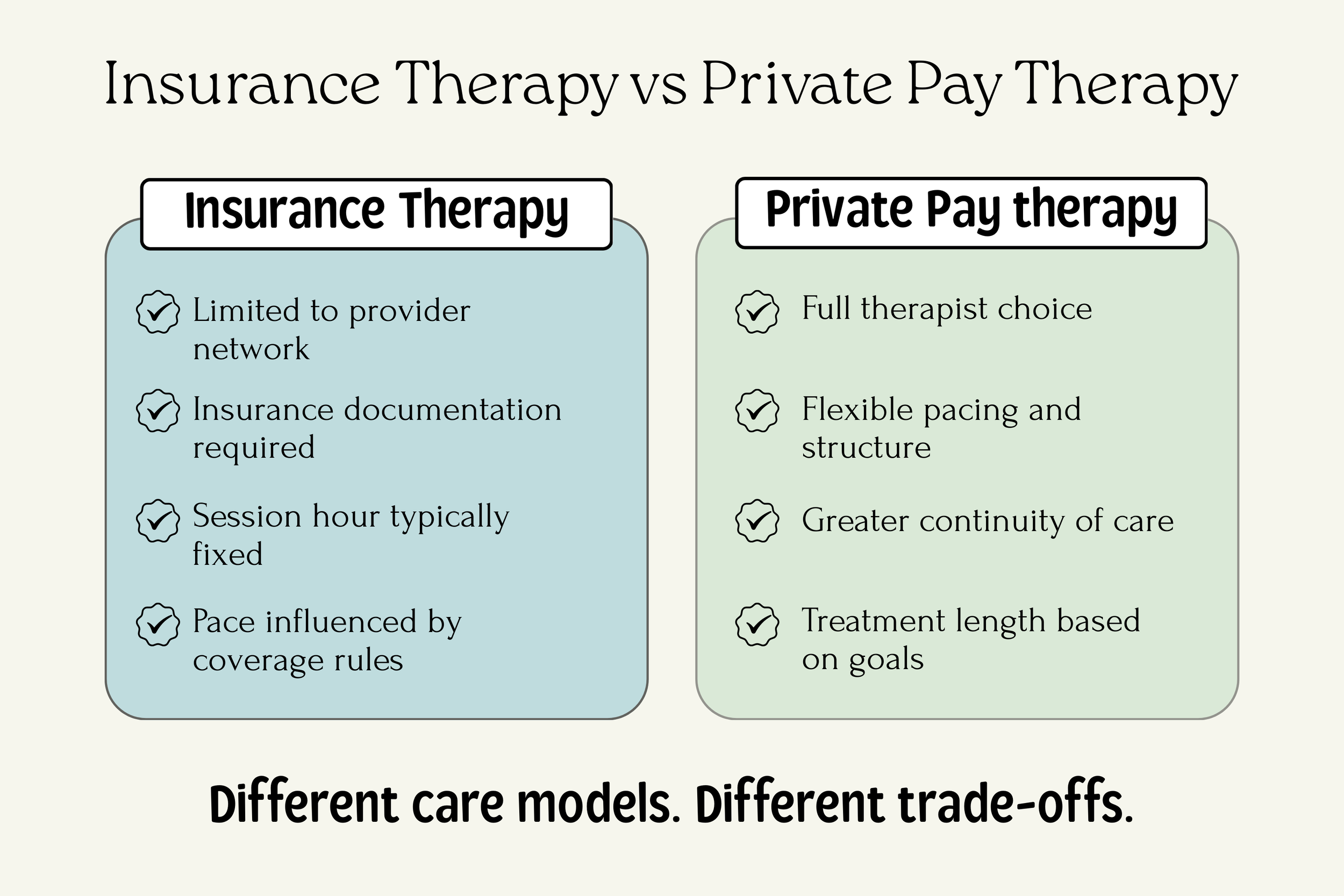
Insurance-based therapy is often optimized for access + coverage rules
That typically means:
provider choice is limited to your network - Sometimes insurances keep their networks small.
there are documentation and “medical necessity” requirements - This means you have to be given a diagnosis, and that diagnosis is submitted to your insurance each session. Your insurance has the right to audit your full mental health record at any time.
the reimbursed unit is usually the session hour or less
authorizations and utilization rules can influence pace and duration (varies by plan and provider)
Plenty of excellent clinicians take insurance. It makes therapy more accessible for more people, it helps therapists fill their caseloads, it helps match clients and clinicians. There are definite benefits, and insurance adds a lot of restrictions.
The constraints are often about the system, not the therapist.
Private-pay therapy is often optimized for choice + flexibility around your goals.
That typically means:
you can choose your therapist without network limitations
there’s more flexibility in cadence (weekly, twice weekly, occasional intensives, etc.)
there’s often more room for depth and continuity
the length of care is more directly aligned with your goals (not a coverage cycle)
Again: not “better humans.”
A different structure.
A quick comparison grid (what tends to be true)
This isn’t a good/bad list. It’s a “what you’re likely to bump into” list.
Insurance therapy often includes
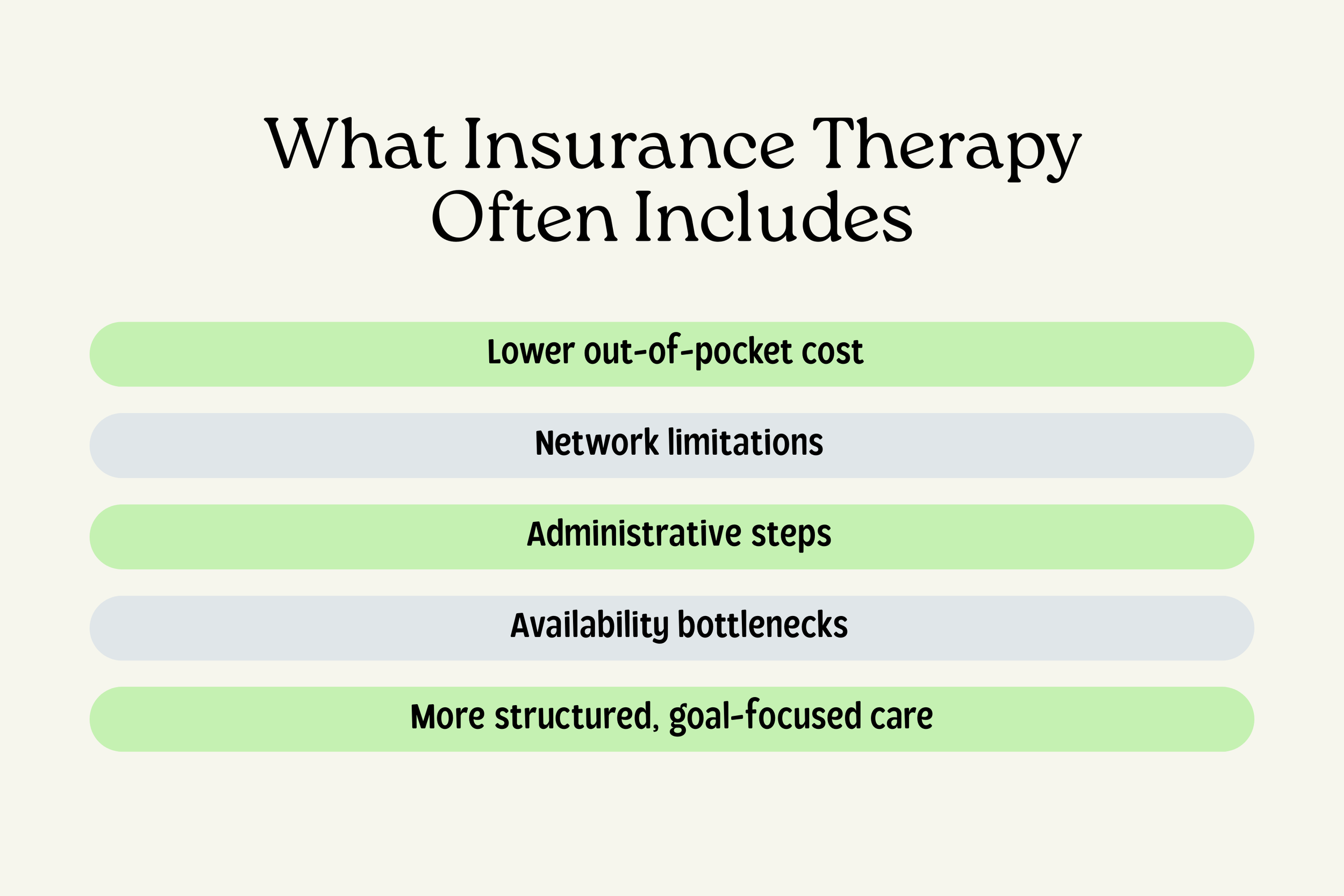
Network constraints on provider choice
More admin (referrals, portals, authorizations, billing processes)
Session hour as the paid unit (not always the invisible work around it) - sometimes as short as 45 minutes
Availability bottlenecks depending on your plan/network
Goal-focused, structured care that may be more time-limited depending on coverage
Confusion about what it will cost - deductibles, copays, lifetime maxes, annual resets, etc.
Private-pay therapy often includes
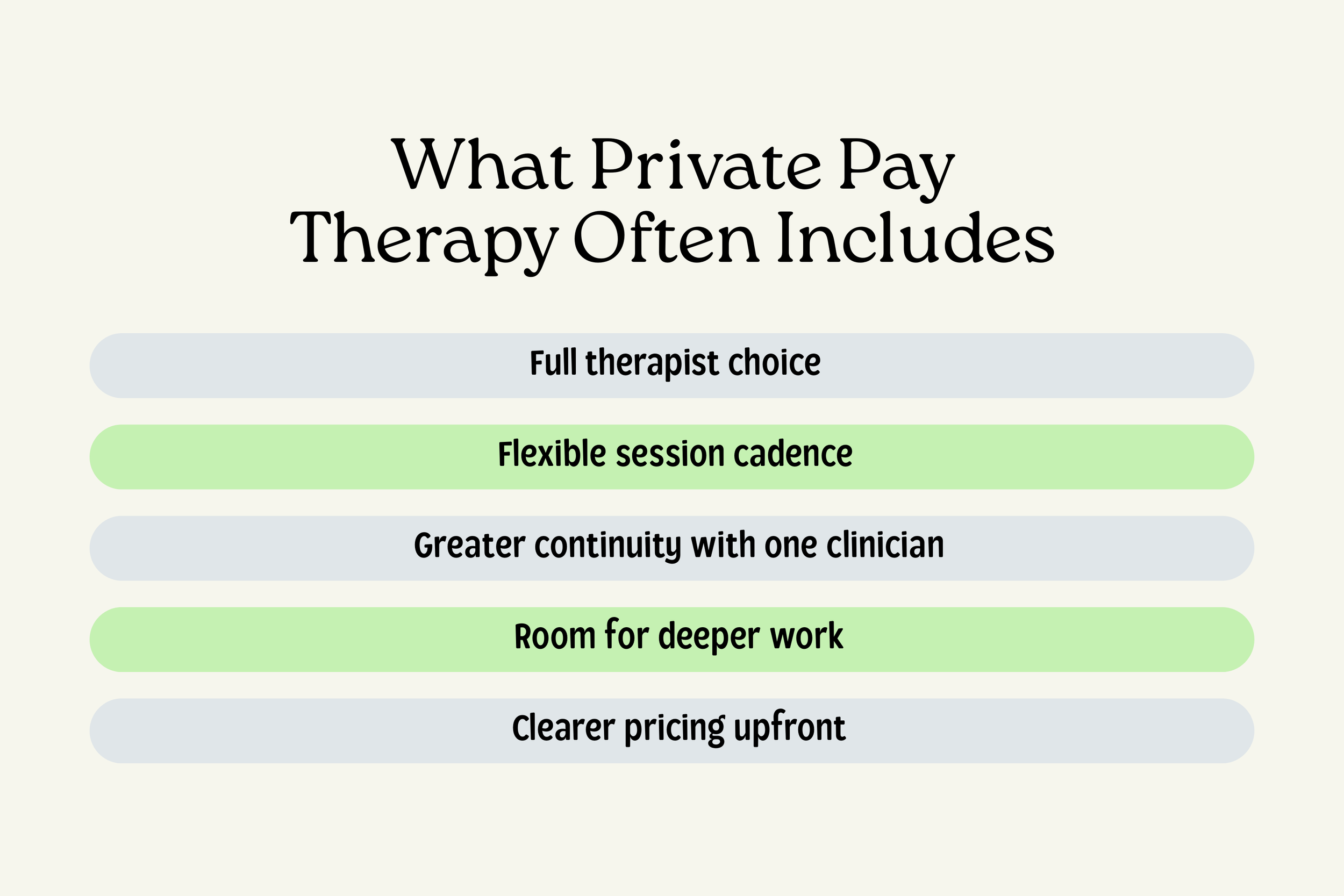
Full provider choice
More flexibility in session cadence and structure
More room for continuity (staying with the same clinician)
More room for depth when you’re working on layered patterns
Clearer pricing and boundaries upfront
Your job is simply to decide: which set of trade-offs fits your life right now?
What insurance therapy is a great fit for
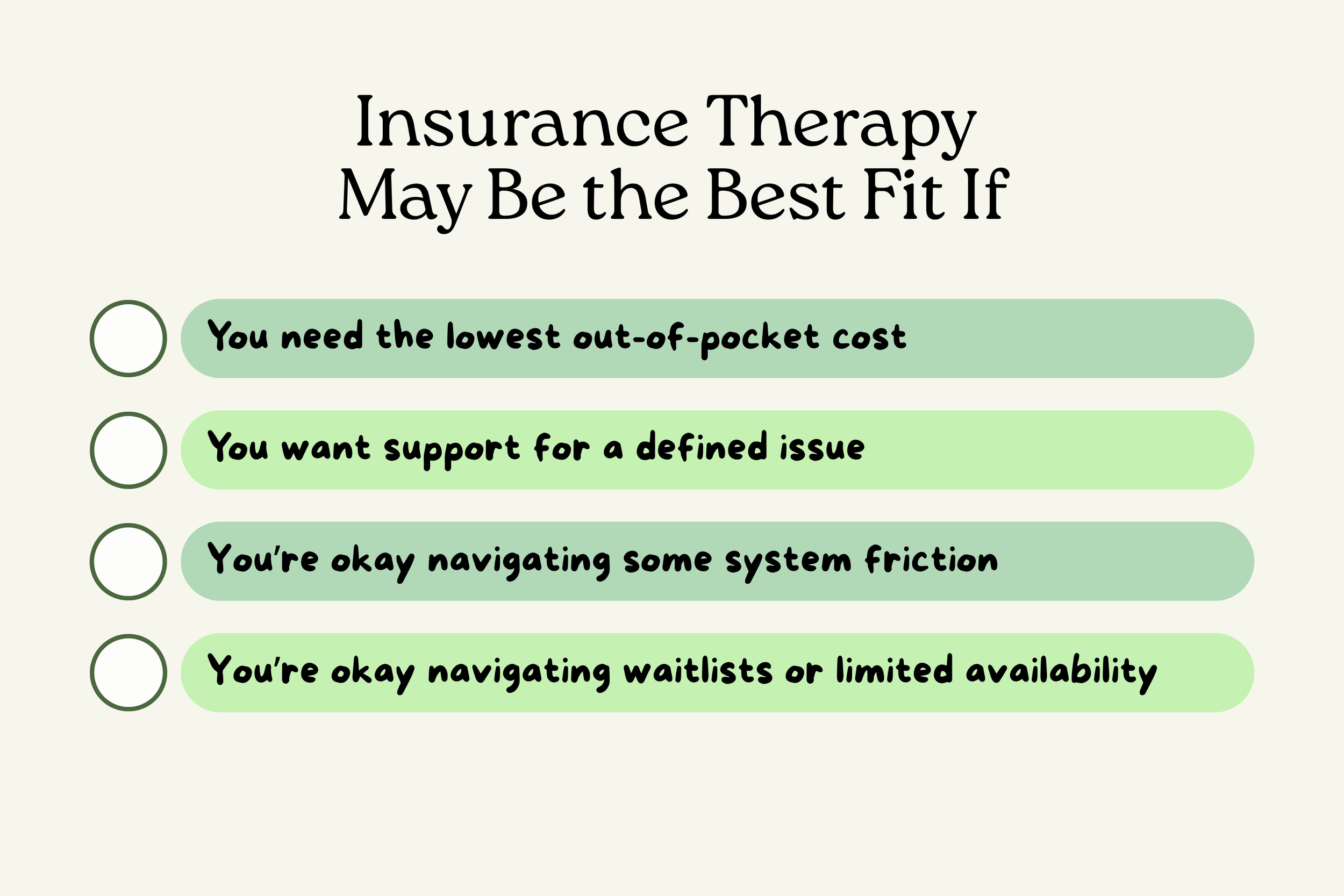
Insurance therapy can be a great fit when you’re prioritizing:
Lowest out-of-pocket cost
Starting somewhere (even if it isn’t perfect)
A defined goal you want support around (ex: coping skills, managing symptoms, support during a specific life stressor)
You can tolerate some system friction (waitlists, limited options, admin steps)
If that’s you, insurance therapy may be the right move — and I mean that.
Starting with insurance-based care is not a “less committed” choice.
It’s often a smart, responsible choice.
What private pay therapy is often a better fit for
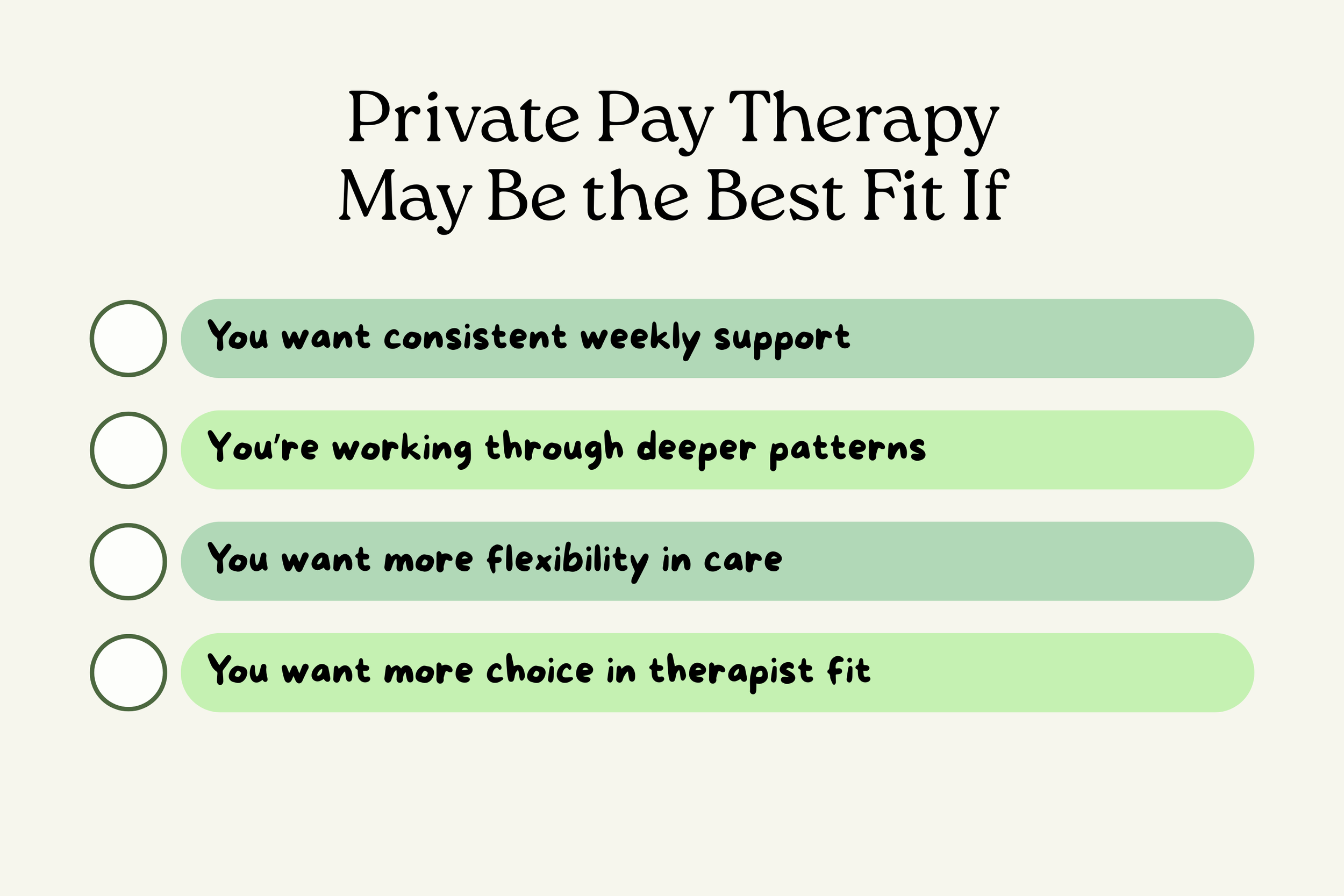
Private pay therapy can be a better fit when you’re prioritizing:
Momentum and consistent pace (weekly support matters)
Continuity (you don’t want to keep starting over)
Depth (patterns that repeat, trauma history, attachment work, nervous-system work, complex relationship dynamics)
Flexibility (your goals evolve, and you don’t want to feel rushed)
Reducing admin burden so your energy goes into healing, not the system
This is the moment many people shift from price-shopping to care-shopping.
Not because they suddenly “have extra money.”
But because they realize:
The cost of staying stuck is starting to feel higher than the cost of care.
That’s a real threshold. And it’s different for everyone.
Why private pay often costs more (without making it about “better”)
Many insurance-based arrangements reimburse for the session hour (or less), but don’t pay for (or don’t adequately pay for) a lot of the invisible work that can support care, like:
care coordination
consultation to ensure best practice
clinical planning
deeper customization between sessions
ongoing education that keeps clinicians at their best
That doesn’t mean insurance therapists don’t do any of that. Many do.
It means the system doesn’t always support it consistently — especially at scale.
Private-pay models can make it more feasible for many clinicians to:
carry a smaller caseload
protect time for training and consultation
offer more flexible pacing
maintain more continuity for clients
So what you’re often paying for is capacity and flexibility — not “a better therapist.”
The decision moment: what’s the best fit for you right now?
Use this section like a quick self-selector.
Insurance may be the best fit if:
You need the lowest possible out-of-pocket cost
You want support around a specific, defined issue with structured goals
You’re okay with fewer scheduling options or longer waits (depending on the network)
You want to start somewhere now, even if it’s not perfect
Private pay may be the best fit if:
You’ve tried short-term approaches and the pattern keeps returning
Your situation feels layered (relationships + trauma history + chronic stress + identity + burnout)
You want consistent support without feeling rushed
You want more choice in therapist fit, method, pacing, and structure
You’re optimizing for quality and momentum over the lowest cost
The middle truth:
Sometimes insurance is cheaper in dollars but more expensive in time and emotional cost.
Sometimes private pay costs more in dollars but saves months of stuckness.
Your best-fit choice is about what you’re optimizing for in this season.
If you’re using insurance: how to make it work better
If insurance is the path right now, here are a few practical ways to reduce frustration:
Ask about cadence upfront: “How often can we meet?” (If you need weekly, you deserve to know if that’s possible.)
Ask about treatment focus: “Do you tend to do short-term goal work, or deeper long-term work?”
Clarify what you need help with: you don’t need perfect language — just a direction.
Don’t assume a mismatch means therapy doesn’t work: sometimes it’s fit, pacing, or approach.
Insurance therapy can be excellent care — especially with the right match.
If you’re considering private pay: what you’re actually buying
If you’ve never done private pay, the unknown can feel big.
Here’s what people often notice when the model fits their needs:
More choice in fit (you’re not limited to a network list)
More consistency when they need momentum
More flexibility in how sessions are structured
More room for depth without pressure to “wrap it up” quickly
Not every private-pay therapist offers between-session support, extra resources, or additional scaffolding — that varies.
But the model often makes it more feasible for your care to be shaped around your goals, not around coverage rules.
How Thrive helps you choose — without making you feel stupid for asking
A lot of people default to insurance because they’re afraid of two things:
spending money and still not getting the right fit
having to start over again and again
At Thrive, we’ve built our practice to reduce both risks.
We help you clarify what kind of care you need
Many people aren’t sure if they need individual vs. couples therapy, short-term support vs. deeper work, therapy vs. psychiatry, etc.
We ask the right questions so you’re not guessing.
We match you instead of making you do all the sorting alone
You can browse our therapists and share preferences, and we’ll help guide the fit based on goals, pace, and what you’ve already tried.
If it’s not a fit, you have options
Fit is real.
And sometimes you learn it by doing.
As a group practice, we can help you adjust without sending you back to square one.
What I want you to take away
If insurance is what you need right now:
You’re not doing it wrong. You’re working within real constraints — and it’s okay to start where you can.
And if you’re considering private pay:
Private pay isn’t a better choice. It’s a different structure — and for certain goals, that structure can make a big difference.
The right choice is the one that matches your goals, your constraints, and what you’re trying to change in this season.
Next step
If you’re unsure what’s the best fit — insurance therapy, private pay therapy, or a mix (like using out-of-network benefits or an HSA or FSA card if you have them) — we can help you sort it out.
Start with our intake process and let our coordinator guide the match, or
Browse our therapist team and tell us who you’re drawn to